Friday, February 10, 2017

The Amphitheater

Earlier this week the city commission in Key West voted to carry on with the construction of a four million dollar outdoor concert venue at Truman Waterfront. They had a public meeting at which half the audience supported the plan, the other half didn't and the remainder wasn't sure. That adds up to more than 100 percent of those in attendance and I think it's fair to say this latest storm in a Key West teacup has left a lot of residents unsure. The whole of the waterfront is now pretty much a construction zone and something like this should emerge by the Fall:
Image result for truman waterfront amphitheater design
At the meeting city staff told the elected leaders that were they to shut down the project plans and closure would cost the city half a million dollars which seemed to decide the outcome. The paper had previously checked around the state and the Citizen found that similar venues elsewhere generate almost no income for their municpialities, a suggestion Mayor Cates found annoying, musing out loud about the perception that a park should pay for itself. That notion was put about by the Spottswoods the premier family that wanted to develop a profitable concern at Truman Waterfront and whose plans were scotched nit by the city but by the Navy who said a firm "No" to the idea of a marina generating money as part of the waterfront park. Ever since then this notion of a park-for-profit has hung in the air, an emanation left over from thedeseprate Spottswood development plan.
Image result for truman waterfront amphitheater design
Which is not to say the park will be a wild and interesting open space as I might like. It will offer facilites and paths and order and control. That at least is the impression they give. Meanwhile we drive through corridors of construction fencing, like travelers passing through Checkpoint Charley in a divided Berlin. Rusty is always ready to inspect anything, such is his curiosity.
Either the amphitheater will be successful beyond anyone's wildest dreams in which case traffic and noise will flood the quality of life in Bahama Village,. Or it will sit idle  most of the time and become a four million dollar monument to the Triumph of Hope.

Thursday, February 9, 2017

Chickens

I was stuck at the Circle K waiting for a friend to meet me so I had two choices, read my Kindle on my phone which was pretty enticing as I am enjoying Havana Blue, a detective story set in contemporary Cuba, or I could play with my camera to pass the time.
There is a surprisingly large cluster of chickens at the Circle K at Mile Marker Ten.  I am no great fan of chickens unless they are on a plate but from time to time I do have to acknowledge that they have their fans.
Visitors to the Keys seem to think iguanas and chickens are first rate public ambassadors and I can't stand either creature. Iguana's wreck local wildlife and chew people's gardens to death and have no natural predators in these islands. Chickens meanwhile are noisy and dirty scattering soil and mulch everywhere in their search for bugs.;
I grew up around chickens and their stupidity is legendary however when you consider the adverse living conditions and  their survival rate I'd say the Lower Keys public chicken population has higher than average intelligence. They can be meaner than snakes too. One chicken ran Rusty off her turf on Appelrouth Lane downtown one day.
 A face only a mother could love ( or a tourist):
I like native birds like these ibis (below). They are quiet dignified and very swift at eating noxious insects. They don't crow at odd hours and they don't kick mulch across sidewalks. I think ibis are the ideal urban insect clean up crew:
Check out this hole: 
The source of Key West's free range street chickens is a mystery shrouded in myth. Some people think they came from Cub when refugees landed in the Keys with their prize cock fighters. This story makes no sense on so many levels I can't understand why it gets propagated so much. I don't recall any refugees in modern history arriving with roosters in their luggage; dogs occasionally have landed but birds from Cuba no, never. Plus if they did bring roosters who would they mate with to propagate the species on the streets?
I have also checked pictures from the early 29th century and none of the folk art I have seen, by Mario Sanchez for instance or Depression Era WPA painters show any signs of chickens in the street. The literature of the era doesn't mention them either. I rather think they got loose probably in the 60s when downtown was collapsing and gradually they evolved into a protected species in the city and a source of tourist largesse.
 In any event here they are and seem bound to stay.
 It's not that I hate chickens but I have no affinity for birds. People are fascinated by parrots but as far as I am concerned I am happy that they live decent lives and long may they do so, but studying them or trailing around behind them does nothing for me. I like dogs.
Chickens have been a source of aggravation too. They city hired a chicken catcher for a while but the humane traps he set out were sprung by well meaning chicken supporters so he had to give up did Armando Parra. I think he made more money from his line of authenticate Key West Chicken Catcher t- shirts than he did from his city bounty actually catching the birds.. 
 There are hundreds of these birds and their fate was much debated. The solemn promise from the city was that they would be rehoused at some sort of humane ranch setting somewhere on the mainland. Some opponents of the catching program envisioned a rather bleaker future like one of those Disney animal cartoon movies about secret slaughter houses from which the heroes have to escape.
 Chickens have their beauty certainly but they are noisy. And anyone who tells you they crow at dawn to herald the arrival of a new day are either misinformed or lying. They make a terrible noise any hour of the day or night.
But they are adaptable, making lives for themselves on the streets and prospering while ignoring the human chaos around them.
 I watched them for quite a while bickering over scraps and strutting around like school yard bullies.
They moved off and I walked up to the deck to keep an eye on the parking lot as I waited for my ride. 
 I don't love Key West's chickens but I don't wish them any harm. They aren't going anywhere and I suppose they shouldn't go away. It's all part of the pageant of Key West.

Wednesday, February 8, 2017

Audubon House

It isn't really the Audubon House, it's the Geiger House, though even in Key West these days the name Geiger sparks no recognition where Audubon is still a well known name. Audubon the painter ( and killer) of birds lived in Key West for six months before the Civil War. He never lived here in this house that bears his name!
As far as can be established he lived nearby and admired the trees growing around the house and Audubon is said to have picked a branch to use in one of his paintings of American birds.
So what you see here, recreated in exquisite detail is the ante bellum (pre-Civil War) home of one of Key West's most successful merchants. He made his fortune by wrecking, that is working as a marine salvager and charging high rates for difficult jobs.  This is a tool used to feed infants apparently and very ornate it is too.
The house is  nicely air conditioned these days but a hundred and fifty years ago I don't  know how they managed. And they had mosquito netting over the beds.
 I hope these were tools to deal with hair and not something like surgery:
The docent advised us the restoration was done using original patterns. The house stayed in the Geiger family until the 1950s when it was allowed to fall into disrepair. Then it was bought by an amateur historian who had it restored.
 Audubon's prints are also on display:

 And you get a view onto Whitehead Street:
This short video is well worth watching with a descendant of Captain Geiger telling some great stories abut life in those days:

 Then there is the garden:
Which makes for a pleasant place to hang out.
My previous essay on the house: Audubon  2015 Link

Tuesday, February 7, 2017

Museum of Art and History

The bright orange blob overlooking Clinton Square next to the former Westin Hotel, now the Margaritaville Resort ("where luxury meets paradise" squirm) is not supposed to be there. For years when Key West went through its latest and most likely last economic crisis the building almost collapsed under the weight of its own neglect. Not anymore, it is now moving from strength to strength as a source of information about the history of Key West with lots of exhibits laid out with a professionalism I never saw in the past.   They seem to be spending money to put on a  good show and it looks excellent.
The Custom House is one of those places in Key West whose name is frequently mispronounced. It is not actually the Customs House, though to hear it said so often you might think it was. Key Plaza is another one as the shopping center where Kmart lives is often called Keys Plaza. And that well known watering hole Schooner Wharf is often given an extra S by those that know no better. Just like the tourists I heard yesterday walking on Whitehead pondering the meaning of Konsh, whether it was a mollusc or a human resident. Or both and either way its still pronounced konk. Very confusing. 
Seward Johnson the noted sculptor of true to life art that some people hate and others don't, has changed up the displays around the exterior of the Museum. Inside there was an exhibit about the Navy in Key West outside they were kissing to celebrate the end of World War Two.
An Irishman by the name of William Kerr came to Key West in 1872 and designed some buildings around town culminating in this Federal Building in 1891. Much is made of the design which supposedly met Federal requirements fo border buildings next to Canada though I know nothing of that. AS to why the roof was pitched as it was I couldn't say but they don't get much snow in Texas if it really was a universal border building Federal design.
Inside there is a permanent Hemingway exhibit with photos of life in Key West and artifacts as merits the city's favorite macho author.

Tennessee Williams has an exhibit honoring his painting skills on display at the moment. Rather crude dare one say simplistic which seem to get traction owing to his reputation as a writer than these naive pieces of art showing off blonde haired very pink young men exhibiting their gentlemen's vegetables to the painter who was rather more interested in their truncheons than in Hemingway's more wholesome interest in killing fish. Here's a discreet depiction of similar that I found online:
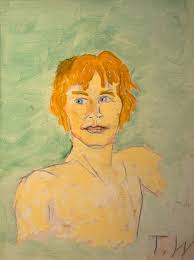
Image result for tennessee williams nude art
Several demure cruise ship passengers came by the discreet exhibit in a closet-like room and backed away rapidly on seeing what was up for their inspection as it were. Apparently Williams' private art was an expression of his self loathing and despair at his homosexuality, according to those who over analyze stuff. More likely the loathing came from the outside:
      In the late 1940s and early 1950s, the McCarthy era, during which Williams wrote his best work, homosexuality branded one a traitor as well as a "degenerate." -from The Closet Professor.

Those were the times he lived in and the way things are going seem likely to start recurring soon if we aren't careful. Another artist on display is the ever popular Mario Sanchez mentioned previously on this page. Here is his art of the arrival of the first train in Key West in 1912 and his allusion to the ride he took later to the mainland:
The train changed Key West's character forever. No longer did you need to take a couple of ferries to drive to the mainland, even though the road out of Key West still only went as far as the ferry terminal on No Name Key some 30 miles away. Hemingway himself came to Key West the first time to pick up a car in this island town. I see a lot of similarities  these days to the transformation the train brought to what was an isolated island. Money now comes in and drives the working class out. The train brought the outside world to a town where many people dreaded it's arrival and the transformation it would bring. But one is obliged to celebrate progress and they do at the Museum. 
Then there is the USS Maine another historical artifact from a  little remembered conflict with lessons for today. The battleship blew up in Havana Harbor said to have been by Spanish sabotage though today the evidence is viewed dispassionately and wet coal in the bunkers is blamed for the accidental explosion that started the Spanish-American war that gave the US Puerto Rico, Cuba, Guam and the Philippines. The inquiry into the sinking took place in Key West where many sailors are still buried.
Key West was a Union town in the Civil War. The man on the left, Captain Brannan made it so by surreptitiously moving his artillery soldiers to Fort Zachary and flying Old Glory in defiance of the aficionados of slavery who ran the town. The middle figure, Stephen Mallory was the Confederate Secretary of War who came home to practice law after his side lost, such was reconciliation in those days. He got a square named for him. Tift on the right ran the Union blockade to supply the Confederacy. He made money and got a street named after him. Brannan who made a singular contribution to helping the good guys (if you oppose slavery) win got nothing. Think about that for a while.
Key West was a little village huddled around the port where you can see pleasure boats these days at Key West Bight and Mallory Square (Port Rodgers as was) which is seen below as a place to unload cargo. In the background (right side) Fort Zachary was an island connected by a causeway. It became integral to Key West by virtue of harbor dredging that threw up dirt around the fort over the decades.
In the picture below you can the pond that used to exist underneath where the main drinking section of town is, in the area of Duval, Greene and Caroline Streets. The oldest house on the 300 block of Duval used to be waterfront property in those days. The city filled the pond in before the Civil War. 
You can see the pond marked on a map of Key West at the Firehouse Museum on Virginia Street:
As for the stories of pirates in key West it's all rubbish I am sorry to say. The city was seen by the US government as an important military base and a rather obnoxious but efficient man David Porter was in charge of the fleet dedicated to protecting cargo in the Western Caribbean. He annoyed the locals so much he was removed in disgrace and went to organize fleets on the Barbary Coast of North Africa.
Lots to see and lots to ponder, especially the value of being nice in a small town. You get voted off the island all too easily, then and now.