Wednesday, May 29, 2019

My Father's War

My father was born in London in 1912 and his earliest memory was of a German Zeppelin airship flying over the city dropping bombs during World War One. He was of the generation practically born into war who lived through war and finally in Western Europe got to enjoy peace after the conflicts. He had a successful career as a barrister specializing in tax law with his chamber sin Lincoln's Inn one of the more famous legal centers in London. It was not to my youthful mind a very glamorous or interesting life in an office, chain smoking and reading pieces of paper all day when not appearing in court. I watched him as a small child arguing case law at the Old Bailey and it was no doubt erudite and clever but to my young mind there were better things to do with one's life. Making money never was on my agenda and I have to say it wasn't on my Father's agenda for me either, so I was never encouraged to follow suit. 
Ours was not a close relationship, I was the favorite of my mother who was in the other camp in our fractured family and when they divorced I remained her favorite child. Nevertheless my Father, a man who lived a double life far more interesting than it appeared on the surface did have an adventurous streak which he satisfied by traveling usually o his own but with us in tow on occasion. One memorable year, 1966 I think, I was pulled from school for the half term week off and found myself flying to Sicily, an unheard of thing flying on a whim in those days, to see Mount Etna exploding. My father wanted to see hot molten lava and we ended up doing the same my older sisters and I driving up the mountain and watching the stuff slide down the hillside.
Perhaps my Father's most relaxing relationship with me took place when he drove me up to Scotland where he owned land as a way he said of investing money he would otherwise pay in taxes, so from time to time we would take a two day road trip across England at a time of hardly any freeways and slow winding mountain roads through Scotland almost all the way to the top of the island. He had time then to reminisce and I heard all about his war. And before that his cycling adventures to Spain to see the Civil War and across Germany to see Poland. He had no money in the 1930s and he took those summer trips on his bicycle! Oddly enough he had no stories of what it was like to be in Spain or Germany in those momentous times but by 1938 he understood war was coming and he signed up to join the RAF. Had his eyesight not been so bad he might have been accepted and probably would have died considering the life expectancy of British pilots at the start of World War Two in 1939.
Me at  school 1967 back row  black hair big smile 3rd from the right

Instead he was sent to the Army recruiting office round the corner where they asked him what skills he had. All he could think of was "driving" so he was sent to the Royal Army Service Crops, responsible for delivering supplies to the front lines. After a short while they found out he was a lawyer and in the class riddled world in which he grew up that seemed to require he be an officer not an enlisted soldier so he promoted and put in charge of things. He was then sent to North Africa to lead supply convoys across the desert to and from Kufra Oasis in the southern Libyan desert:
Related image
Wikipedia image


He recalled this part of his war as the best kind of fighting. He navigated by compass and sextant driving as he wished across the open desert with no civilians to avoid and no danger of them getting caught in any crossfire. He did get bombed by German planes and one exuberant day he drove fast over a dune unexpectedly  steep, whereupon his staff car took to the air and landed badly enough the rest of the journey was completed by Second Lieutenant Beattie in truck like any enlisted soldier. 
Image result for british truck convoys western desert 1942
Wikipedia image


Eventually the allies pushed the Axis out of North Africa but before then the convoys had ceased and my father was trained to parachute and thus he arrived in Yugoslavia where he fought with Tito and his partisans in the mountains of the Balkans. Actually the way he told it there wasn't anything much to do hiding out in the mountains and he got bored enough he asked for a transfer out of Tito's headquarters. He missed the carefree days of driving the desert and eating cans of corned beef, a type of food he alone, enjoyed among all the ranks of the British Army who universally loathed cans of "bully beef.."
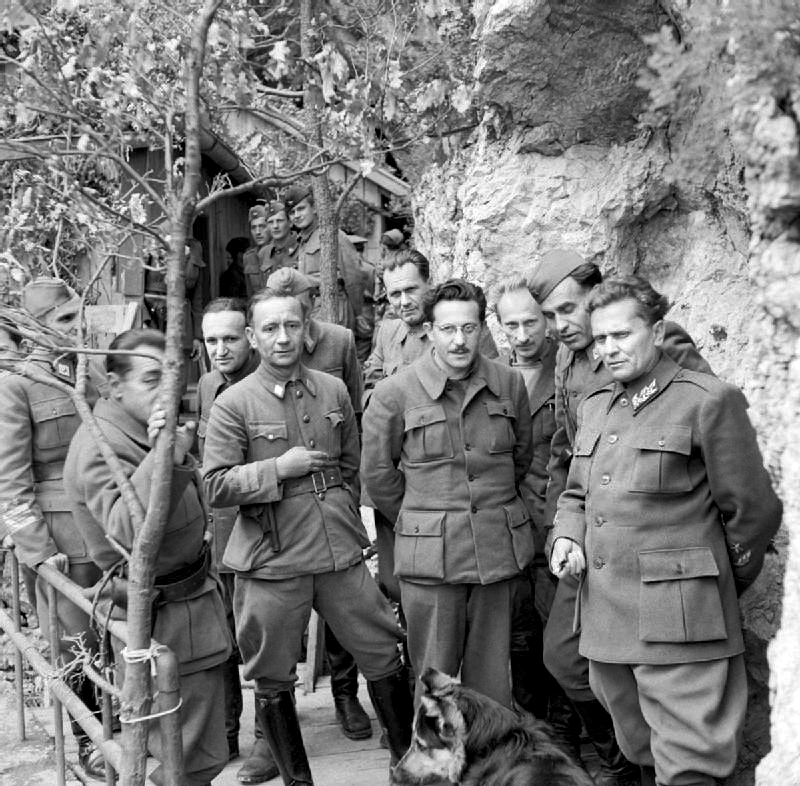
Image result for tito hq yugoslavia 1942
Tito far right, Yugoslavia 1943  Wikipedia image

After sitting around in the mountains for a while my father was transferred to Italy where the Allies were struggling to push the Germans across the heavily fortified mountains of the peninsula. My father was a strange man and I am reminded of that because he felt deprived he said during his war years. He kept applying for postings to what he thought would be front line fighting and he kept ending up in the rear echelons away from the bullets. I don't know if his complaint was bravado or what but he seemed annoyed by his various roles  behind the lines. In Italy he worked for the SOE -Special Operations Executive  the precursor to the CIA - and he managed agents sending them across the front line to collect information. It was later in the closing months of the war when he was driving around Italy compensating Italians who hid allied soldiers and airmen from the Germans while they were on the run. I remember he told me the Russians did that much better. Where he went through villages painstakingly justifying his disbursement of monies, his Russian counterparts drove into the village square and from the back of their truck would throw handfuls of money into the crowds of curious villagers while shouting "A gift from the workers of the USSR!" Much simpler he said.
Image result for italy soe
SOE Italy  1943 Wikipedia Image


The SOE job did lead him to one good place, which it turned out was where my mother lived. They were married in a hurried ceremony in early 1947 after he had left the Army and like so many wartime couples he went back to being what he was before while she learned to live in London with a young lawyer for a husband, with two twin girls just born into a world of rationing and war time recovery. They were, they tell us, the greatest generation. Perhaps so but certainly they learned to make do and put up with privations such as we couldn't imagine happily for us. I spent some of my Memorial Weekend thinking about what they went through that we never had to.

Monday, May 27, 2019

Red Mangroves

I guess I take mangroves for granted these days. I got a note from a friend Up North mentioning how little overseas travel she had done and never to the tropics so the Keys are as tropical as it gets. And that set me to thinking the sentiment is probably true for a great many people who visit the Keys.
I was struck years ago by certain similarities when I rented a car in Georgetown on the Bahamian island of Great Exuma. My wife and I took a drive north checking out the coast road and the villages we had seen as we sailed south to the harbor. There really wasn't much there, a few houses a winding narrow strip of pavement, and tons of mangroves. Looks just like the Keys I thought to myself, and it did. Lots of scrubby green bushes all across Great Exuma. It's wood that's not good for much, too green to burn too twisted to use  to build and to awkward to walk amongst. 
Some parts of the Keys more closely resemble  what one might think of as classic tropical forests of red mangroves typically found at the waters edge in Central America and the Caribbean. Where the Bahamas might be rocky and dry stands of red mangroves like this I have seen in Belize, Puerto Rico and Mexico. Talk about impenetrable:
There is a path on Sugarloaf through these stands of mangroves and buttonwoods and Rusty and I were enjoying the breeze while I played with the camera and he played with his nostrils. These strong  east winds lately have made the great outdoors more great than usual  as the cooling breezes keep the humidity and mosquitoes at bay.
Which is not to say it isn't hot because by noon it''s ninety  degrees no matter how much the breeze is blowing. As I stood on the trail in the shade an overheated couple came sauntering down the path toward me. It turned out they were looking for the Sugarloaf Jumping Bridge which I was nowhere near. Lucky they met me on the path because they could have walked for an hour and a half in the wrong direction had they been so inclined. I doubt they would have but it is four long hot miles to the end of this trail which Rusty and I last walked July last year, two months before the Catastrophe. We were both pretty hot by the time we reached the trailhead which ends bizarrely in a bunch of bushes at the water's edge, like this:
This time around we walked a short distance further after the nice couple from Texas turned back to drive to the Jumping Bridge area and left us to our own devices.
 My device was my camera while Rusty trotted back and forth sniffing something.
So how do red mangroves grow? They spread two ways and one is by dropping seed pods called propagules like this:
 The red mangroves are the mangroves that grow closest to saltwater, indeed they will put roots down right into tidal waters because the plants have learned to separate salt from seawater. It's pretty amazing actually. They push the salt into selected leaves which turn yellow and drop off year round, while the rest of the mangrove flourishes on the salt water purified of salt by the leaf's sacrifice.
Then they grow huge seed pods which they scatter around themselves in the wind. If they fall into water they float pointing straight down and eventually sink into the bottom and put down roots underwater.
The other way red mangroves propagate is by simply spreading their roots which look like long brown tubes which become  a shiny maroon red color when wet. Hence the name red mangrove. the roots spread from the main plant and reach to the ground and dig in, to dirt mud or even rock.They are unstoppable.
These falling roots  create a positive web of rubbery entanglements making it impossible to walk through these forests. A shoreline covered in red mangroves is a tough place to walk.
 Ready to drop seeds:
If I stop to think about it this is a pretty weird place to be walking. There are no hills, no views, no rivers no lakes...indeed there aren't many topographical features at all unless you count roads and shorelines. And yet these strangely twisted year round trees and bushes, twisted by nature shredded by hurricanes just keep on keeping on.
So does my dog who likes to sit at the top of the stairs and monitor the neighborhood after he's had his walk. This is how he watches me leave when I go into town without him. He doesn't need to work out at the gym; I do.  

Saturday, May 25, 2019

Beach Scenes

Sometimes you just have to stop and take a breath as you pause in life's daily rush. So I did at the White Street Pier, which is now named for a local developer who died recently.
Looking east toward the airport the colors looked lovely but the "beach" looked typical for these islands, consisting of dead seaweed and rocks.
Looking west  toward the Martello Tower at Higgs beach, the 19th century brick coastal fortification that houses the garden club these days. Actual sand , imported from the Bahamas.


 I can't remember why I turned the camera on myself but I did. 

Friday, May 24, 2019

Simonton and Truman

Every time I walk down Simonton Street at Olivia I see this funky old place perfectly illuminated and every time I try to capture it, if my impatient dog gives me time enough.
This place further up the street toward Truman Avenue caught my eye with all those wheelchairs to rent, and it provoked unhappy memories of my time wheeling myself around.
I was not interested in buy the motorcycle for sale but I did wonder how many strong people it took to manhandle it up onto that cement platform:
The St Mary's catholic church complex on Truman Avenue puts me in mind of Christian missionary churches I've seen in Africa, and I'm not sure if I can put my finger on exactly why that comparison springs to my mind.  Perhaps a combination of architecture and plants fertilized by the hot tropical night air.
The county building on Simonton Street is called the Gato building after the cigar making family that had a factory there. They moved to Tampa to reduce costs and the county now makes use of the Gato Building to house some offices.
 Conch cottage:
 Rusty silhouetted by the dawn on Catherine Street:
 A scooter with an ice chest work boots and hard hat ready to go. The ultimate commuter.
On our way out of town Rusty and I on White Street met  a posse of chickens near the pier who answered the age old question about why the chicken crossed the street.
This lot didn't. They just stood there.

Thursday, May 23, 2019

Niles Channel Road

An early start one morning and I got to watch the moon set over the wilderness.
 So much of the perception of the Keys is palms, beaches, sunrises and sailboats. 
 I find myself seeking solitude these days, and with winter residents gone the hordes of cyclists and joggers and dog walkers and on and on are all Up North, blessed relief.
 I can be by myself after a night of 911 calls and mayhem on the police radio.
 Not quite alone.
 I love seeing the still waters like a giant mirror. 
 But more often I am looking at the unglamorous end of Rusty as I struggle to keep up.
Fewer photos and more walking is his preference.

Wednesday, May 22, 2019

My Afternoon

My sister in Italy has found WhatsApp on her telephone and with free communication with me half way round the world. In an instant I found myself trying to update her on my life which is so far out of the range of her experience I was not sure really where to begin. She has lived for half a century in a small picturesque Italian mountain village in Umbria.  Just the fact I live in an endless summer is already a lot to figure for someone used to seasons.
This idea of instant communications is nothing new to most  of us but when I started to reflect on what this means to me I found myself analyzing my daily life and I found to my surprise I am pretty well compartmentalized, a daily round robin of getting home from work and walking the dog, sleep, exercise at the gym, dinner with with wife after second dog walk and then drive to work and round we go again, save for those nights I'm not working.
There really isn't much variation these days. After the surgeon told me I will get 95% of my mobility back in the first year after the accident I have been on a drive to exercise, exercise some more and walk as much as I can. Rusty of course plays a major part in all this. And yet  when I have to tell my sister what I'm up to - because now I can - there isn't that much to say.  
Which is not to say I am pining or upset by this turn of events. It's just part of the recovery and I don't have much inclination to spend a lot of energy traveling or going to movies or staying up late as I much more interested in getting my bones to heal and to rebuild my muscles before the deadline of August 31st. 
 One good thing for me is that all this walking gets me outdoors and I do enjoy the breezes and the hot sunny afternoons.  It's not suffocatingly hot yet as the east wind is still strong and fresh and keeps temperatures bearable, at least to me. By July and into November the heat really piles on.
Hurricane season starts June 1st of course and runs through the end of November. Nothing deterred Mother Nature has already whipped up a named storm which the National Hurricane Center called Andrea. Its supposed to be dumping rain and winds to 40 miles per hour on Bermuda about now. No big deal I suppose except it's a damned sight too early in the year for named cyclonic winds thank you very much.
 I am enjoying this part of my recovery actually though it does make for less than exciting stuff to write about and I fear this page may turn into more of a collection of pictures as I enjoy playing with the camera while Rusty walks. Fair warning.
Aside from hurricane season this is also the time I get envious of my friends Up North where greenery is growing again after being dormant all winter. Temperatures are rising and lovely summer twilight turns day into night so slowly it takes my breath away. This close to the Equator day turns to night almost instantly and dusk is something I miss.  I miss winding roads and summer evenings, mountains and lakes and views that stretch beyond the curvature of the earth. 
Still I shall see what I can do to observe these same scenes in these flat islands from different and perhaps fresh perspectives. Perhaps this is a good time to reflect, without being too trite I hope, on how lucky we all are to e able to see and feel what is around us wherever we are. 
Rusty poses no such problems for himself. He knows which side his bread is buttered on, and he I am sure does not forget the dark days that came before the sunny life he lives now.