Monday, April 12, 2021

Mangrove Walk

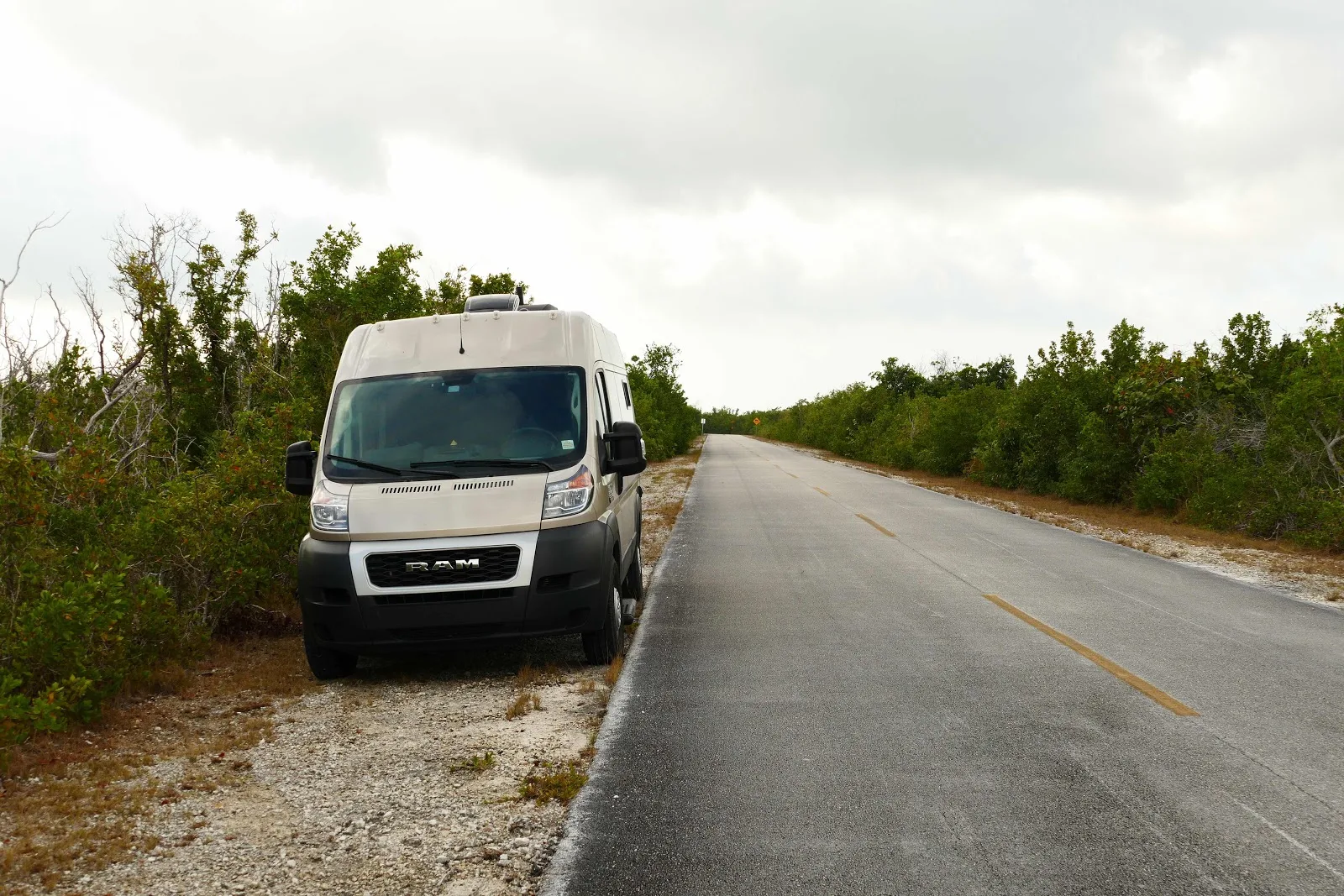
Twenty minutes from home where my wife was Zoom teaching and we were far away and out of hearing. Rusty and I had the woods to ourselves.

There was humidity in the air, which produced summer-like clouds overhead and I love looking at those through my camera lens.  

The wind was out of the west, a harbinger of a north wind and cooler temperatures, and the sun came and went which opened and closed piles of white puffy clouds overhead.


It looked just like summer and it was starting to feel like it.

Imagine standing there in silence, a panting hot dog sitting in mud thickened water. Clouds moving overhead changing shape creating changing shadows on the ground. Miles from people and viruses and 911 calls. I felt liberated.

Spring break is back and its taking its toll even as hotels are full and bars are doing a roaring trade. Lost identity papers, broken relationships, disappearing lovers, every day the stress of being young and intense is brought home to this old man. Every year we have to listen to tearful tales and send the rozzers out to fix the losses and at the end of six week every single employee is screaming for peace and quite, just for a little bit.

I find my refuge out here among the buttonwoods and spiny thorns and big green seagrape leaves. A walk, some reading, a cup of tea, a nap, a van gives it all to you. Home away from home before it becomes home next year.

When we can drive further I'm looking forward to different scenery and lots of variety but I've learned to find colors and shapes in things as simple as mangroves and buttonwoods. Its good practice.

Look at that sinuous trunk whirling its way into the heavens...

It was hot and Rusty slipped down into the mud a couple of times to cool off. I would have rather unzipped him but he wasn't having any of that so he got muddy instead to cool off inside his fur coat.

I may have walked him too far in my pursuit of pictures. He was fine really, but sometimes he's like a child, tired but unwilling to hang it up for the day. The large bowl of cold water (thank you GANNET2) was a much appreciated reward. For him, for me I finished my cold tea. 

A successful morning out on a small van trip, a reminder of what is to come. One more Spring Break, just one more.

Sunday, April 11, 2021

The Other Key West


Florida Keys History: African-American Landmarks & Sites


Florida Keys history is rich and diverse, with African American landmarks and legacies in various locations throughout the state. The following historical sites can be found in Monroe County. While some of these sites can be visited, other listings are marked "private" and are not open to the public.
Historical Sites in Key West
Bahama Village


Bordered by Whitehead, Louisa, Fort and Angela Streets Key West’s Bahama Village is a time capsule of unique residences, businesses, churches and community centers that were built during the 1800s when several hundred free blacks came from the Bahamas along with white Bahamian (English) settlers. Homes were built on land owned by John Simonton, William Whitehead, and John Fleming. Bahama Village was part of the original platted section of what is now downtown Key West. It's a great stop to experience Bahamian culture.
Bethel African Methodist Episcopal Church


223 Truman Avenue
The original church building was first established in 1878, in the 700 block of Duval Street. The Ku Klux Klan was rumored to be the culprit when it burned down in 1922. Reconstruction began in 1923. It's an important stop on a tour of Florida Keys history.
Bill Butler Park


Poorhouse Lane near the City Cemetery
This was the site of the county’s home for indigent senior citizens, also known as Monroe County Colored Folks Home. In 1986 the City created a park to honor the memory of William “Bill” Butler, a musician and founding father of the Key West Junkanoos and member of the Welter’s Coronet Band. The park is the site of the New Year’s morning Junkanoo Parade, a celebration with African roots which began in the Bahamas in the 17th century to preserve African cultural traditions in danger of being lost in the displacement process of the slave trade.
The Church of God of Prophecy


815 Elizabeth Street
Constructed in the late 1920s, this building began as an 800-square-foot family dwelling. Brother Kemp, a black Bahamian, and his protégé, John Bruce Knowles, Sr., remodeled it. This church was also called the “Jumper Church.”

The Community Pool at the Dr. Martin Luther King, Jr., Memorial Community Center


300 Catherine Street
The City of Key West built this pool for African Americans in 1946, when Key West beaches were segregated.

Cornish Memorial African Methodist Episcopal Zion Church


702 Whitehead Street
This wood-frame, Gothic Revival structure is the oldest AME Zion church in Florida. Built in 1903, it is named in honor of Sandy Cornish, an early Bahamian immigrant who founded the congregation.

Higgs Beach Historic Marker


Atlantic Boulevard
In 1860, African men, women and children being transported to Cuba on three American-owned ships, to be sold into slavery, were rescued by the U.S. Navy and brought to Key West. Local authorities took responsibility for the Africans while in Key West. While some returned to Africa, 294 were too ill to make the journey and died. They were buried in a mass grave on Higgs Beach where West Martello Tower now stands.

Key West Cemetery


Frank E. Adams, a black man, was the first law-enforcement officer in the Keys to be killed in the line of duty. Adams carried a gun and a badge as a Deputy Sheriff when few blacks in the nation held such jobs. Adams died on October 7, 1901, and was buried the next day. The location of his grave remained a mystery until it was discovered that Adams was not buried in the traditional black section of the cemetery because he was Catholic.

Nelson English Park


Corner of Thomas and Amelia Streets
Located in Bahama Village, this park is named for the African American civic leader who was the island’s postmaster from 1882 to 1886.

St. James First Missionary Baptist Church

312 Olivia Street
This church was founded in 1876 by freed blacks from Georgia, Alabama and North Florida who had come to the Keys to work on Henry Flagler’s railroad. Today’s masonry building is built around the wood original.

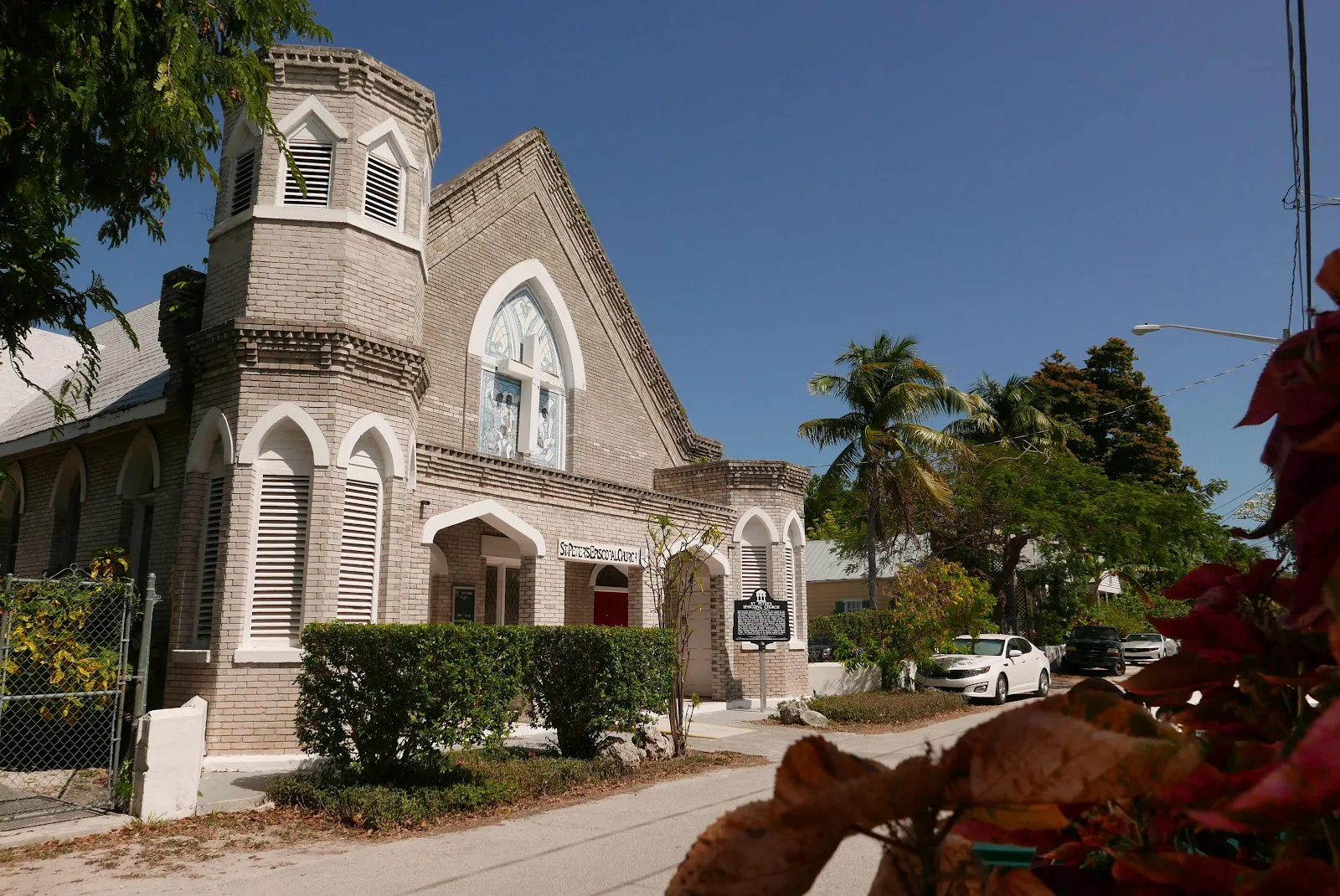
St. Peter’s Episcopal Church


800 Center Street
St. Peter’s is the oldest black Anglican Church in the Diocese of South Florida. It was designed and built in 1923 by Joseph Hannibal, a Key West native and son of Shadrack Hannibal, a runaway slave. The church was founded in 1875. A hurricane blew down the original building.

Trinity Presbyterian Street


717 Simonton Street
Served by ministers from the Bahamas on a quarterly basis until 1895, Trinity English Wesleylan Methodist Church was then accepted in the St. John’s Presbytery, and its name changed to Trinity Presbyterian. Established by both black and white Bahamians, the congregation was truly integrated, with no designated seating.

Trinity Wesleyan Methodist Church


619 Petronia Street
Trinity Wesleyan Methodist Church began when the congregation sought to join the U.S Presbyterian denomination because English ministers stopped coming from the Bahamas to serve Trinity, then the only English Wesleyan Methodist Church in America. George Allen, Sr., became an ordained pastor, and all pastors since have come from within the Allen Family. As a result, Trinity is informally known as Reverend Allen’s Church or the Allen Family Church.

Truman Little White House


111 Front Street
At the “Little White House,” on December 3, 1951, President Harry S. Truman, wrote the fourth Executive Order establishing the Committee on Government Contract Compliance to secure better compliance by contractors and subcontractors with laws that forbade discrimination because of race, creed, color or national origin. Truman announced the Executive Order to the press from the steps of this building. It's a significant part of Florida Keys history.

V.F.W. American Legion Hall


803 Emma Street
Architect and County Mayor C.B. Harvey donated plans for the building. Also known as the Black Town Hall, the building was constructed in 1951 by its members. The hall is named to commemorate blacks killed in World War I (William Weech American Legion Post) and World War II (Walter Mickens V.F.W. Post 6021).
Photos from my own archive to illustrate this Visit Florida article.
Saturday, April 10, 2021

Aerial Bight

I do from time to time drive to the top of the parking garage at 300 Grinnell and I look down upon the city spread before me. The great thing here is it is free, plus you don't have to pant to get up there.
This picture is looking north more or less, mentioned previously on this page showing inexpensive and behind them very expensive condos.
Across Caroline Street the Conch Train has a stop at the Flagler museum.
Properly masked and striding purposefully:
The loop bus for tourists used to be free and frequent, then they decided to charge a buck per ride, not the best idea probably to encourage riders, and now it is just "frequent."
Trumbo Road with at the top the Coastguard base gates, then school district administrative offices and then the dog park (obviously!) and someone camping in their van. Disgraceful behavior!
I keep hoping gaining height will be more interesting than it turns out to be. If you want to earn a view, and one that is slightly better than this one, pay to climb the many steps to the top of the Lighthouse on Whitehead Street. Or drive to the top of the Park and Ride garage and prepare not to be impressed even though as I said, it is free.

Friday, April 9, 2021

Old Harris School

This building used to be Key West's school and many people still alive got their education here. Nowadays the parking lot is used as a private pay-to-park space and the grounds are barely maintained, in a manner that seems more designed to avoid complaints than to actually officer any beauty in landscaping.  I found an article on the school from two years ago in Keys Weekly. The magazine is online and I find it as dependable as any publication and I rather enjoy the fact that Key West still has a weekly publication printed on paper in best 20th century style. The depth of this story will I hope induce you to give it a look.
by Hays Blinkman 2018:
It’s a cautionary tale for all, about big decisions made by elected officials. Let’s go back 12 years to 2006, when the Monroe County School Board decided to sell the historic Harris School at 812 Southard St. to a private owner. Leading up to the decision was a contentious 2004 school board race, when John Padget, gubernatorially appointed school superintendent, lost the election to Randy Acevedo. During his tenure, Padget facilitated a deal to sell the property to the Rodel Foundation for $6 million to create the now popular Studios of Key West. Rodel would have also contributed another $6 million toward renovation of 812 Southard, laden with asbestos and in disrepair. Long story short, the property would look very different than it does today if the newly elected officials had considered the outgoing superintendent’s plan more carefully.
Instead, in 2006, the school board voted against the Rodel deal because the offer required the creation of affordable housing for teachers (seems terribly ironic now). While the housing market fluctuated in ’06, the school board accepted a private offer from owner Peter Brawn for $4.5 million – $1.5 million less – and a very different future began for the majestic property.
So what does the property look like today? Littered with scooters, a jet ski, a large Lu La Roe trailer, and work trucks, it’s used as a monthly parking lot, and just recently, a daily parking lot, as advertised by the large plywood, homemade signs decorating the lot. Owner Brawn was issued a Business Tax receipt permit in 2009 to operate a commercial parking lot, as well as a Property Management license. Essentially, the property has become a functioning inner city parking lot in the heart of Old Town. But all has not gone smoothly for Brawn, as the property has been cited multiple times for code violations. According to Code Compliance Director Jim Young, the property has been cited 39 times since 2000 (although Brawn took possession in ’06) and 19 times since 2013. The complaints include overgrown lots, operating unlicensed business, trash and obstruction of traffic.
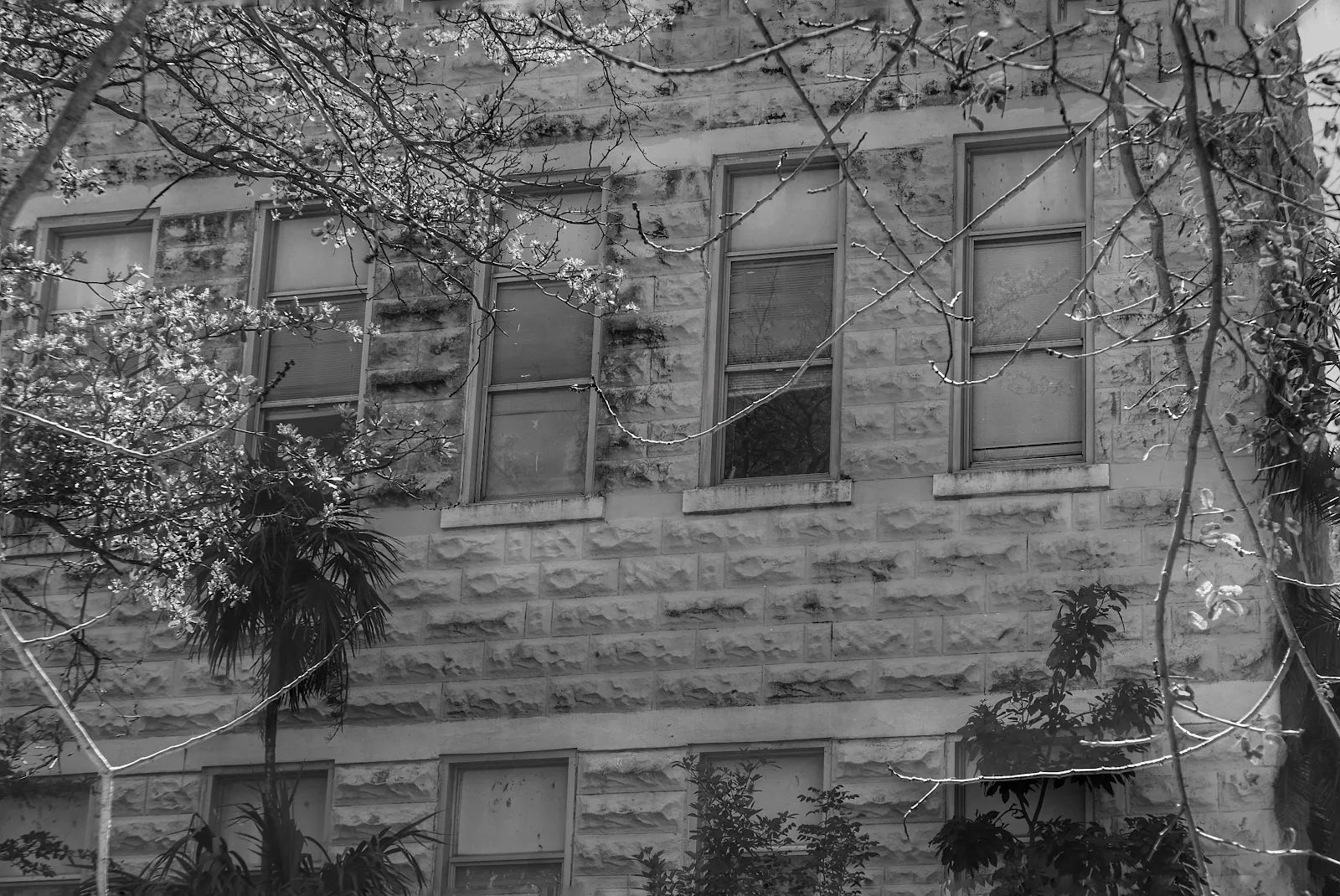
In May 2017, there was a formal code hearing for “Failure to cut overgrown weeds around subject property,” which was dismissed with no fines. And in April 2018, the city received complaints about business being conducted from a tractor trailer parked at the property. But the neighbors have much more to say about the old school than what’s on paper.
“We’re not sure what’s going on,” said resident Glen Kingsbury. “I’ve seen more miscellaneous things in the past five years. I have seen sex acts in the parking lot, loitering, people coming in and out of the building day and night.” There is no Certificate of Occupancy, meaning no one can live on the property, although the satellite dish atop the building could suggest otherwise.
“Neighbors did not have a problem with using it for huge event parking,” said Kingsbury, “but there was overnight parking, littering and dumping and we hope not other illegal activity.”
There is the misconception that the property is in Commissioner Jimmy Weekley’s district, but he is just a resident of the neighborhood. “I am constantly getting complaints about the school. It’s not hard to tell there are derelict vehicles everywhere and to see the trash. At least we stopped the RV parking on the fields and got the commercial lot only to park on the blacktop pavement.”
The school is in Commissioner Clayton Lopez’s district, who said, “If residents spoke up enough, I would listen; it’s all our neighborhood and of course, I want to help.” The commercial parking license expires in September but a simple payment by Brawn will keep his business license operational. Lopez may be hearing from his constituents unless the property sells before then for its $15 million asking price.
“The African Kapok tree used to be one of the most photographed trees in town; now it is covered by weeds, seedlings and surrounded by scooters,” said resident Don Dotzauer. He would like to see the neighborhood maintained and kept beautiful, noting that many residents have spent a great deal of time renovating old properties surrounding the Harris School. “I don’t thrive on conflict, but we just want everyone to be good neighbors and just do the right thing.”
I'd love to see an update but the Old Harris School as lovely as ever sits there and is home to parked cars. Too bad really but at least it hasn't crumbled into the ground. There are so many memories on this block of Southard Street. 
This essay is from 2014 and refers to the Bernie Madoff scandal that destroyed the foundation that had hoped to create an artist's colony here:


Thursday, April 8, 2021

Night Walk

Ann Street at four in the morning, almost empty of people and full of atmosphere.

The back of the Curry Mansion, a beehive of steps and landings and doors and rooms. there is nothing straightforward about Old Town architecture.

I looked in at Sloppy Joe's, closed at last and getting cleaned.  The lookalike contest will be back soon enough, to keep summers busy in Key West:

It surprises me how durable the Hemingway myth has remained.

Light and darkness, I tend to walk around looking up to see what shows against the pitch black tropical night sky.

Photographers call it negative space, the darkness or light that surrounds the object of the picture. Here below the Key West Harbor is the actual empty space.

One day I shall look back in wonder at these ubiquitous signs that seem so critical now and will one day be a faint memory. Did we really..? I photograph as many as I see to keep the memory fresh of what we had to do.

More negative space above El Meson de Pepe...

And surrounding the playhouse next door:

I hope live theater comes back before too long. 

Hogs Breath Bar  and store advertising below. Pirates and mermaids and other myths.

Duval Street was renovated once before when the city was led by the man who famously water skied to Cuba. That renovation feels as distant as the Bicentennial it helped to celebrate.

Inspirational wood plaques taken in for safety during the night leaving a sign open to interpretation.