Showing posts with label Gemini Catamarans. Show all posts

Sunday, October 24, 2021

The End Of The Journey, Key West 2000

Leaving Cuba after the storm cleared and we had finished exploring Punta Jutia we sailed once again for Key West and the next evening we dropped anchor behind Christmas Tree Island. The dogs got their walks immediately of course  and we slept secure ion the knowledge we had arrived, almost penniless, back in the US of A.  The next morning after another island walk we pulled up at the fuel dock at the city marina and called Customs to check us in.

It was good to be back but we were still thinking about our crazy illegal time anchored off Cuba's north shore, as in this photo taken from the upper deck of a friendly Cuban boat anchored nearby avoiding the same storm.

We walked around Key West at this stage pretty sure we were going back to our house in California. We missed our friends in Santa Cruz but I had no desire to go back to the great pay of truck driving 18 wheelers through San Francisco, and Layne had no desire to go back to lawyering. We walked and pondered our future.  

The thing I notice about our pictures of Key West was how little so much of it has changed in the past twenty years. We checked out houses and found a crappy upstairs studio for $185,000 making us think our boat might be best. We weren't even thinking of hurricane damage possible every summer at that point.

Curtis, Robert and his wife Nola greeted us and made us feel at home. I knew them from previous efforts to settle in Florida and at some point we figured we might want to join them. What happened was that Layne found her arthritis hurt much less in the tropical heat than in the cold damp of coastal California. The plan slowly formed that perhaps we should stay and settle in Key West.

I still liked living on the water, photographed here rowing into Garrison Bight from the mooring Curt loaned us out by Rat Island. We surprised our friends by applying for work. Layne got hired as aJuvenile probation officer much to her surprise. In those days regular office jobs were easy to come by as work in bars and hotels paid a lot more but Layne wanted a pension. She was determined on that point. I got hired as about captain thanks to my license, earned in a. moment of madness and I turned my hobby into my job. That pension thing kept nagging which is how I ended up at the police department. We sold our California home and bought a house on Ramrod Key and there we were. A new life done and dusted.

The dogs continued traveling with us as we moved between our old life in California and our new life in Florida. It took us a while to move what stuff we needed, to sell the boat and to move into a new life.
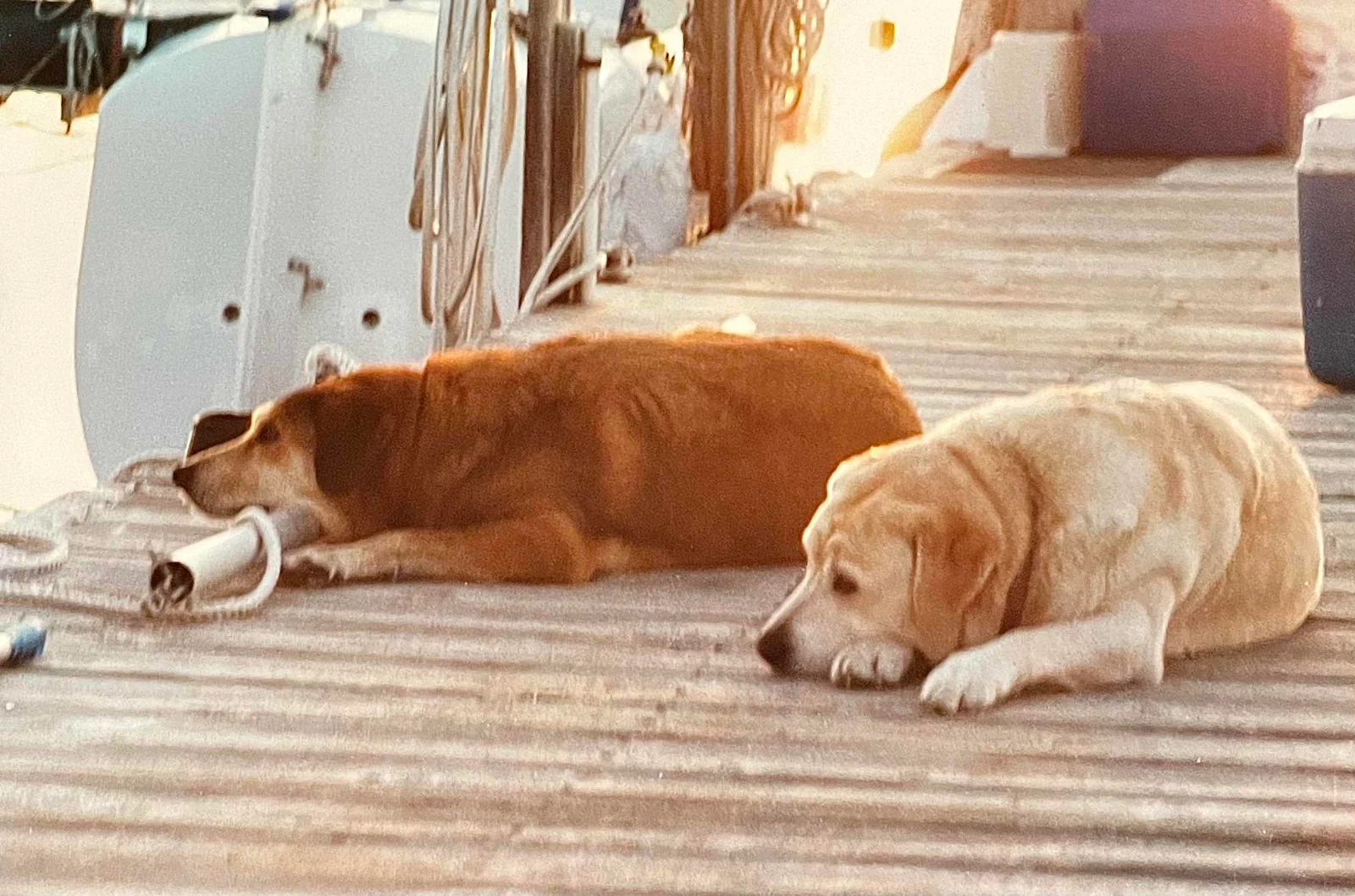
I took this picture on Grinnell near Five Brothers and I remember it well. I used to commute in this car to my job in San Jose and a friend kept it for us while we went sailing. It had no air conditioning but we drove it back and forth between Santa Cruz and Key West.

With two large dogs, alternating between the front and back seats. We humans shared the driving and the dogs switched between the back seat as one of us rested and the front seat keeping the driver company. We surprised a few people at our stops as the four of uncoiled from inside the little clown car. That Geo Metro 5 speed was a brilliant little machine.
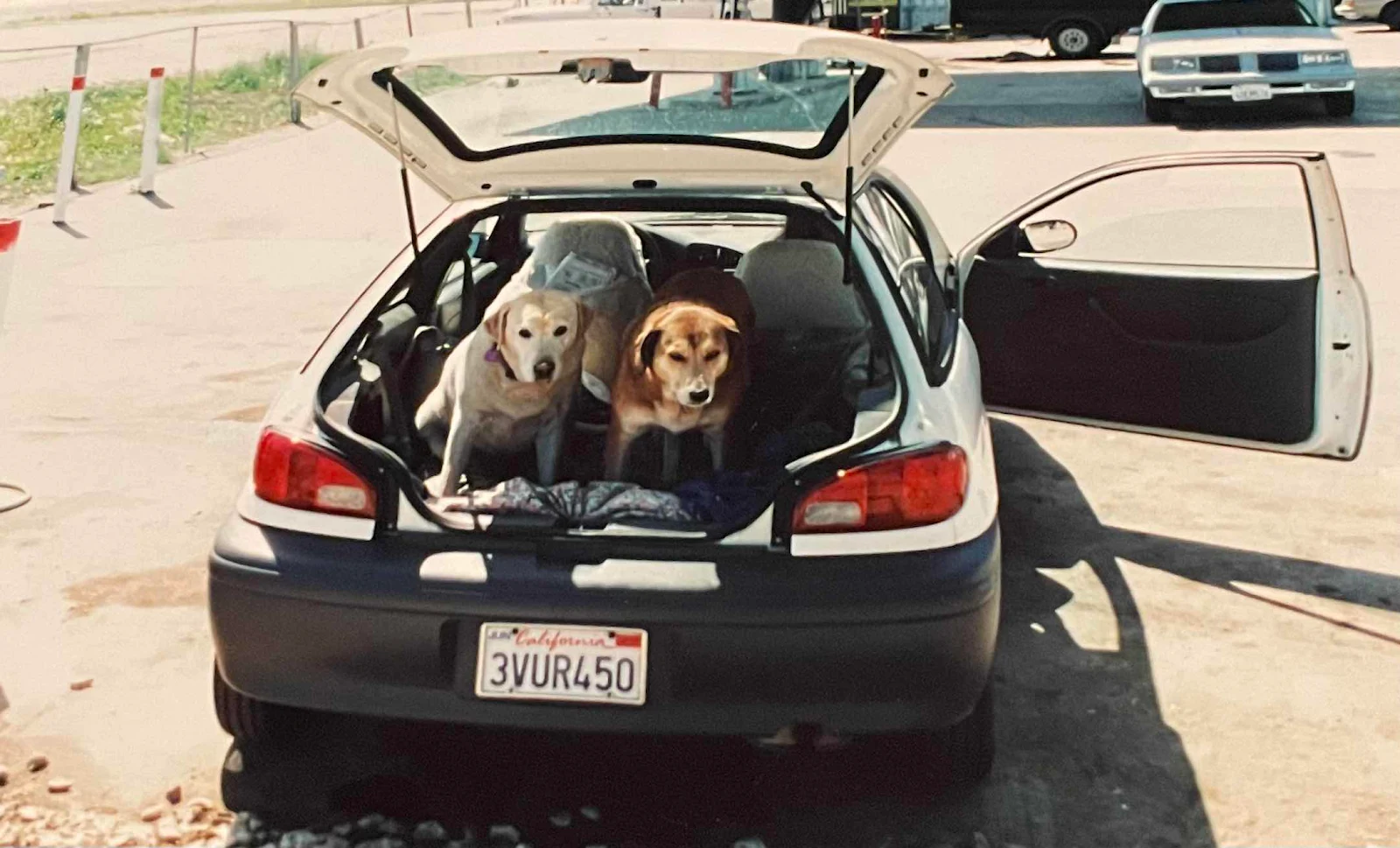
Back in the US the stops along I-10 were rather less scenic than the places we had explored from the boat. But we went back to walking and exploring as we could.

I am not looking forward to droning I-10 even now so I am planning a zig zag route to see friends in Arizona next month. We saw a lot of desert in those years.

Debs stopped eating suddenly while we were in Santa Cruz. He had inoperable liver cancer and died suddenly just like that, to general family devastation. Emma mourned him for the rest of her life but she lived on for a few more years dying eventually in our Ramrod Key house with Dr Edie in attendance, the same vet who just gave Rusty his travel documents for our next journey. It's been a long life earning our pensions. I am ready for another go.

The buddies running through their favorite Santa Cruz walk, the open space at Porter Sesnon in Aptos.


Sunday, May 27, 2018

Bumping The Shallows

The first time I went aground I did the job completely and thoroughly and stayed parked in the riverbank for twenty five very long and embarrassing hours.  I had taken three weeks off and had decided to explore San Francisco Bay as carefully and extensively as I could while afloat. I had read about the joys of river sailing up the Petaluma River where I was told the breezes were constant and air temperatures approached tropical, an alluring prospect to one used to sailing the frigid Central California Coast.
At first it all went beautifully to plan starting with an overnight trip from my home base at the Santa Cruz harbor overnight to Half Moon Bay in my twenty foot pocket cruiser, a Flicka built by Pacific Seacraft, then in Santa Ana, California.
Image result for flicka sailboat santa cruz
I made my way to San Pablo bay carefully following the charts and I turned toward the Petaluma River motoring up a long row of markers stuck on posts above the thick brown waters. Much to my astonishment I could occasionally see the bottom in the eight to ten feet of water. I felt very daring taking my three foot draft into such thin water over a  sandy  bottom.
 
By the time I passed under the road bridge and found myself in the river itself two things became apparent: one was that the famous land breeze blowing down the valley was right there but unexpectedly the river views were miserable as I found myself locked on river bordered by tall riverbanks, levees in the local parlance, tall enough to contain the river at flood but also tall enough to obstruct all views. This was not what I had imagined, picturing myself sailing lazily up a brook between meadows, sharing the afternoon sun with cows and fields of pasture and whatnot.
So I did what a sailor does and I started sailing. I am going to tack up river all day if I have to, and great fun it was too, in flat water with a  fresh breeze on the nose.  The Flicka was a fine boat to sail being small enough to make single handing simple, sheets to hand a stout tiller and a responsive cutaway full keel. Except...I seemed to be having difficulty coming about, a pronounced reluctance to spin through the wind alerted me to the fact that a change of plan was in order but I was too slow. Suddenly, very suddenly the boat got a mind of it's own and chose to ignore my efforts on the tiller by driving itself into the reeds at the river's edge with the determination of a Samurai hellbent on self destruction in some glorious act of self sacrifice. 

Unfortunately my dignity was the only thing offered in sacrifice  that day in distant 1987. The Flicka plowed those reeds apart like Moses crossing the Red Sea and we came to a gentle halt in glutinous dark mud clamped all round the hull perching the boat bolt upright in the muck. I of course lowered sails as the boat wasn't heeling one bit, The ten horsepower diesel was no match for the muck and soon I found myself sitting in the sun on a perfectly level sailboat with a splendid view of the many and various weekend afternoon activities on the water. And all of them could stare back and giggle at my predicament. 

I was released eventually by a cheerful power boater ("stink pot" as we sailors derisively term them) who gratefully took a bottle of wine for his trouble. I was pathetically in his debt as I had tried all the textbook maneuvers to get out of the mud and failed - kedging with an anchor, trying to dig the mud out from under the boat with a paddle, and waking up at the top of the moderate high tide in the middle of the night in a hopeless effort to motor smartly out of the mud. Nothing doing, it took a ski boat with a monstrous large outboard to un-stick the Flicka.


As California has a steep and therefore deep coastline the chaos I suffered on the river was about as much experience as I would get in shallow water until I went sailing in Florida and the Bahamas three years later. I trailered the Flicka to Texas and motored round to a new job in Tampa. After I wore out my welcome I set off for the Bahamas with my girlfriend at the time.

It was an unhappy journey as I felt the responsibility keenly to keep my little home afloat and  safe not just for me but for her as well. Our relationship did not survive the cruise but my boat and my sailing ambition did. While in the Bahamas I came face to face with my worst fear: shallow water.  I sailed with determination and awful memories of 25 hours aground in the Petaluma River. To my amazement I did okay. I was scared, and scarred, but I piloted the shallows of those lovely crystal clear waters.

I had the  best sailing of my life in the Bahamas, thanks to the  steady breezes and close knit islands. For the  first time ever I really didn't much need a motor. It is possible to take all day to sail a few miles, following a late breakfast and  before the obligatory sundowner drinks, that sort of a "day" not sun up to dusk....Some short tacks in water barely deeper than your keel, the splash of an anchor and settling down for a swim and drink in the silence of an engine-free day. The Bahamas can offer the best sailing even if ashore there is nothing much to see or do. To visit the Family Islands not on your own boat seems a waste of time to me.
 
My wife and I wanted to sail level so we bought a catamaran and kept it on San Francisco bay in the mid 1990s, traveling upo from Santa Cruz most weekends, learning to handle strong winds and powerful currents and cold breezes. There was method to our madness for in 1998 we took off with our two dogs and aimed squarely at the Panama Canal with final destination my old hunting grounds of Key West.

Which I suppose makes the choice of a boat with an 18 inch draft rather odd as the coastline is mountainous and the waters are deep right up to the beach almost all the way from San Francisco to Panama City ( and beyond from what I've read). But there was no doubt our  34 foot Gemini catamaran was light, easy to sail well and very comfortable for us and the dogs.

 Debs ready to leap off to chase something while Emma always kept an eye on me.

Eventually it happened that shallow draft became not just nice to have in certain uncertain anchorages, Belize's coastline comes to mind mostly shallow and full of reefs, as well as the San Blas islands all very deep except where they suddenly were't...mostly we sailed and anchored in deepish water. 

On the very final leg of our two year trip to Key West we met the second major storm of the journey, strong winds and large seas in the middle of the Gulf Stream south of the Dry Tortugas. One boat in our group hove to, stopped in the stream to wait, while we and another smaller catamaran similar to ours turned tail and fled for the Cuban coast. I had no desire to sit like a duck in the path of one of the world's busiest shipping channels. We found refuge in Cuba and that was where I finally learned to embrace shallow water.
The couple fo who sailed See Ya, another Gemini catamaran showed me the way ahead, threading inside the reef along the north coast of Cuba, in waters protected from the storm, too far from land to be interfered with by officialdom. I watched the rocky bottom of Cuba's reef slip underneath my gaze with just a few inches to spare under the keels of the catamaran. When See Ya ran aground the crew laughed, and I tittered nervously alongside. They got off we proceeded. They dodged rocks and slipped through narrow passes, they watched the bottom and ignored the flimsy fake charts we had copied from some other Cuban wannabe visitor. I had never wanted to visit the Forbidden Isle wrapped up as it is in bureaucracy and ill feeling from our officials but there I was and in almost no water and having the time of my life.
I have never had any mentors in my life and every crazy idea that passed through the antechamber of my brain had to mature and express itself by my will power alone. To be taught how to sail the shallows by an almost stranger was a gift and I took the lessons with gratitude. Much easier than learning to sail a river by being stuck aground for 25 hours in the mud.

Wednesday, September 27, 2017

After The Storm

Many years ago, eighteen to be precise, my wife and I found ourselves going to the movies one night. We left the dogs on the boat in the marina after a very long walk, and picked up a cab at the gates for the drive round the waterfront to the more upscale side of town where we found a shopping mall with a theater. I forget the title of the movie but it was some Hollywood production, in English with Spanish subtitles as they rarely seem to dub movies in Mexico. Halfway through the film the projector stopped, the lights came up and we had an obligatory intermission when people could buy candy and catch up on missing plot lines. It was rather charming.
 Leaving San Diego October 1998, Baha Ha Ha VI Rally. Gemini 105 catamaran hull #529

After the movie ended we stretched and got up out of armchairs and waded through a  sea of wrappers and popcorn containers to the exits and then we realized once again we were back in Mexico, more precisely Acapulco and we had thousands of miles yet to travel before we reach Key West. Damn! For a moment there we had been transported back to the US in the dark, back to he familiar, the easy and the known. And it wasn't that we weren't enjoying the journey necessarily, we just wanted a break from the daily grind of living in a foreign culture.
Panama Canal, Miraflores Lake, Emma and Debs wishing they were ashore August 1999

These days I feel like that a lot of the time. I wish I could wake up and walk away from this culture of torn up trees and quirky electricity and boil water orders and so forth. You can't make the argument that any of this is fun, but like choosing to go sailing with your family, choosing to live in the hurricane belt with your family is up to you. And even so there are good bits to being caught up in a Category Four storm,
At anchor in the wild and lonely Pacific Coast islands of Panama, of our favorite cruising grounds. 1999

To get to live through a major hurricane is an event in one's life that some people crave. They want bragging rights which I find odd. I knew before Irma showed up that despite leveling an entire Third World island that lacked building codes like ours (and ours could be a lot stricter!) only one person among 1800 died on Barbuda. The chances of my dying seemed remote, especially to someone who defies death every day by commuting by motorcycle. The thing is, the adrenaline rush passes, the survival of the event transforms into the survival of the drudgery that follows, and it is a drudge to survive after the storm has gone.
Now it is endless clean up, removing debris, filing paperwork, talking to adjusters, waiting for electricity, flushing toilets by hand and so forth. And just like in a Acapulco that warm tropical night two decades ago I would like to be transported away, even if for just a little while to a place where the grass is green and tree have leaves and no one is surprised to see running tap water or menus outside open restaurants. This is the part about the storm that people elsewhere don't understand. You don't die in hurricanes you just get fed up and bored and angry. You just want the damned electric lights to work and keep working. This is how for the past two weeks we entered and left our street. Had we needed an ambulance or fire truck it would have been curtains. As it was we all drove through our neighbor's yard to get in and out:
Just room enough for a sedan or a pick up truck thanks to the efforts of my neighbor Jose who propped the wires up on cross beams of his invention, no thanks to Keys Energy for their lack of help:
I am sure you are tired of hearing about the daily drudgery but my world has shrunk. For a week I was happy to forget the name of the President, Governor Rick Scott did outstanding work organizing relief and being a presence to remind everyone help for us was important to him and I am grateful. This storm has changed me. I am not willing to assume that there will be no more hurricanes. I know there will be more and this circus will be repeated. I cannot take for granted water or electricity or phone service after the abysmal collapse of everything civilized following Irma. My expectations are low. We have electricity now but tomorrow who knows? I came across friend steam cleaning his garage of mud with an electric appliance. I turned to my wife and said: "They til have electricity" as though it could have been in doubt. I keep doubting.
A group of Latter Day Saints came by a friend's wrecked house and put order inside and out in a couple of hours. She couldn't believe it. One woman said she flew to Miami from San Francisco the day before and there she was with her family of all ages tearing it up. It was a hell of thing and saved Kathy a bunch of grief and despair. Better change our stereotypes of the Mormons I guess. There is kindness in the midst of wreckage.
After it all goes into the history books I will be left with a vaguely unsatisfactory feeling that even when I know what to expect I still fail to measure up to my own standards. Hurricanes  get you like that, you never what exactly they will end up doing even if you yourself know the sequence of emotions that go through your mind after the storms have blown away. And still I'd rather be two hundred miles away in a green and pleasant land they used to call Florida - the flowery state.

Monday, September 19, 2011

Sailing Home

The sun was starting to get close to the horizon at our backs, the horizon in front of us, to the east began to get that dark blue tint at sea level that tells a sailor that dusk will be upon the boat soon enough. Which sometimes is a good thing but not if the slow boat from Mexico is trying to make the anchorage before dark.


At sea the dark is a pleasure in the tropics, relief from the heat, fantastic light shows overhead with moon or stars but not both simultaneously as one cancels out the others, but my wife and I were tired of nights at sea after two years on the road. Most nights we had spent at anchor but most days sailing involved a night or two or three underway, taking turns on watch, sleeping with one dog or the other but not each other. My wife got dinner going and I took the first watch in the darkness then we'd eat together in the cabin of our catamaran keeping a nervous eye on the windows looking for signs of life and then she took the watch on deck while i washed up and went to sleep. She would wake me at some God awful hour and go to bed and I would sit up as long as I could hopefully till dawn when she would make breakfast, I would wash up and she would take the watch while I slept. I found the disjointed hours of life underway to be irritating and we had been sailing from Isla Mujeres for almost two weeks.


We were tired in general as we passed the Sand Key Light, shown here in a picture from Wikipedia, with the tiny nub of sand that the dogs looked at longingly. I did too thinking perhaps we should take a mooring and stop here for the night, seven miles from our destination. My wife said we should press on with daylight on our side.


It was the first dry land we had seen since we had left the north coast of Cuba thirty six hours previously. We were ready to stop but we had issues. Our three day crossing from Isla Mujeres to Key West had become a two week odyssey, interrupted a hundred miles from Key West by a storm that threatened to blow us more than 200 miles back to Mexico.

We took refuge inside the Cuban Reef and because we had planned to be back in the land of abundance within three days we took no perishable food with us from Isla Mujeres. American Customs are rather fussy about the importation of salad and apples and bananas. By the time we had drifted past the Sand Key outpost of uninhabited barren sand we were tired. We were tired of sailing adn keeping watch, of not having fresh food, of having to think all the damned time as every experience was new, we were tired of everything being complicated by language barriers and cultural weirdness,of not having anything be simple even for two Spanish speakers and travelers like ourselves. In some ways it may seem rather petulant to be fretting about voluntary isolation in a world made crowded by too many people but we had been traveling for a while we four and we were all tired. We wanted modern facilities and convenient modern life ashore, embarrassingly enough. Washing a salty Eugene Debs with a garden sprayer of fresh water after every beach excusrion at least twice a day got old for both of us.

It was a race with darkness, watching the sun set behind us, listening to the light breeze rustle the mainsail as the diesel burbled us forward at a speed a little faster than a brisk walk. The odd thing about making landfall is that you can be scouring the horizon for hours and after a long stretch on the water one tends to get antsy about confirming one's position so one keeps looking for the elusive first sight of land, in the manner of a member of Columbus's crew looking for a glimpse of the mythical Indies.

I spent altogether too much time standing on the deck under the weak and fading February sun looking for my first glimpse of Key West, our goal, more or less since we left San Francisco in the summer of 1998. I had friends and acquaintances in Key West and we hoped to stop and work for a while before setting off south again for a stint in the proper tropics of the West Indies where we had honeymooned six years previously. Our trip through the Panama Canal in the final months of US Administration had beset us with heat and humidity and we had enjoyed it. Cold was not on our list of to-dos.Key West held out the prospect of being a crossroads where travelers' tales could keep the dream alive we thought and keep us focused on further journeys. We had not been prepared for how tired we felt.


I was tired of fixing the boat in strange places. Even though the Gemini 105 is a light boat by most standards we had traveled well, and the boat, new in 1996 had kept us secure and dry through some terrible trials, tropical rain, horrendous waves and endless winds ancillary parts had a tendency to give up. I was an expert at disassembling and rebuilding the toilet, shit and all. The water maker was my essential companion. The lines and sails fell to my hands through force of habit, and the oil filter and fuel filters of the diesel a good deal less so. The boat was a home and an collection of pumps and engines and pipes and seals and crap that I needed to keep us going.


My wife had been cooking in a tiny space in the right hand hull. She made do with two burners, lamenting her six burner commercial stove in our home in Santa Cruz. The fridge, operated by propane gas was the size of two vegetable bins in our human sized fridge at home, and supplies came and went in ways that seemed more deliberately obtuse than random in our travels. We got used to buying what we saw when we saw it. We never assumed we would see it again tomorrow.She looks like Cheyenne but she was Emma, saved from the Santa Cruz SPCA and forced into a traveler's life that would have suited Cheyenne ironically enough but that Emma took up unwillingly to simply be with us.


We four, we happy band of travelers, exhausted, arrived in key West. It was Valentine's Day 2000.

Sunday, July 12, 2009

Mexican People. Tenacatita

It was a regular winter's day on the Pacific Coast of Mexico, with one exception: the offshore breeze was blowing and it was only early afternoon. Winds along Mexico's mountainous west coast tend to follow strict diurnal patterns. Hot sea air rises during the day as the sun warms the air over the water and at night the air cools and rolls back downhill producing an offshore breeze in the early hours. Passage planning in winter on a sailboat requires the frugal sailor take advantage of these breezes as one can save a few a few hours of motoring on a twenty four passage.
.
We were entering Tenacatita Bay a few miles north of our destination on this leg, which was the little beach town of Barra De Navidad, a bizarre name given it by the Spanish explorers who located the sandbar the city is built on, around Christmas time. So it is called Christmas Bar. Tenacatita Bay is an isolated pair of bays, an inner and an outer, with hills, palm trees and only a few buildings clustered mostly in the village of La Manzanilla. It is what California sailors look for during a winter away from the cold wet months Up North.
I unrolled the sails and our Gemini catamaran took off like a scalded cat...amaran. We turned hard on the wind and sailed for the beach. One tack away and we were in the mouth of the inner bay. With my wife working the sheets and flopping the foresail we turned about and headed back to the beach on the next tack. And so on, all with the backdrop of blue sky, brown mountains and green trees. We had no time to look down at the deep dark waters we were slicing through on this unexpected breeze.
.
"That was fun," my wife said as we took a final tack to the head of the bay where we were planning on anchoring. "Let's do it again," I said impulsively. She is nothing if not able to go with the flow so she threw off the jib sheet, the sail let loose and we headed downwind towards the outer bay. We turned around and did it again, tacking up the bay to the beach. It had been a short hop that morning from Chamela, a small indentation some 25 miles up the coast so we were full of energy and the dogs were in no hurry to get to the beach. Finally we dropped the anchor without even needing to turn on the engine. It felt satisfying, and an all too rare occurrence on the wind-free coast of Mexico.
.
As is the way a neighbor came over in her dinghy to say hello and she introduced herself, telling us her husband was hunkered down on their boat, a trim 32-foot ketch, a sailboat with two masts, anchored nearby. We talked for a while of the local attractions, the river through the mangroves, the French restaurant on the beach, the setting for an obscure-to-me movie called Hale's Navy, she said. She asked shyly what had we been doing hunting around tacking through the anchorage- twice! "Oh," I said, feeling foolish. "We were just having fun enjoying the unexpected breeze," like a child caught stealing cookies. She got a dreamy look in her eyes.We asked how their trip was going. Um, she said, okay, but she wasn't enthusiastic. I'm not the most politic person in the world so I asked for details.
."
Well," she began. "My husband is retreating into himself. Bob stays on the boat drinking our wine collection and smoking his cigars. But that's not the worst thing," she went on. "What would be your greatest fear anchoring here?" I looked blank. Fear? In Tenacatita? After you've got past the odd isolated rock near the entrance there isn't much to worry about..."Bob?" she interrupted my struggle to find something to fear. "Bob is worried about bandits," she said with finality. Bandits? what bandits?
.
There are lots of reasons not to go sailing and I've heard a million excuses. At home it seems reasonable not to leave because you lack money or skill, or you like your life, or you have grand children. But once you've made the commitment and you've cast off it gets harder to find a reason not to enjoy the life that so many aspire to. That fear of bandits in Tenacatita Bay in the Fall of 1998 was a new one to me. Bandits in Colombia were on everyone's lips who was out cruising. Nowadays Bob and Jane sail a motor home and volunteer at parks up and down the Western States. We live in a house in the Keys and the bandits of Tenacatita Bay are probably still there, lurking in the mangroves, ready to shoo home any unwary sailor who may feel he has bitten off more than he can chew.One day I was working my job as a boat captain in Key West harbor a few years after we had been in Tenacatita Bay, when I spotted a pretty little ketch similar in many respects to the one picture above. I recognized the name with a start and I went over to complete this chance encounter. I knew Jane and Bob had sold the boat but I was moved to meet this old friend in this unexpected place. The new owner was a dour Scotsman worried about something and totally uninterested in me and my story. He grunted me off and disappeared below. The next day when I came back to work the boat was gone.

Saturday, December 8, 2007

Panama 1999

We transited the Panama Canal on our sailboat Miki G in the Fall of the year the US finally pulled out of that operation.I doubt the Autoridad in charge these days would be too impressed were we to return and expect a transit for our 34-foot catamaran through the canal. These days its a self funding operation and every transit has to pay for itself and sailboats are very low on the totem pole. Our buddy Anna rode through with us to check out how she and her husband Ian were going to cope with their boat Joss. We had a minor crash later when the tug we tied up to left us in the lurch and we were slightly beaten up as we were dragged through the lock sideways by the currents. Damage was minor but we stared death in the face for a few awful minutes.Days later Joss made it through fine, though I was always worrying about what had happened to us as we locked through on their trip. Ian confided in me later that he couldn't get the image out of his mind of Miki G swirling helplessly through the lock like a leaf down a drain.


We were weeks ahead of the hand-over to full Panamanian control of the Canal, but years later I did meet the skipper of the last boat to be issued a US transit permit as the seconds ticked up to the noon hour December 30th 1999. Ghost, a suitably elderly wooden sailboat that I believe was shipped back from Marathon here in the Keys, to the owner's home in Marin County California.
When people find out we sailed our Gemini catamaran from California to Florida they are always fascinated by our transit ($500, two days, and the dogs behaved impeccably!), but we remain fascinated by the country of Panama at large.Miki G moored for several weeks at the now defunct Pedro Miguel Boat Club, next to the Pedro Miguel locks on Lake Miraflores. The marina used to be a Canal Zone perk, but during the US Administration it was also an excellent place to tie upto make repairs and rest from the culturally arduous business of cruising Latin America. Pedro Miguel was an English speaking, boater friendly, oasis even in the years after the Zone was ended and Americans only stayed on to help transition to Panamanian Administration. However the Autoridad del Canal de Panama has shut the place down after a long legal battle and pictures such as this can no longer be taken because the club is gone (plus we sold the boat to a friend in Key West who isn't interested in cruising right now!). One of these days I'm going to write an entry about all the place I've been that no longer exist. A depressingly long list, indicating an excessively long and well traveled life I think, even though the places themselves weren't that great; the USSR and East Germany high on the lackluster destinations I Have Known.


Panama started for us when we rounded the cape separating Costa Rica from Panama one dark and windy night. We blew into Panama full tilt and never got over how much we wanted to be there. The river trip to the second largest city in the country David ("Dah" with the emphasis on the "i" ) was an amazing maze to navigate. Non sailors often think rivers are refuges but we found that jungle river to be a pain in the ass with massive tides, floating debris and low overhanging branches, not to mention sandbars and few places to anchor.I keep this picture framed in my office to remind me of our mad cap adventures trying to find places to walk the dogs away from the prying eyes of the officious Customs agent who was determined to enforce Panama's 'no pets ashore' rule. Emma, our Labrador stuck close to me while Debs, our Husky dived into the bushes like the little explorer he always was. Everyone in the rest of the country ignored the quarantine rule and we took the dogs everywhere with us, into Panama City, into Darien by rental car, and up into the mountains in the middle of the country.


We really got to enjoy Panama among the Pacific Islands that dot the uninhabited coast. There are beaches, palm trees and crystal clear waters in an immense 300 mile playground where sailors can play Adam and Eve for months and not see the same place twice. We washed up on Isla Contadora in the Perlas Islands, which has an airstrip, hotels, some stores and fuel supplies. A walk was de rigeur through the ritzy neighborhoods where rich Panamanians keep weekend homes. I like this picture, it inverts the usual stereotype of Latin Americans being the gardeners for wealthy white Americans. "Mow yer lawn, guv?" After we got through the Canal we spent several more idylic weeks in the more famous San Blas islands on the Caribbean side of Panama. These Kuna indian islanders practice a low tech medieval lifestyle in their own autonomous province known to them as their Kuna Yala, with their own system of justice and social pecking order, similar to, but more idylic than, a US Indian Reservation. These islands resembled the Keys somewhat, in as much as they had coconuts, narrow sandy beaches and lots of scrub vegetation. We sailors gathered in calm anchorages and hung out barbequing under the stars, telling stories, swimming and playing cards until our supplies ran out and we had a private plane fly us out the fixings for a massive Thanksgiving dinner in November 1999. Believe me, we were absolutely bulging with thanks that memorable desert island holiday.Teaching kids to pet the dogs (with treats of course!) on the Rio Diablo/Corazon de Jesus footbridge in the Kuna Yala. Kids are kids in the most remote places and Labradors do like their treats.

Panama was a hell of a place, far more varied and interesting than Costa Rica with a greater percentage of land given over to parks and all the benefits iof a money laundering economy with excellent banking (they use the US dollar for their currency) and superb medical facilities. Retirement? Who knows!