Thursday, September 9, 2021

Transiting The Panama Canal

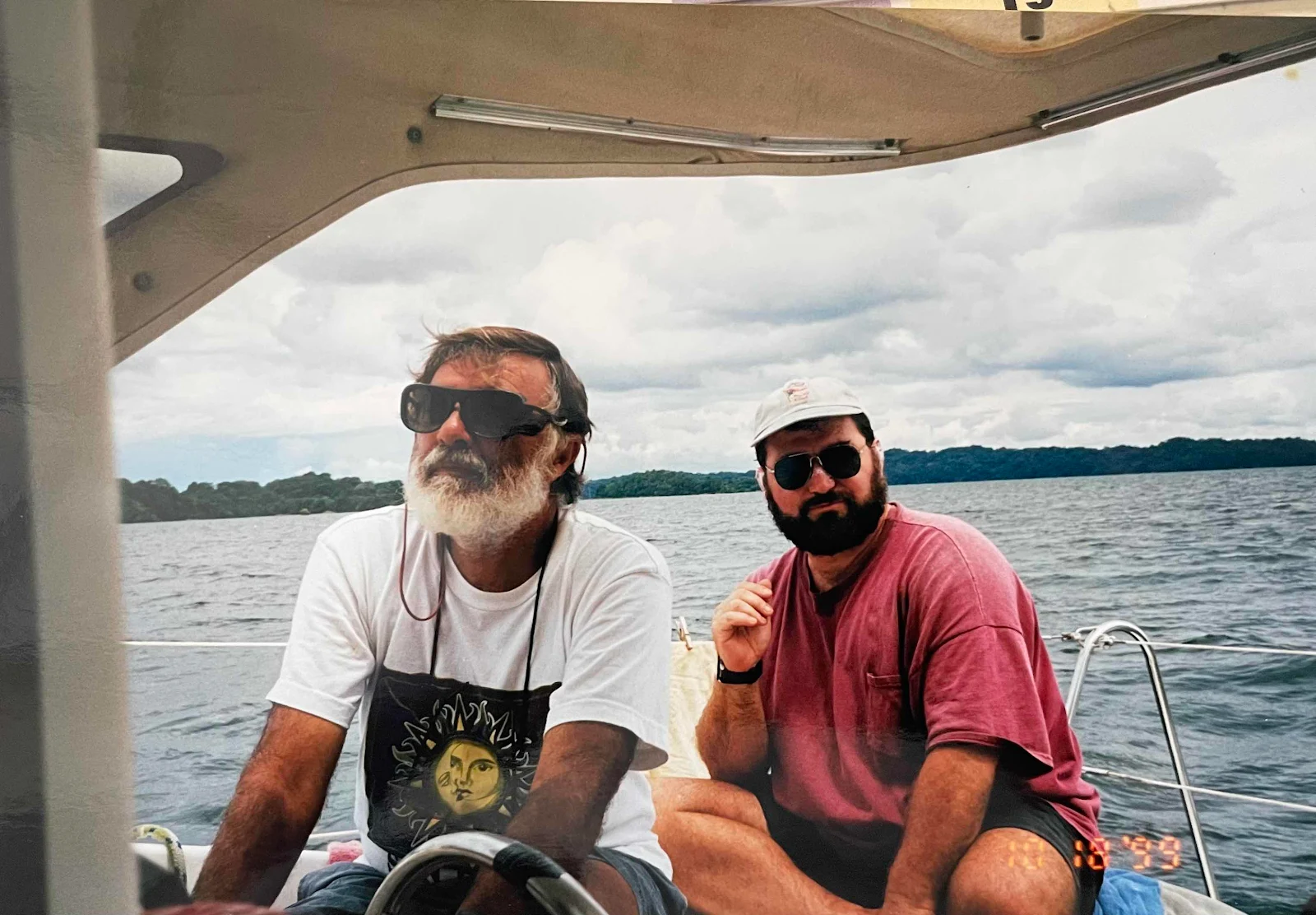
Taboga Island, Panama 1999. The island lies 12 miles off the entrance to the Panama Canal on the Pacific Coast. When we stopped off there before our transit there were three pick ups on the island but the streets were paved and the dogs enjoyed the walk. We had had a brilliant sail from the Perlas Islands to this idyllic spot and Emma and Debs were ready to stretch their legs in the heat of a rainy summer. I was 42 years old. Taboga was a vacation spot during the canal zone years but before that it was used as a sanatorium for canal diggers to recover from the difficulties of plowing a channel through the jungle. Yellow fever was endemic until a vaccine was developed by Colonel William Gorgas, and thousands got sick and many died. Nowadays the hospital island is a vacation spot in the cooling breezes offshore.

We had been island hopping Panama's west coast that summer, a paradise of uninhabited rocky islands covered in coconut palms with actual freshwater streams offering easily filtered water and abundant showers..! Until we arrived at the inhabited Perlas Islands at the entrance to the Gulf of Panama we had only met occasional fisherman braving summer rains along the mountainous empty coast.
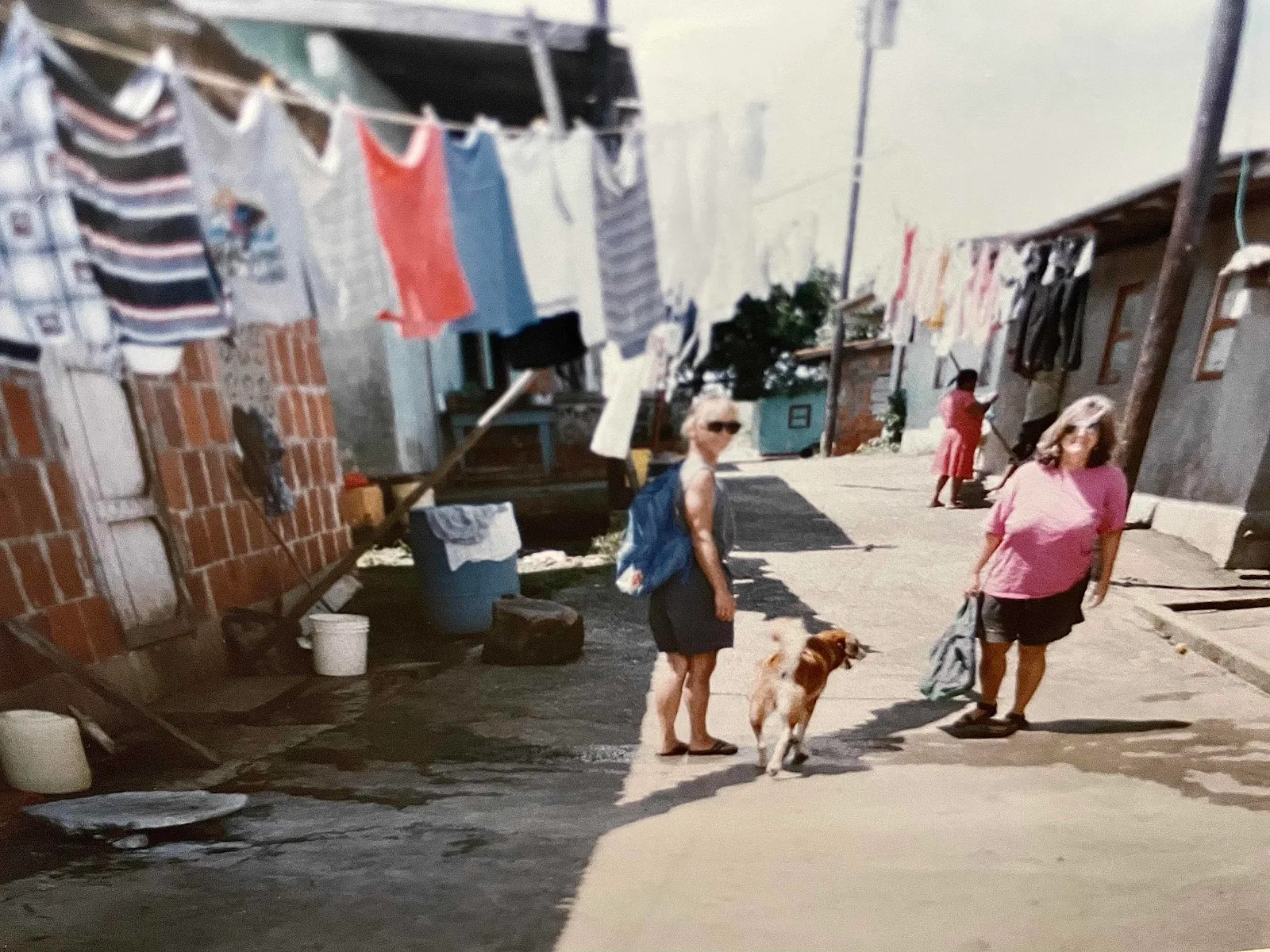
While our boating partner Anna, sailing with her husband Ian on "Joss" answered questions from eager kids Layne called the bank back in Santa Cruz California to get a financial update. I ignored money but bank calls always made Layne gloomy.

We greatly enjoyed Panama, a country that uses the US dollar for currency (called the balboa locally) and has first rate banks that trade around the world (remember the Panama Papers scandal?) and a postal system as reliable as the USPS. The roads were excellent, buses and taxis were everywhere and if we wanted to watch a movie there was a Blockbuster outlet just beyond the anchorage, a source for English language video tapes. We sounded our horn on our mooring and a Balboa Yacht Club launch would appear and drive us to the dock. We tipped profusely - a buck a ride - so we got impressive service compared to our more stingy neighbors. Here comes Layne with her dog and protector Debs, anxiously awaited by his love Emma:

We arrived in Panama a few weeks before the end of the US administration of the Canal and there was an air of uncertainty about the future of yacht transits when Panama took complete control. Mickey Donoghue was our admeasurer who came aboard to issue us with our papers to transit the canal. Luckily he liked dogs. He told us he was staying on "after" and he expected no changes in the system. We paid $500 and we were ready to apply for a transit date.

The day dawned when we were to take our  passage up the first two locks at Miraflores. August 30th 1999 started our transit and our advisor came alongside ready to do the job. Advisors in training guide small boats which are obviously less prestigious than proper merchant ships but we had rigorous requirements we had to meet too.

The Bridge of the Americas, built to connect the two sides of the Canal Zone I am told has been supplemented since our distant journey by a second bridge. It was the largest public works structure we had since since San Diego four thousand miles and a year previously.

I was not totally calm facing the prospect of sharing a 1000 foot lock with a merchant ship and a tug, as we had been warned by our advisor. we motored between the other anchored cruisers most of whom were waiting their turn, some of whom were planning a passage to the Galapagos Islands 800 miles into a Pacific crossing. With the dogs for crew that was never on the cards for us.

Emma adapted well to the hubbub of canal life. We had to rent four of these gnarly dock lines so we could tie off safely in the locks and she appropriated one immediately for her bed. 

Debs wanted to use the dock line deployed on the foredeck for his observation post. He was always fascinated by everything that was going on. Emma had found him chained in a  neighbor's yard in Santa Cruz and promptly fell in love with him. My wife fell in love with him too when on his first break out he ran round to our house and flopped in her lap and said he wanted to stay. The feelings were mutual and Debs spent six months breaking out and hiding at our house for a while before we were forced to give him back each visit. We offered to buy him but in the end they just gave up and let us keep him. That was an emotional time. He made up for it by never running away from us and getting totally involved in every family activity. He was Layne's dog, obviously.

Anna wanted to see what line handling was all about and how to transit the canal before she and Ian brought their steel sailboat through the canal. She wore the absurd yet necessary massive gloves and sit on the foredeck ready for what came next.

Into the first chamber we went. 

We pulled alongside a Panama Canal tug called Guia ("guide") which was the best possible position for a small fragile sailboat in a canal chamber. The tug took care of the rising waters and we simply tied off and floated alongside. Relief.
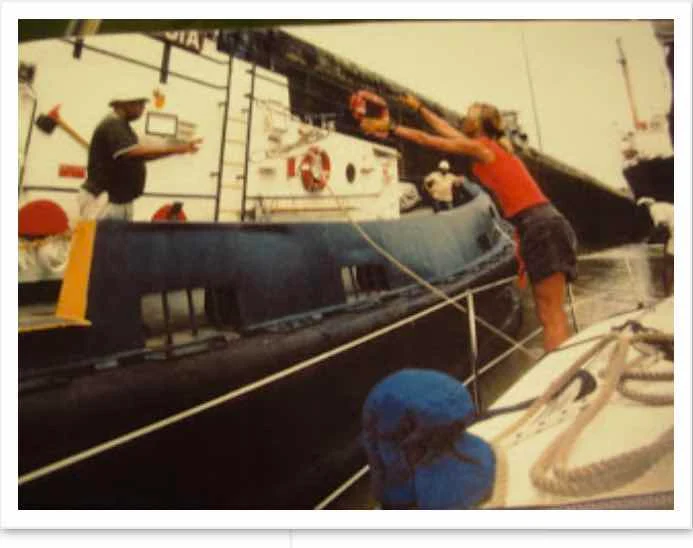
The hardest part we found of transiting the canal was losing control of our lives. Suddenly for the modest price of five hundred bucks we had to meet deadlines and agree to controls and give up all autonomy after months of living almost completely free from oversight and schedules. We had no say in how we went through each lock or what time we departed or arrived. Transiting the Panama Canal is a lesson in humility and a reminder of how lucky one is to travel independently.

Layne took the wheel for a while and I was happy to hand it over. She wanted to know she could drive the canal too and it is indeed a feat of patience and steering to cope as the fresh water bubbles into the chamber like a huge boiling vat creating currents and swirls. Everything is massive around here. She did fine of course.

Guia had places to go and people to see and had no concerns about us bouncing around on the huge waves created by the wake. I rather think they did it on purpose. There was a sense throughout the Canal that Panama's time had come and our little boat was one more symbol of Yankee oppression being replaced by Panamanian control. I didn't feel like an oppressor but symbols are not to be denied and we had a flag.

Somehow my buddy Tim in Santa Cruz figured out our crossing time on his computer at home and caught a screen shot of the small white blob between the tug and the ship leaving the Miraflores Locks. The internet was in its infancy back then but luckily Tim was a nerd and look what he caught at lunch time:

After we made it to Miraflores Lake we had a reservation at the Pedro Miguel Yacht Club, long a boating haven for Canal employees during the era of the Canal Zone. When we were there it was still an American non profit operating on the territory of the Panama Canal Commission. They fought a valiant battle but the Panamanian controllers were not fond of small boats on their lake and the club was shut down and demolished. We were very grateful for it's presence on the Canal.

The dogs were not unhappy either to have easy access to land. You weren't advised to swim in the lake as there were alligators patrolling and indeed some of them would come up and bask on the lawns at water's edge. They were Debs' toys. I simply could not cure him of the habit of ambushing the dinosaurs and frightening them back into the water. He freaked us out but never came to any harm. Nor did the alligators as he hated the water and never swam which probably saved his tenacious little life.

Pedro Miguel was the cluster of little buildings in the bottom left corner right next to the Gatun locks which opened up to the center portion of the Canal. The railroad to the right was already out of service. I have heard that there are trains running between Panama City and Colon these days but that may just be an Internet rumor. It would be a fascinating ride.

And sitting on the boat we had a sailor's eye view of all the traffic, including the Coastguard sail training ship making a transit. My buddy Bob got all excited monitoring the progress of the USS Missouri which was getting towed through the canal one day, while tankers freighters and cruise ships were a constant silent procession. Looking back the Pedro Miguel club docks were an extraordinary privilege. I lived there for six weeks while Layne made a trip back to California to sort out paperwork and medical visits and stuff.

The bus to town was a short walk away on the main road which went 50 miles coast to coast, but for a mere 25 cents we rode for half an hour to Panama City. The dogs were happy and safe on the grounds of the club while we were away. I walked them morning and evening and obviously cleaned up after them. They weren't allowed inside the club house but they lounged in the shade and slept under the overhangs when it rained.

Old Panama City was full of tourist cops patrolling the streets and making sure no one bothered us. Another extraordinary privilege of life in Panama. My sister Lucy joined us and we went shopping in this very cosmopolitan city.

We also rented a car and took the dogs exploring all over Panama. We checked the Caribbean Coast a mere fifty miles away and we took a day trip to drive to the Darien Gap where the dogs learned to enjoy even more jungle!
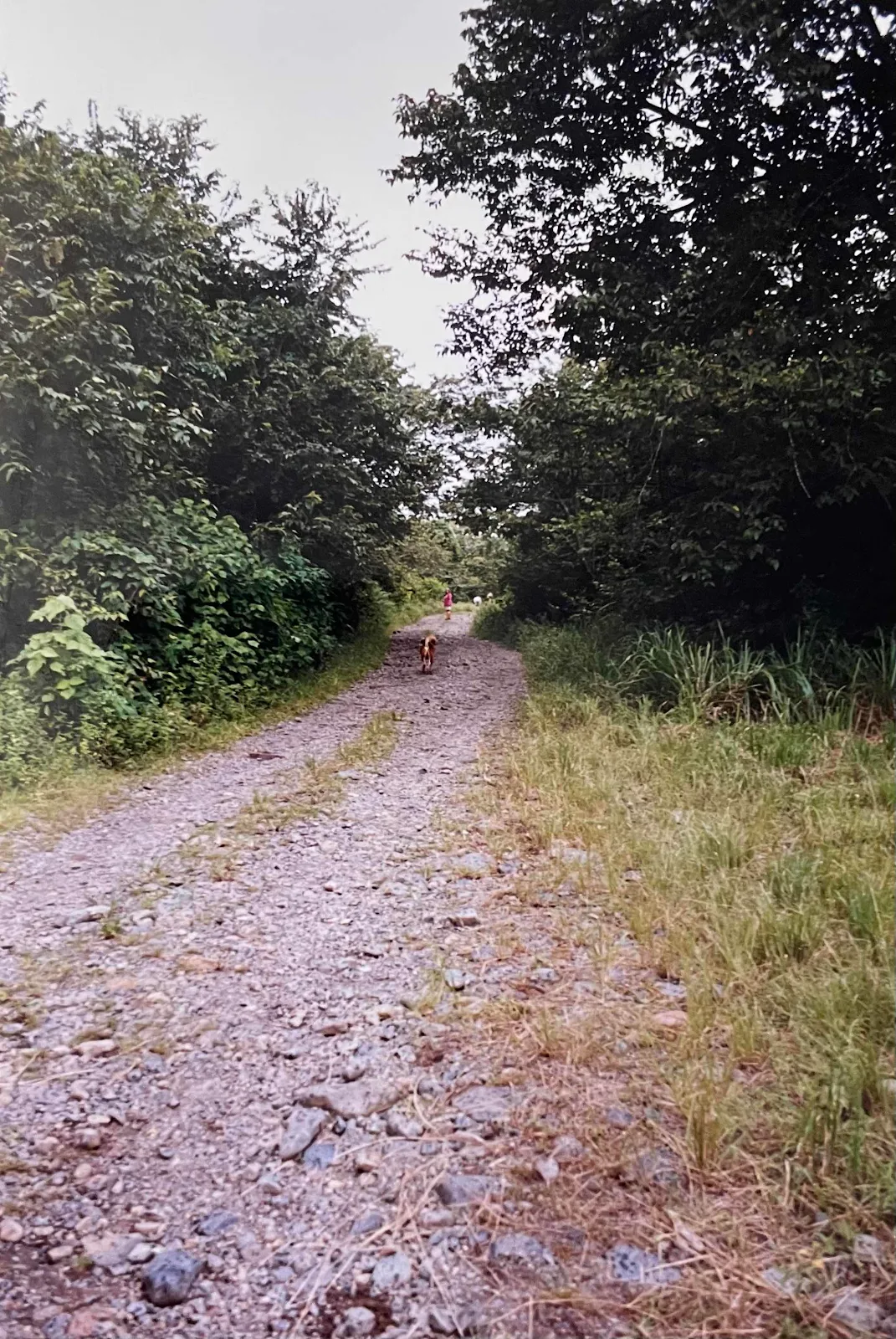
The mist shrouded hills were a feature of summer life in Panama, moisture was everywhere and rain was a constant companion. The road in the Darien Gap with our rented Nissan Sentra was not totally comfortable. We did not get  to the end of the road which reputedly dead ends in a small village in the middle of nowhere.

Darien separates Panama from Colombia in South America. When the US decided a canal would be a good idea to connect both coasts of the US they stirred up trouble and encouraged the province of Panama to break away from Colombia. The Darien Gap, a swampy forested mountainous jungle had never been opened up and it made the ideal border while the US built up Panama and then split the country by forcing it to agree to the creation of the Canal Zone declared an integral part of the United States.

The Gap could certainly be breached by rail and road connections nowadays but no one  wants to spend the money to do it, not least on the grounds that the Gap prevents the transmission of foot and mouth disease, deadly to cattle and endemic to South America. Aside from any and all ecological considerations that fear overrides all other plans to build a road. Consequently the Gap is  a lawless smuggling area known for its nefarious characters and tight military presence. A determined hitch hiker can get around the Gap  taking rides on boats between coastal villages but drivers of vehicles have to use freighter services to Colombia or Ecuador to get to South America. I trust that hurdle is in our not too distant future.

The former Canal Zone has massively impacted Panama and I would be curious to see how much that impact has lessened since we were there. However even in 1999 when the Zone itself had been taken down for twenty years the architecture and customs of the American presence were to be felt everywhere. Street signs, sidewalks and curbs, and architecture reflected the American presence for most of the 20th century. In front of the Panama Canal Commission building, still flying the Stars and Stripes for a few more weeks, there was a countdown clock marking the days and hours and minutes to the moment of handover on December 31st at noon in that year 1999. 

Cement sidewalks, neat lines of trees and hurricane fencing such as you would see anywhere in the US, certainly in tropical Miami. For us this sudden reversion to US currency, and US familiarity was pleasantly jarring after so  much time spent in unfamiliar cultural landscapes. Nowadays China has taken over the ports at each end of the canal and I regret that. The Canal never made money for the US, whose taxpayers ended up subsidizing the operation. Still I don't feel brilliant that China has effectively taken control of freight operations at the Canal in the 21st century. Panama is a leading light in China's belt and road plan to harness world trade while we argue amongst ourselves about Covid vaccinations.

Given as I am to nostalgia I wondered what the last graduation at Balboa High School had looked like that June. I was less impressed when we motored in our boat past the animal quarantine pens alongside the Canal. Under US administration incoming animals had to abide most properly by the Republic of Panama's four month quarantine rule, all supposedly in aid of keeping foot and mouth away. The Americans were bound by treaty to deal with quarantine and I'm glad we weren't there in those days with dogs. Modern YouTube travelers complain mightily about the $136 fee charged to import each pet into Panama  but I find that much easier than the fake quarantine rigmarole we faced. After we entered in David the dogs traveled with us as normal but it was a worry before we arrived. I'd happily settle for a fee thanks.

The last iteration of miles per hour in the former zone.

Back at the yacht club they had a fancy electric monitoring perimeter system so while we were gadding about organizing paperwork and a flight to California for Layne, the dogs were getting used to their surroundings. Emma the Labrador enjoyed baths behind the alligator proof fence

And the lake front lawn was a rather nice treat for dogs used to fiberglass decks. Pedro Miguel was a lovely spot, the nicest inland dock I had ever had and I am not fond of inland sailing.

The club had a primitive computer connected -gasp! - to the Internet. I don't miss those days of low connectivity, for all the hassles of modern Internet trolling and the like, traveling with the help of the Web is still a revolutionary treat for me.

Freya was Bob and Barb's Tayana 42 sailboat from San Jose California. We had met them at various anchorages ever since we had Thanksgiving together in Mexico's Sea of Cortez. Bob would join us for the final leg out of the Canal when Layne got back from California.

Pot luck at the Pedro Miguel. The dogs napped on the verandah while we all shot the breeze inside. It's hard to explain but having the opportunity to mingle in a  familiar culture was refreshing for all of us. It wasn't that we hated central America, far from it, but after a while it's nice to be among people who know and understand the nuances of daily living as we were used to "back home." There were Europeans here too of course and yet in all the mix we had the sailing in common, the sense of achievement in common and the pleasure of  conversation without translation. It was a refreshing interlude.

And then it was time to go. I spent six weeks in the Canal and i was ready to get going. How the dogs and I survived without air conditioning in the summer heat and rain is a testament to what you can do even when you think you can't...I'm glad the van has modern electronics and a roof air conditioner as we plan to see some steamy Brazilian jungles aboard Gannet2. Below we see Barb, Chris the Club Commodore and Bob our line handler and Manuel the Club handyman and caster-offer of dock lines. Coffee and a last chat waiting for our transit adviser.

And then we slipped out and away hoping for the best for the club and knowing the worst was going to prevent us seeing it again. They fought in the courts but with the Americans completely gone Panama wanted the canal to itself and offered them land elsewhere. I think some club survivors moved to the Caribbean coast and opened a marina there.

Manuel waved good bye and we lined up for another lock experience at Pedro Miguel Lock where we had seen so many ships coming and going it was our turn.

I had been through before, helping our friends so the experience of traveling the entire canal wasn't totally new. After the last up lock we had a long drive of several hours through the canal itself to Gatun Lake, where if we were lucky we could lock down that day. Or we would anchor for the night if we missed our spot. Layne made lunch for everyone as stipulated in the transit contract. The rest of us wer eon deck watching the fields and woods float by and the tall muddy ramparts of the Gaillard Cut until we reached the open waters of Gatun Lake, the main reservoir of water to operate the locks.

It was illegal to sail on the canal but the breeze on the lake was fresh and we all wanted to pretend we were at sea again so we tacked around waiting for our spot to open in the ranks of ships anchored in the lake waiting like us.

Ghost was going down with us or after us and was drifting around like us. They had sails down unlike us. Bob was a keen sailor and he was going to have fun. Later he enjoyed getting beaten up in the Western Caribbean pounding to the Dutch Antilles, his wife Barb less so. We took the easy route and sailed downwind to Belize. We met in Key West and after that in the Bahamas for more sailing. But that was later, before we settled down to jobs.
Finally we got the all clear and slipped past the moored freighter and parked in front of it in the chamber for the three giant steps down through the final Gatun Locks.  After that we would anchor on the Flats next to the city of Cristobal (the former Canal Zone town next to the Republic of Panama city of Colon) and look out at the turquoise waters of the Caribbean.  

That is quite enough words and pictures for the longest essay ever on this page and there will be more later after I sort out a few more pictures of the other end of the canal. The photoalbum has to be packed soon and we have to drive it to the storage locker in Miami...

Wednesday, September 8, 2021

Higgs Night

I got to work early Sunday morning, so early I took the time to visit my favorite beach area. I like Higgs beach not because I like to sit in the sand toasting myself but because this small patch of sand encompasses variety.

I love the toilet building at Higgs, a circular cement shed designed to please Salvador  Dali's taste for eccentric architecture with interior nooks and crannies for the various toilet stalls. It is the hardest interior to photograph because who wants to meet a creep with a camera tiptoeing inside a public loo? I don't and I'm pretty sure anyone seeing me oohing and aaahing at the compound curves wouldn't want to encounter me. And at this hour of the night its locked.

I have attempted this socially awkward feat over the years to bring you the most up-to-date perspective on public toilets in Key West but my efforts have failed to inspire even me:
You can't really see how odd the interior of this building really is.
If you are in the area you should walk through this maze disguised as a toilet and enjoy the eccentric architecture inadequately displayed here.
Back to the Sunday morning exterior and I spent twenty minutes wandering  around looking at light and shadows.

The bums used to camp out at the tables under the ramadas until people with power got fed up with receiving complaints. They took the initiative and put up a fence saying only parents with children could hang out here. That solved the bum problem but a tree limb nearly fell on a little dear so they cut down the trees and replaced with with shade sails. Which is still better than enjoying afternoon performances daily of bum drama at the tables.

It's rainy season so I spent some time avoiding puddles. I spent more time framing a photograph of same:

The Key West tractor. For one as me who grew up in farming country for part of his childhood the absence of farm equipment took a while to get used to but I was relieved to see the beach cleaning was carried out by a farm implement. Rather than harrowing the soil the trailer towed by the tractor brushes the sand and sweeps up debris and leave neat parallel lines in the sand for human feet ot mess up.

Seagrape leaf study 100 thousand and seventy eight. These dinner plates on branches fascinate me.

I want you to know I crouched in a  swamp of rich rotting food smells to get this glimpse of a mural. The gate must hide the trash cans because I was very glad to get the frame and get away.

I am looking forward to Mexico this winter - deus vult - but for now I found Mexico not just in my fevered imagination but also in the back of Salute restaurant at Higgs Beach.

Clarence Samuel Higgs died in 1961 at the age of 57 unexpectedly at home on Grinnell Street. He had had heart issues apparently but his death wasn't expected.  They named this beach for him because as county commissioner he was responsible for the push to build the modern White Street Pier. He was also head of the carpenters union and belonged to every civic group he could find in Key West. Doubtless the sort of model citizen and mover and shaker who could be useful today in this city. Remembering him through the beach is helpful to remind us the good our leaders can accomplish.

Tuesday, September 7, 2021

David, Panama 1999

Panama's third largest city lies in the north of the country deep inland but still available to passing sailors via the Rio Pedregal. It is a boom town and even 20 years ago was an economic powerhouse for Panama. Weirdly enough it's named for the Biblical King David and was founded in 1602 by those delightful administrators, the Spanish. The two founders of the city were converted Jews and the speculation now is that Panama City refused to give official recognition to the new administrative center for that reason! I don't think anyone in the city cares and they never mentioned it when we were there getting our teeth cleaned and going to watch Star Wars with Spanish subtitles at the movies.
I also came across some rather spiffing fruit called pifa which are like chestnuts, dry and not sweet, supposedly known as peach palm fruit in English but we didn't know that before the internet.  I would buy a bunch for twenty five cents and eat them walking everywhere peeling off the skin and discarding the pits like a Panamanian. I want to go back to Panama to eat pixbae as they are known.
I hear modern travelers to Panama complain bitterly about paying $230  to get their dogs through customs into the country. In the dark ages when we arrived at David and met the customs officer there was a four month quarantine to land animals in the country. Panama is trying to keep foot and mouth disease in South America and so it is a road through the Dairen Gap to Colombia has never been built even though the quarantine seems to have been forgotten.
However the Customs official told us our dogs had been seen as we had incautiously walked them into town but he was not in his office before 9 and he went home promptly at five. We took the hint. The dogs lounged on the boat during those hours in full view of the Pedregal Marina onlookers...but morning and evening the marina compound was theirs.
I am not a river rat as I find fast flowing bodies of water to be more awkward than the open ocean. Rivers are unpredictable and filled with debris and currents push branches and logs into your boat. Then there are the cows:
We drove the boat up the river everyday and landed at a jungle trail well out of sight of any onlookers. There the dogs ran and explored and had a real walk until they were exhausted. Then we drove back to the anchorage. In the midst of it all we got a taxi ride back to the marina after spending a  morning in town doing chores and the driver Edgar invited us to go inland with him and his wife for a road trip. 
We left the dogs on the boat which isn't as awful as it sounds as the door was open and they could stroll in and out of the patio-like cockpit on the catamaran at will. To keep them comfortable we risked some rain getting into the boat and they did fine while we were away for much of the day. I got to see my first rodeo:
We drove high onto the mountains into a  cool region of Alpine fields and buildings with strangely peaked roofs as though heavy snow were a possibility. We bought root vegetables, the kinds that grow in temperate climates under the direction of Demaris, Edgar's wife and his mother Doris.
Doris and Demaris joined me in some foolishness as Doris expressed a wonderment about the US. I remember in particular Doris thought of America as a clean place and that view colored the rest of our journey through Latin America.
Americans who think about these countries tend to like Costa Rica, the country with no Army. I like Panama a country with numerous national parks, vibrant Indian cultures totally absent from Costa Rica, the whole Canal system which has infused the country with money and an international outlook that is quite surprising. Panama was a vital link in the transfer of wealth from South America to Spain and that inhumane trade in people and coin has left a trail of astonishing physical ruins. There is a sense of history, for good or ill, in Panama that Costa Rica completely lacks. 
I never got to stand in a freezing cold stream in Costa Rica though I have to say I never expected to find one therefore I never looked. These experiences in and around Boquete in Panama gave me a sensation of confusion at Eight degrees north of the Equator the closest I had ever been to the middle of the globe. 
It was an interesting enjoyable day and I expect that if we do drive to Panama in the van a tour of Boquete will be on the cards and we will ooh and ahh with the memories. This time Rusty will be with us to enjoy the cold, not left at sea level. 
But of course when we got back to the boat the dogs needed walking so we moved the boat up the river to our landing and this time we showed the cab driver and his family how it's done on the water.  Happily after this stop to check into Panama the dog quarantine was never mentioned again and our dogs were free. We just had to negotiate the canal and that was no easy thing.

Monday, September 6, 2021

Move To Key West

Over the years people have turned to me to ask my opinion on moving to key West and I am leery about offering advice, mostly because it is ignored and sometimes misinterpreted but at this late stage I suppose I can offer my thoughts especially by way of thanks to people who think I know more than I do.
The first question I have is why would you want to move to the Keys?  Layne and I washed up here looking for a place to earn some money to continue sailing and I had friends here from previous visits and thus it all fell into place. If you want to move to the Keys you have to know why. It's  a long way from nowhere and and as much as people promise to visit you shouldn't count on it. The Cuban embargo effectively makes Key West a dead end and you will have to learn to live separated from your former life. This isn't a  frontier town in the traditional sense with a nearby  open door to new cultures. It's a cul-de-sac for most residents.
The fundamentals of living in the Keys are the same as anywhere else. Except consider this: you have to drive north of Atlanta some 800 miles from Key West to see a mountain. I love the varied landscapes of the Florida peninsula but the terrain is seen as monotonous by most people. The other point to consider is Miami is a shithole. I used to hear other people characterize it thus and felt rather put out. My wife and I speak Spanish and we enjoy different cultures but Miami is a cross roads of incivility, indifference and cruelty. Of course there are people and pockets that buck the trend but it takes years to find the places you can enjoy and its a tough journey to find what you like in that city. Miami does not add  nearly as much as you'd like to think it would to the experience of living in the Keys and it's a shame. That's my very personal subjective view of a city I wanted to love and that has spurned me. Like everything else I write you may have a very different experience and I hope you do.

You need to make a plan and part of that plan is understanding the limitations. At work you have to dump your ambition and your expectation. The best career positions are taken and you need to understand you are optional in the cog of career  choices in the Keys. The best paid jobs are for permanent residents, people with connections and roots and you will be tolerated as long as you threaten no one. Innovation, over work and pushiness are fatal to your prospects. It may not be immediately apparent but you will be sidelined. If you live to work stay away. The best career move you can make in the Keys is to be reliable, show up and do things as you are taught how to do them. Become an old timer yourself...
Quit yer bitchin'. I promise you no one cares how you did it Up North. If you move to Old Town and think you have a divine right to park you can easily start a neighborhood war and remember you don't know who your new enemy knows. Connections are everything. Make friends not enemies. If you aren't used to living without offsets you'd better practice. Your neighbors live in your butt crack so enjoy. No one cares how many millions you paid for your shack. You suffer the same shortcomings everyone else does on your street not least because they paid more. Your reputation will be set in stone by the end of your first week and it will take years to overcome whatever negative characteristics have been attached to your character by silent, unseen observers.
Make friends and keep them close. Connections in the Keys are everything. We got our rental home thanks to a friend who lived two doors down and acted as our character witness and we got to check out the available home before it came on the market. My wife took it instantly and had the cash to pay first last and deposit in cash. Layne is a planner. Do not come to the Keys impoverished unless you are young and happy to sleep rough and couch surf and all those improvisations of our long lost childhood. If you want to live on a  boat know the best anchorage for liveaboard is in Marathon and key West harbor sucks. Look at a  chart: its exposed in all directions, the bottom is thin sand over rock and as i said above all the bets spots are already taken. When Layne and I arrived from San Francisco I had a friend with a mooring ready to help me settle in. Make a plan, execute the plan and show up on time. I'm not telling you things I don't do and haven't done myself. If you come and hope for the best you will need lots of money but if you have lots of money you know that already.
Island Time. Oh how I hate that phrase, applied to so many ideas of how to live and used as a blanket to cover up endless miles of sins and omissions.  For you Island Time means moving slowly mon, ignoring the clock and shrugging when your appointment shows up late, if at all. That sort of island time is deployed by the idle rich as a measure of how cool they are now they live in name brand sandals on a  tropical island. No worries mon, I can live without air conditioning/running water/ a functional car for a few more days. That's island time for the sidewalk philosophers who have to justify an inability to function. This is all bullshit. I have been late to work twice in 17 years if I remember correctly and I have commuted 25 miles on the ever clogged US 1. Island time in my book means live your own life on your terms and pull out of the way if you are clogging up someone else's life. Island time means don't be a snitch. Because I choose to live differently than you isn't cause for you to interfere. Offer a hand but don't get butt hurt if you are rejected.
Richard has lived on the streets of Key West  for 46  years. I asked him once if he gets bored and he looked startled - in Key West? he said incredulously. I made the faux pas of offering money in my ridiculously suburbanite way -money cures all ills- but he looked at me again as though I were stupid. I've found street people like to pet Rusty, the non judgmental, silent soft ball of furry warmth. It's the human touch not easily found on the streets. And it comes from a  dog. Remember the true value and meaning of Island Time. If you can stand an atheist quoting the Bible at you Island Time means Judge not lest ye be judged, for with what judgement ye judge ye shall be judged. Try and figure the difference between a criminal, a lunatic and a non conformist before you feel called upon to act.
In a way I feel like Covid has brought the rest of the country down to the level of service the Keys have been enjoying for years. The problem is you can't get a job that justifies spending the money required to buy a house. Professionals can manage but even so the work to pay ratio remains out of proportion and the only true compensation is joy in living here. For people not planning to be doctors accountants vets and managers the cost of living requires you work all the time so you don't get to enjoy the living in the Keys side of things. So you leave. Thus under staffing is a permanent issue. There is no shopping in the Keys compared to the mainland. If you don't like ordering stuff you are going to be living truly minimally. On busy weekends and during the winter my internet service routinely pixilates my Netflix on my television as the bandwidth is insufficient for the influx of people. See above: quit yer bitchin'. Layne and I developed a saying 20 years ago after cruising Central America on our boat. The Keys: First World Prices with Third World Service and none of the charm.
You know what the good bits are but be warned the difficulties are real and friends have a habit of leaving town and scattering so the people you'd like to grow old around may be in California, North Carolina, Maine, Ocala or Tennessee or any number of other interesting places. So you may find yourself negotiating the difficult times alone. Friendships are also hard to make in a town where people scatter all the time. No one wants to invest in you if you have one foot out the door. I feel it myself now that I am on the down escalator, life carries on and you are history. Know that you will be lonely for a long while and you will need to prove yourself. Don't be pushy but think of Keys residents as wild deer, let them approach and get to know you slowly. Make yourself available but don't beg. Its a tight rope, I'm telling you.
Come on down, the water's lovely, but tamp down your expectations, be cool and don't put a Conch Republic sticker on your car to show off your new status. And please, do me a favor and start taking pictures and walking a round Key West to remind me of what I left behind. Try to make me regret my choice. Thank you.

Sunday, September 5, 2021

Loading Gannet 2

I think in at least one respect I am like most men inasmuch as I like to be, if not clean at least tidy. My wife respects my neurosis but I have to say that tidying up a house we are trying to empty is an art that has got away from us. It's a sort of moving target, today the kitchen is neat and the spare room, well, not so much. Tomorrow we tidy the bedroom and then we have to empty a drawer somewhere so we pour it onto the bed and then slowly sift through the contents, some for discard and some few to save for storage. and on it goes.
The van is such a small space cleanliness and tidiness go hand in hand but fortunately the 70 square feet are easy to clean and sort in no time at all.  Layne designed the bed/couches to sit above a hidden storage area we call the basement, which is where we keep all the stuff we won't use daily. On the left in the pull out drawer we have our table and sand mat to sit outdoors, our Moonshade awning for cover and the air compressor to inflate the tires. In the middle cupboard we have our recovery gear, the treads, straps, shackles and rope and shovel. As well as the mythical Deadman to wrap around boulders or trees or bury in sand as an anchor for the winch:
All on the off chance we get stuck.  I don't want to go four wheeling but I want to have the ability to stretch my exploration a little with the ability to take care of myself in mud holes or sand pits. So last week we did our first test run loading the van. It went okay.
My wife has decided the right hand locker, the shortest basement door is for the exercise gear, weights, rubber bands, a mat and so forth. Her domain even though we both exercise on the road as we do at home. Old age is unremitting and I certainly don't want my legs to seize up for want of movement after all that time I spent learning to walk in the hospital. The round silver thing is the water tank cap where we can fill the water tank by hand if there is no hose available. We even bought water filters to purify water as we fill the tank. A stream will do as our source if necessary. I would rather just plug a hose into the other pressure filler and let the water pressure do the work but I like having simple back up systems. We could live in the woods for a long time if we wanted to, as long as Kindle keeps functioning...
The middle cupboard of the basement with all the recovery gear and stuff is actually pretty huge. Inside the living space of the van the basement forms a step up from the kitchen floor. In this way we were able to scrap plans to carry a bulky and awkward box on the back of the van on a hitch and put equipment we may need from time to time out of sight. 
On the roof we have our four 100-watt solar panels which put out up to 20 amps combined between all of them every hour in the  brightest and most overhead sunshine. If we don't run the air conditioning and we have a reasonable day of mild sunlight the roof will keep our massive battery bank well charged. We run our inverter all the time and keep the electric fridge on and all our wall units and cooking accessories available.
All our outlets work when we want them just as one does at home. The idea of having to ration electricity seems very uncomfortable and annoying to me in this era of modern technology. The little black box is a fan and the big black box is the air conditioner which we run off our batteries with a cell phone booster mounted on top. I'm not sure the booster does much but everybody swears by them...
Under the bed in a distant compartment we will store our new winter clothing, a puffy jacket thermal underwear and waterproof boots. We are resigned to facing cold damp weather even in summer and a large part of dealing with that is having at least a few bits of clothing that will help. 
Getting the clothing right will be a long difficult curve after so many years of treating a  fleece as heavy duty winter clothing.
Boxes bins and an increasing number of empty spaces on the walls define my life at home. I had forgotten what a long drawn out drag is the process of packing up a house. 
Rusty sleeps through chaos. An example to us all.