Thursday, January 19, 2023

Southern Arizona

When no one was calling 911 at three in the morning in Key West and my eyelids were drooping I would open Google maps and wander the planet. What, I would ask myself, goes on here?

Not much, it turns out, which may be good or bad depending on your personality and your mood at the moment. It may happen that one day I shall return to Organ Pipe Cactus National Monument but at the moment that looks like long odds. 

After three nights on public land dispersed camping near Ajo I wanted to see what was what in a monument dedicated in 1937 to organ pipe cactus and it’s preservation. 

Organ Pipe looks rather similar to Saguaro, the cactus of popular imagination but instead of a distinctive central stem with arms branching off it has a whole bunch of stems growing out of a central spot. At least that is the non-botanist explanation. 

It therefore seems reasonable to argue that Organ Pipe Cactus National Monument taught me this one thing. However it’s a thirty mile drive through what is essentially one more stretch of Sonoran Desert. 

Here it is, free access with no fee charged to drive through. 

This would be a saguaro (sag-hew-aro) cactus I think: 

There are a couple of rest areas with trash cans (bring your own toilet to the Monument) and there is a visitor center. The campground is the “fee area” with full facilities and gets high marks from visitors. You can pay to see the night sky and hike the trails. Or you can disperse camp for free on BLM land south of Ajo. 

The fly in the ointment is Lukeville at the southern end of the highway. This is the end of the road if you aren’t going to Mexico. There is a gas station advertising only regular gas ($4:00) when we paused there and there is a diner and that’s it. Your only option is to turn around and drive back which is what we did as we weren’t ready yet to cross to Sayulita an unmemorable town we drove through last summer. The motel looked very dead. 

65 miles south of here is the city of Puerto Peñasco known to Arizonans as Rocky Point, a beach resort of 65,000 residents that has made its fortune catering to land locked Arizonans. You only need a tourist card at the border and your vehicle needs no permits to enter Mexico here so this road sees tons of beach goers bound for the high rises and chain bars of Rocky Point. 

The border is open 6am to 8pm so you need to time your drive to avoid disappointment. We saw lots of cars heading north on Martin Luther King day, the end of a long weekend. 

We drove back to the dot called Why, a gas station, a casino and some trailers and turned toward Tucson, 90 minutes away through the Tohono O’Odham Indian reservation. 

Apparently Why started out as Y naked for the y-junction of the two highways, one to Tucson and the other to Ajo but the state highway department required town names to have three letters…with 65 inhabitants Why is more of a wide spot in the road than a village of note for anything other than its name. The iconoclasts and misanthropes and loners who need wide spaces and emptiness are lucky to have these places to retreat to. 
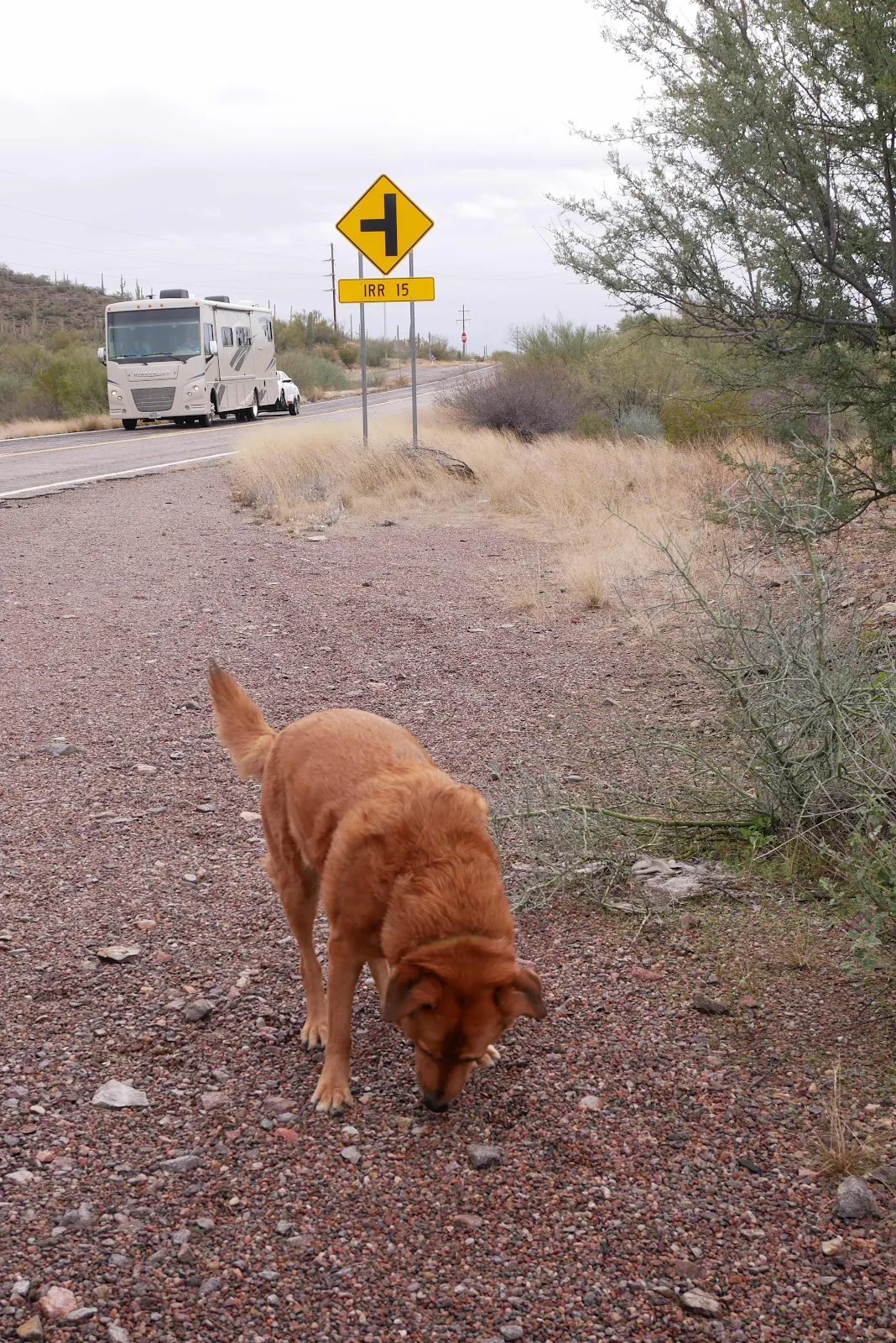
We stopped to make tea and coffee and walk Rusty somewhere in the reservation, near Indian Reservation Road 15. 

I got a hankering for the Miccosukee and Seminole reservations of south Florida as we drove through the damp overcast desert. I missed the greenery and the wildlife and the feeling of home I get in South Florida. 

The casinos of South Florida have brought the Indians wealth and space in a crowded peninsula. Here there is no built in tourist market or population seeking escape in the sage way for these Indians. 

The scenery was spectacular and luckily Kitt Peak was closed as I wasn’t much in the mood to stop. 

It was dark and gray and chilly and the numerous Border Patrol checkpoints were all closed. 

Tucson with its dreadful potholes torn up streets and aggressive traffic beckoned to us. The bright lights and esoteric joys of Trader Joe’s and Costco and preparations for a Mexico were next on the list. 

That’s another small corner of this vast country checked off the list. Glad I took the time to see it. It’s always better to go there than to just see a street view. 

Tuesday, January 17, 2023

Ajo, Arizona.

I awoke to rain pattering on the roof. It was dark outside and I lay in bed knowing I had to get up and get going as we had a long day ahead of us. But the sound of the raindrops on the tin roof of GANNET2 lulled me into a meditative state. The sheets were soft (they should be; they were damnably expensive, I’ve never paid so much for Egyptian cotton) and the comforter was snug. Rusty was snoring at my feet while Layne was doing her number at my side. I lay really, really still hoping to slow the clock and allow me time for a lie-in. 

Alley Road out of the Bureau of Land Management wilderness was full of puddles and looked slick in the headlights but the Promaster van comes with a slick electronic differential lock which helps limit slipping in the dirt and we drove out easily on the steep but graded dirt road now turned to mud.  

Ajo was fast asleep as daylight broke over this unincorporated town in  Pima County. Tucson is the county seat making Pima the second most populous in the state after Maricopa which is the location of Phoenix the state capital. Ajo has a population of 3300 people roughly, down from its highest ever of 7,000 in 1960. 

I took an umbrella we keep in the “attic” - a shelf above the driver’s seat and my Panasonic G95 camera which is rain and dust proof they say and let an anxious Rusty loose on an unsuspecting town. 

My formerly stray dog doesn’t mind getting wet these days when he knows he has a dry bed to come home to.  When I first got him in February 2016 he dreaded the rain as  I suspect he had suffered a lot of cold wet days in the bushes on the edges of Homestead. Rainy season in south Florida is very unforgiving to those stuck outdoors. I steered him to the covered portions of Ajo’s plaza. 

Ajo was founded in 1847 and was named “Garlic” in Spanish only because that word was the closest approximation to the Indian word “o’oho” which means paint. The Indians apparently found red pigment in the area and thus the name of the new township they say. Sounds odd but plausible as early settlers weren’t always attuned to subtlety. 

There are ore deposits all around here which attracted early settlers, Indians, Spaniards and finally Americans. It’s interesting to me how much cross border mining has gone on along the length of the frontier. I saw the same pursuit of ore in Boquillas Del Carmen across from Big Bend in Texas and also in Alamos and Kino in Sonora. Mining was what drew people to these desert areas. 

Nowadays Ajo is on the main road to a Mexican town known in Arizona as “Rocky Point” on the beach at the Sea of Cortez. Puerto Peñasco has made its high rise fortune as the beach town where Arizona goes to play. The border at Lukeville is 43 miles south of Ajo and Puerto Penñasco is 65 miles further. There’s a beach a hundred miles from here if you don’t mind driving in Mexico. 

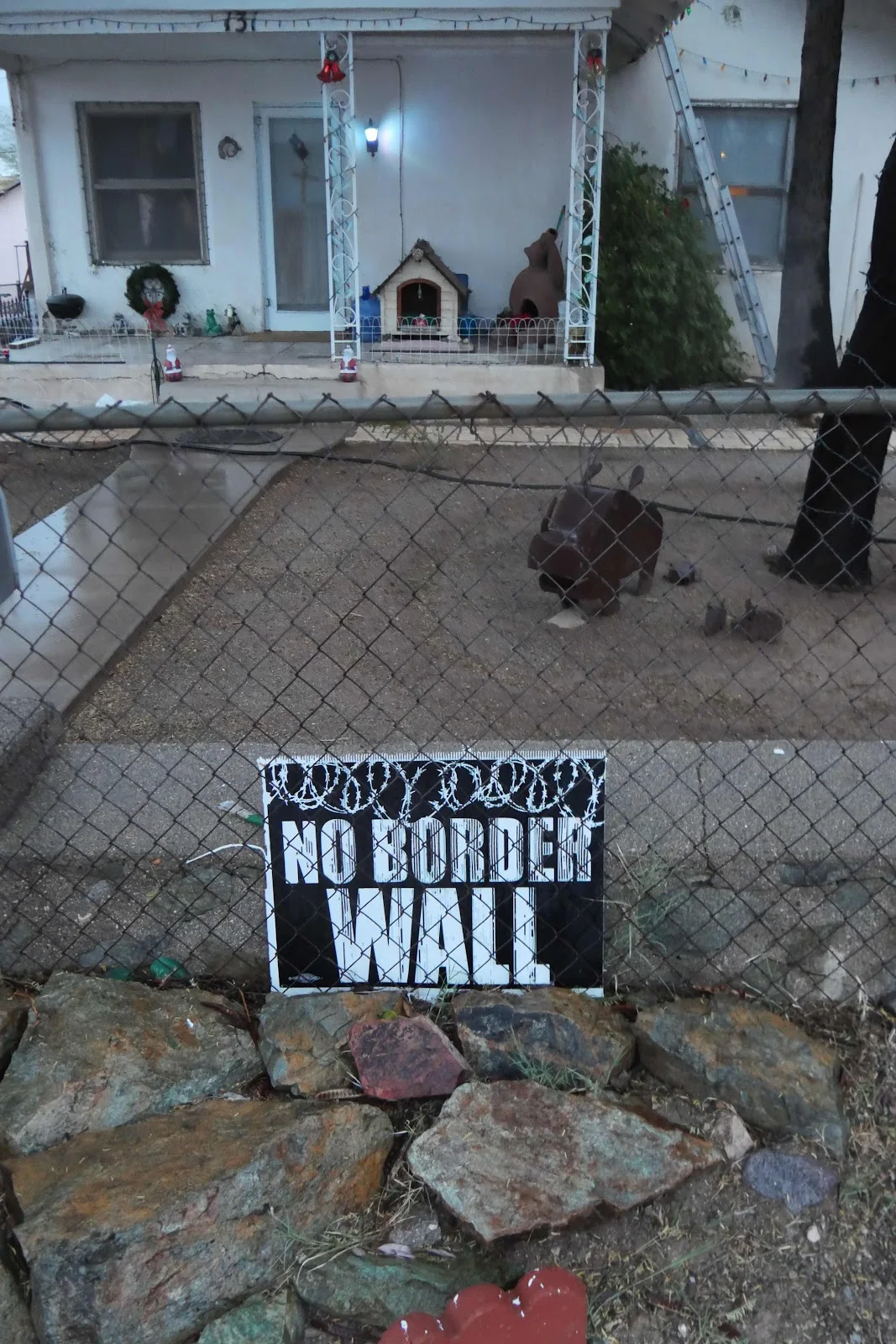
You can see the border tension in the artwork in Ajo which provides homes to law enforcement patrolling the border and advocates of help to people foolish enough to try to cross this appalling desert after entering the country illegally. On a cold rainy winter day you’d worry about hypothermia but in summer you’ll shrivel up like parchment around here. 


A century ago Ajo was segregated and the three groups referred to in town were the Tohono O’Odham Indians and the Latinos who were clumped into “Mexican” and the whites who get this weird designation as Caucasian. You’ll see signs referring to the three tribes. 

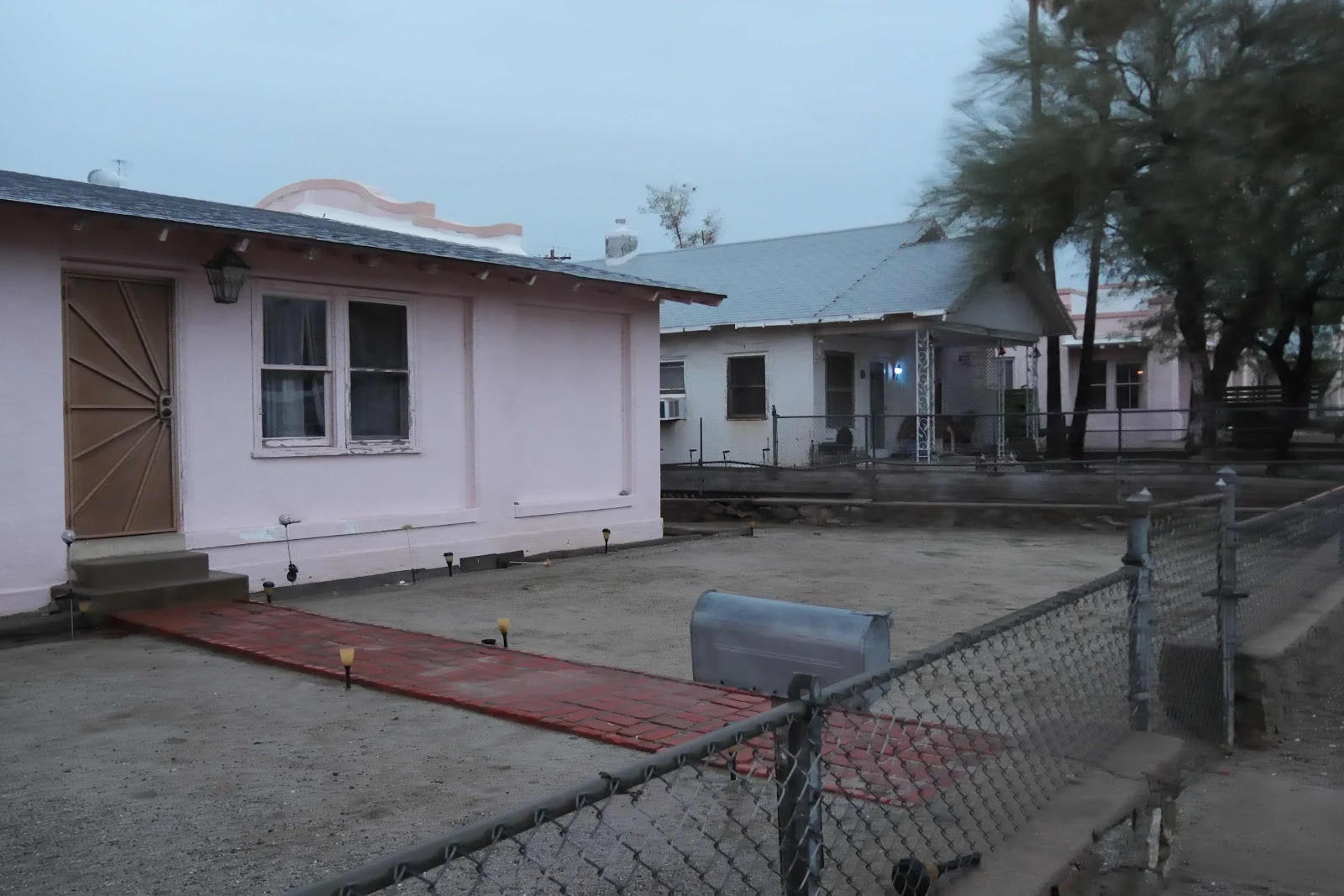
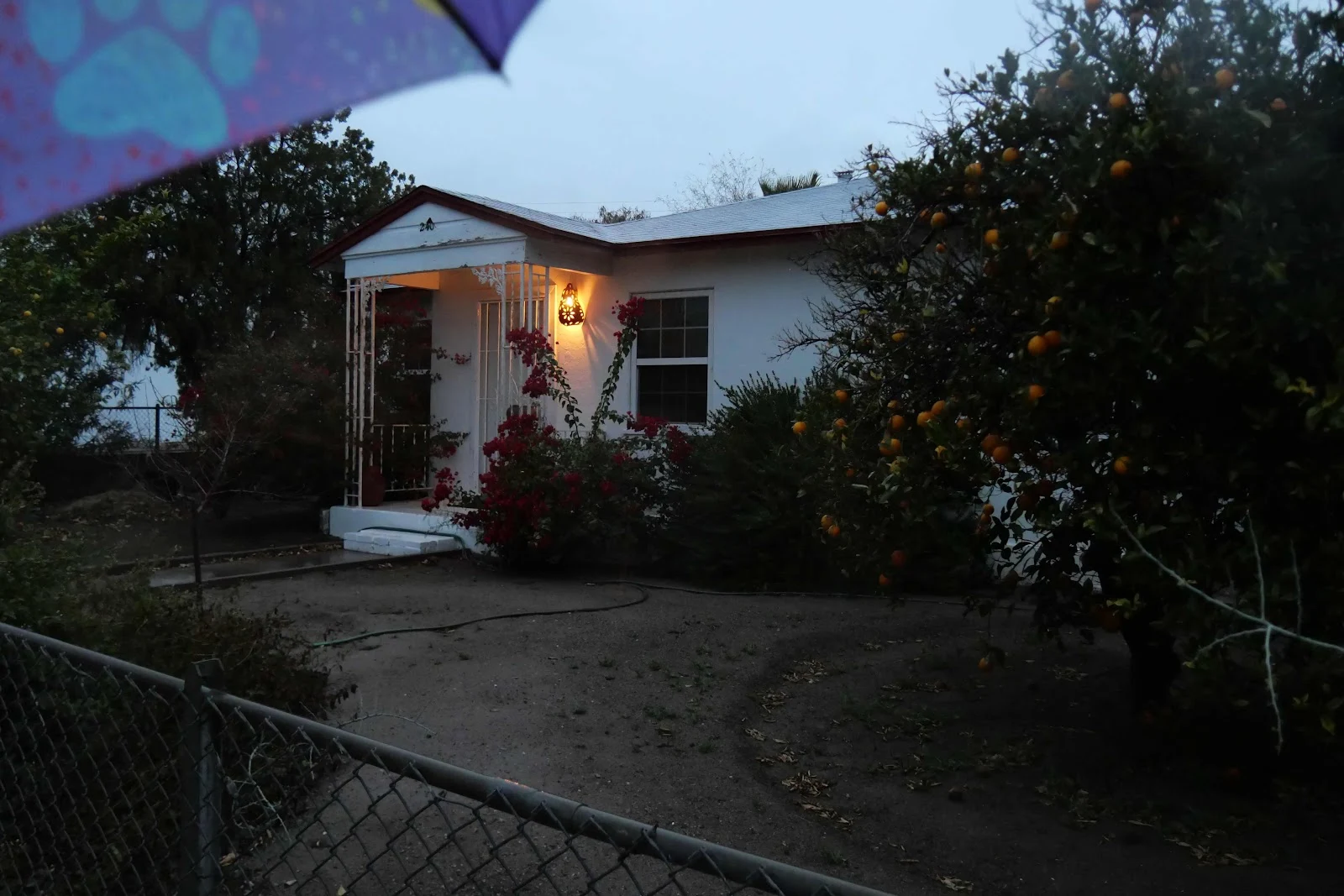
The town was empty at 6:30 on a rainy Sunday morning but I enjoyed following Rusty lead me through this historic town. Everywhere you can see signs of past glory when they mined ajoite and papagayoite, of which minerals I know nothing. 

Warmer winters draw people to southern Arizona but the border tensions in the struggle to control the flow of people seeking work must be stressful. 

Fort Jefferson was closed temporarily a few weeks ago when hundreds of Cubans landed overwhelming the facilities at the National Park. It isn’t shears easy being the place where so many people want to live. 

We walked for an hour in the drizzle and Rusty seemed to want more. I had my agenda of exploration and Layne wanted to stock up in Tucson before we go to Mexico on Wednesday so it was time to go. 

I don’t know if I’ll ever be back here but it was an interesting pre dawn walk in Ajo. Thought provoking. I hope you enjoy the pictures.