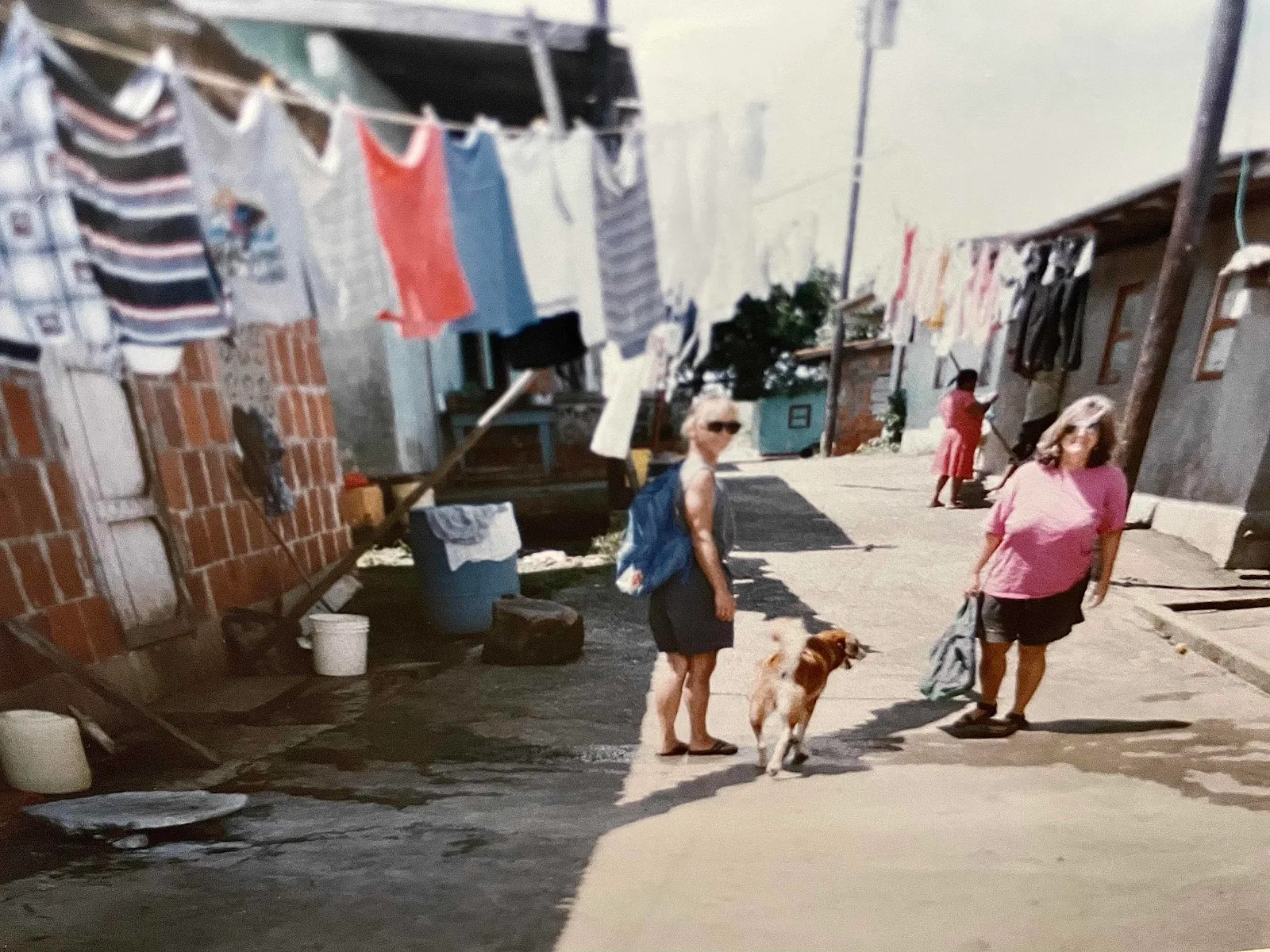
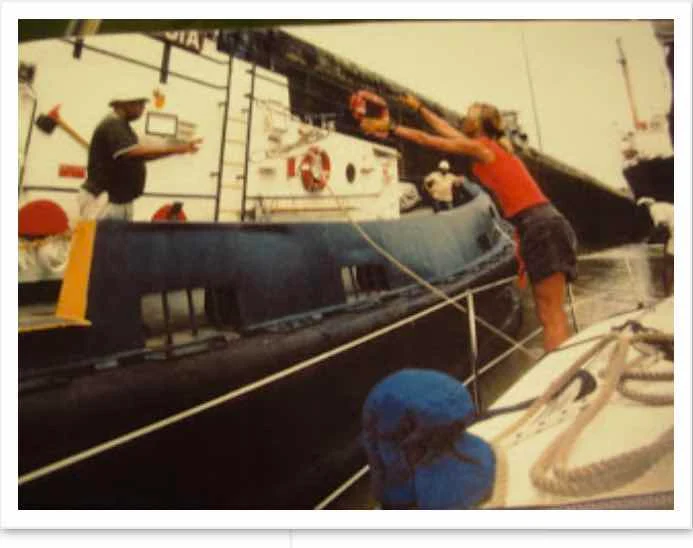
Layne took the wheel for a while and I was happy to hand it over. She wanted to know she could drive the canal too and it is indeed a feat of patience and steering to cope as the fresh water bubbles into the chamber like a huge boiling vat creating currents and swirls. Everything is massive around here. She did fine of course.

Guia had places to go and people to see and had no concerns about us bouncing around on the huge waves created by the wake. I rather think they did it on purpose. There was a sense throughout the Canal that Panama's time had come and our little boat was one more symbol of Yankee oppression being replaced by Panamanian control. I didn't feel like an oppressor but symbols are not to be denied and we had a flag.

Somehow my buddy Tim in Santa Cruz figured out our crossing time on his computer at home and caught a screen shot of the small white blob between the tug and the ship leaving the Miraflores Locks. The internet was in its infancy back then but luckily Tim was a nerd and look what he caught at lunch time:

After we made it to Miraflores Lake we had a reservation at the Pedro Miguel Yacht Club, long a boating haven for Canal employees during the era of the Canal Zone. When we were there it was still an American non profit operating on the territory of the Panama Canal Commission. They fought a valiant battle but the Panamanian controllers were not fond of small boats on their lake and the club was shut down and demolished. We were very grateful for it's presence on the Canal.

The dogs were not unhappy either to have easy access to land. You weren't advised to swim in the lake as there were alligators patrolling and indeed some of them would come up and bask on the lawns at water's edge. They were Debs' toys. I simply could not cure him of the habit of ambushing the dinosaurs and frightening them back into the water. He freaked us out but never came to any harm. Nor did the alligators as he hated the water and never swam which probably saved his tenacious little life.

Pedro Miguel was the cluster of little buildings in the bottom left corner right next to the Gatun locks which opened up to the center portion of the Canal. The railroad to the right was already out of service. I have heard that there are trains running between Panama City and Colon these days but that may just be an Internet rumor. It would be a fascinating ride.

And sitting on the boat we had a sailor's eye view of all the traffic, including the Coastguard sail training ship making a transit. My buddy Bob got all excited monitoring the progress of the USS Missouri which was getting towed through the canal one day, while tankers freighters and cruise ships were a constant silent procession. Looking back the Pedro Miguel club docks were an extraordinary privilege. I lived there for six weeks while Layne made a trip back to California to sort out paperwork and medical visits and stuff.

The bus to town was a short walk away on the main road which went 50 miles coast to coast, but for a mere 25 cents we rode for half an hour to Panama City. The dogs were happy and safe on the grounds of the club while we were away. I walked them morning and evening and obviously cleaned up after them. They weren't allowed inside the club house but they lounged in the shade and slept under the overhangs when it rained.

Old Panama City was full of tourist cops patrolling the streets and making sure no one bothered us. Another extraordinary privilege of life in Panama. My sister Lucy joined us and we went shopping in this very cosmopolitan city.

We also rented a car and took the dogs exploring all over Panama. We checked the Caribbean Coast a mere fifty miles away and we took a day trip to drive to the Darien Gap where the dogs learned to enjoy even more jungle!
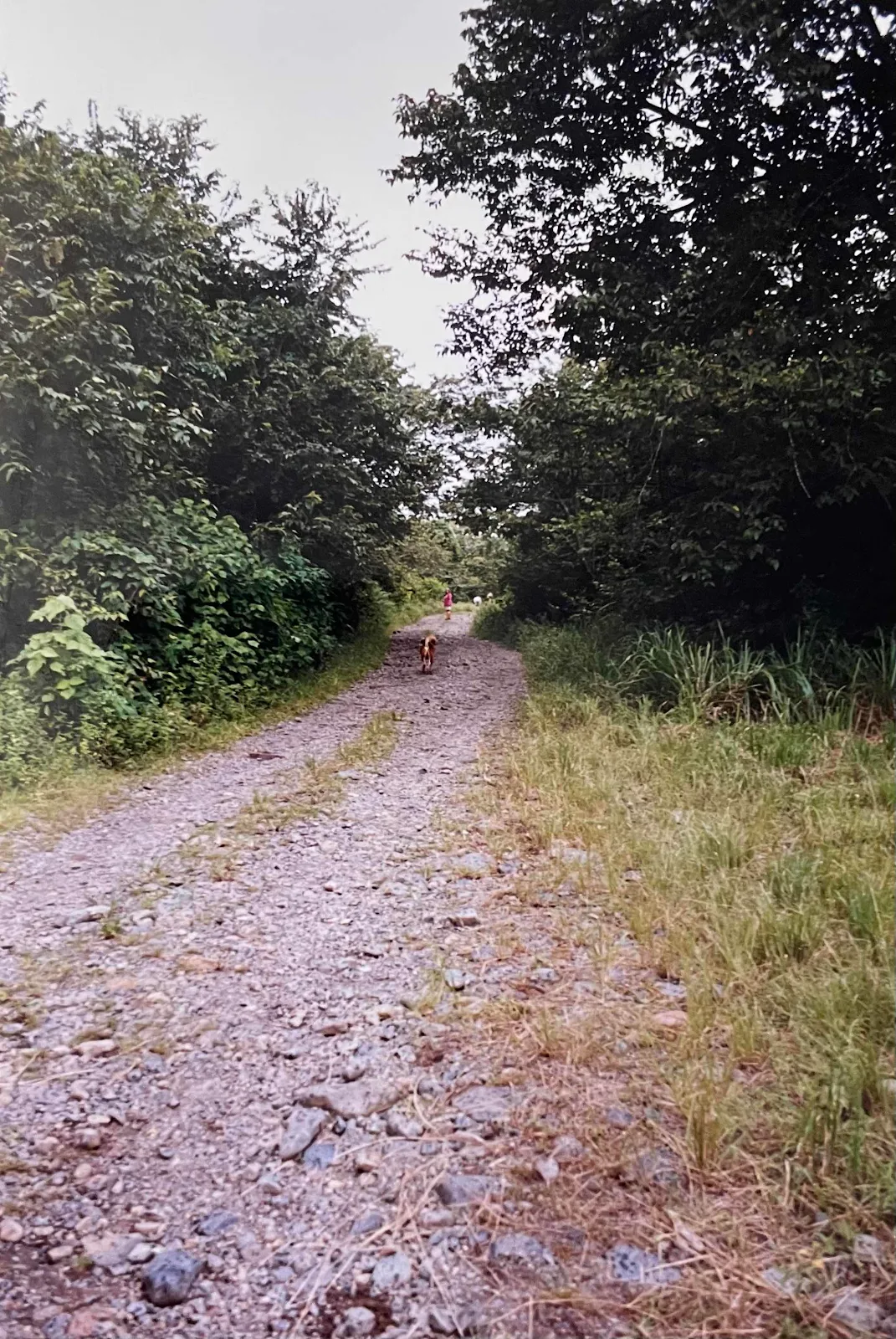
The mist shrouded hills were a feature of summer life in Panama, moisture was everywhere and rain was a constant companion. The road in the Darien Gap with our rented Nissan Sentra was not totally comfortable. We did not get to the end of the road which reputedly dead ends in a small village in the middle of nowhere.

Darien separates Panama from Colombia in South America. When the US decided a canal would be a good idea to connect both coasts of the US they stirred up trouble and encouraged the province of Panama to break away from Colombia. The Darien Gap, a swampy forested mountainous jungle had never been opened up and it made the ideal border while the US built up Panama and then split the country by forcing it to agree to the creation of the Canal Zone declared an integral part of the United States.

The Gap could certainly be breached by rail and road connections nowadays but no one wants to spend the money to do it, not least on the grounds that the Gap prevents the transmission of foot and mouth disease, deadly to cattle and endemic to South America. Aside from any and all ecological considerations that fear overrides all other plans to build a road. Consequently the Gap is a lawless smuggling area known for its nefarious characters and tight military presence. A determined hitch hiker can get around the Gap taking rides on boats between coastal villages but drivers of vehicles have to use freighter services to Colombia or Ecuador to get to South America. I trust that hurdle is in our not too distant future.

The former Canal Zone has massively impacted Panama and I would be curious to see how much that impact has lessened since we were there. However even in 1999 when the Zone itself had been taken down for twenty years the architecture and customs of the American presence were to be felt everywhere. Street signs, sidewalks and curbs, and architecture reflected the American presence for most of the 20th century. In front of the Panama Canal Commission building, still flying the Stars and Stripes for a few more weeks, there was a countdown clock marking the days and hours and minutes to the moment of handover on
December 31st at noon in that year 1999.

Cement sidewalks, neat lines of trees and hurricane fencing such as you would see anywhere in the US, certainly in tropical Miami. For us this sudden reversion to US currency, and US familiarity was pleasantly jarring after so much time spent in unfamiliar cultural landscapes. Nowadays China has taken over the ports at each end of the canal and I regret that. The Canal never made money for the US, whose taxpayers ended up subsidizing the operation. Still I don't feel brilliant that
China has effectively taken control of freight operations at the Canal in the 21st century. Panama is a leading light in China's belt and road plan to harness world trade while we argue amongst ourselves about Covid vaccinations.

Given as I am to nostalgia I wondered what the last graduation at Balboa High School had looked like that June. I was less impressed when we motored in our boat past the animal quarantine pens alongside the Canal. Under US administration incoming animals had to abide most properly by the Republic of Panama's four month quarantine rule, all supposedly in aid of keeping foot and mouth away. The Americans were bound by treaty to deal with quarantine and I'm glad we weren't there in those days with dogs. Modern YouTube travelers complain mightily about the $136 fee charged to import each pet into Panama but I find that much easier than the fake quarantine rigmarole we faced. After we entered in David the dogs traveled with us as normal but it was a worry before we arrived. I'd happily settle for a fee thanks.

The last iteration of miles per hour in the former zone.

Back at the yacht club they had a fancy electric monitoring perimeter system so while we were gadding about organizing paperwork and a flight to California for Layne, the dogs were getting used to their surroundings. Emma the Labrador enjoyed baths behind the alligator proof fence

And the lake front lawn was a rather nice treat for dogs used to fiberglass decks. Pedro Miguel was a lovely spot, the nicest inland dock I had ever had and I am not fond of inland sailing.

The club had a primitive computer connected -gasp! - to the Internet. I don't miss those days of low connectivity, for all the hassles of modern Internet trolling and the like, traveling with the help of the Web is still a revolutionary treat for me.

Freya was Bob and Barb's Tayana 42 sailboat from San Jose California. We had met them at various anchorages ever since we had Thanksgiving together in Mexico's Sea of Cortez. Bob would join us for the final leg out of the Canal when Layne got back from California.

Pot luck at the Pedro Miguel. The dogs napped on the verandah while we all shot the breeze inside. It's hard to explain but having the opportunity to mingle in a familiar culture was refreshing for all of us. It wasn't that we hated central America, far from it, but after a while it's nice to be among people who know and understand the nuances of daily living as we were used to "back home." There were Europeans here too of course and yet in all the mix we had the sailing in common, the sense of achievement in common and the pleasure of conversation without translation. It was a refreshing interlude.

And then it was time to go. I spent six weeks in the Canal and i was ready to get going. How the dogs and I survived without air conditioning in the summer heat and rain is a testament to what you can do even when you think you can't...I'm glad the van has modern electronics and a roof air conditioner as we plan to see some steamy Brazilian jungles aboard Gannet2. Below we see Barb, Chris the Club Commodore and Bob our line handler and Manuel the Club handyman and caster-offer of dock lines. Coffee and a last chat waiting for our transit adviser.

And then we slipped out and away hoping for the best for the club and knowing the worst was going to prevent us seeing it again. They fought in the courts but with the Americans completely gone Panama wanted the canal to itself and offered them land elsewhere. I think some club survivors moved to the Caribbean coast and opened a marina there.

Manuel waved good bye and we lined up for another lock experience at Pedro Miguel Lock where we had seen so many ships coming and going it was our turn.

I had been through before, helping our friends so the experience of traveling the entire canal wasn't totally new. After the last up lock we had a long drive of several hours through the canal itself to Gatun Lake, where if we were lucky we could lock down that day. Or we would anchor for the night if we missed our spot. Layne made lunch for everyone as stipulated in the transit contract. The rest of us wer eon deck watching the fields and woods float by and the tall muddy ramparts of the Gaillard Cut until we reached the open waters of Gatun Lake, the main reservoir of water to operate the locks.

It was illegal to sail on the canal but the breeze on the lake was fresh and we all wanted to pretend we were at sea again so we tacked around waiting for our spot to open in the ranks of ships anchored in the lake waiting like us.

Ghost was going down with us or after us and was drifting around like us. They had sails down unlike us. Bob was a keen sailor and he was going to have fun. Later he enjoyed getting beaten up in the Western Caribbean pounding to the Dutch Antilles, his wife Barb less so. We took the easy route and sailed downwind to Belize. We met in Key West and after that in the Bahamas for more sailing. But that was later, before we settled down to jobs.
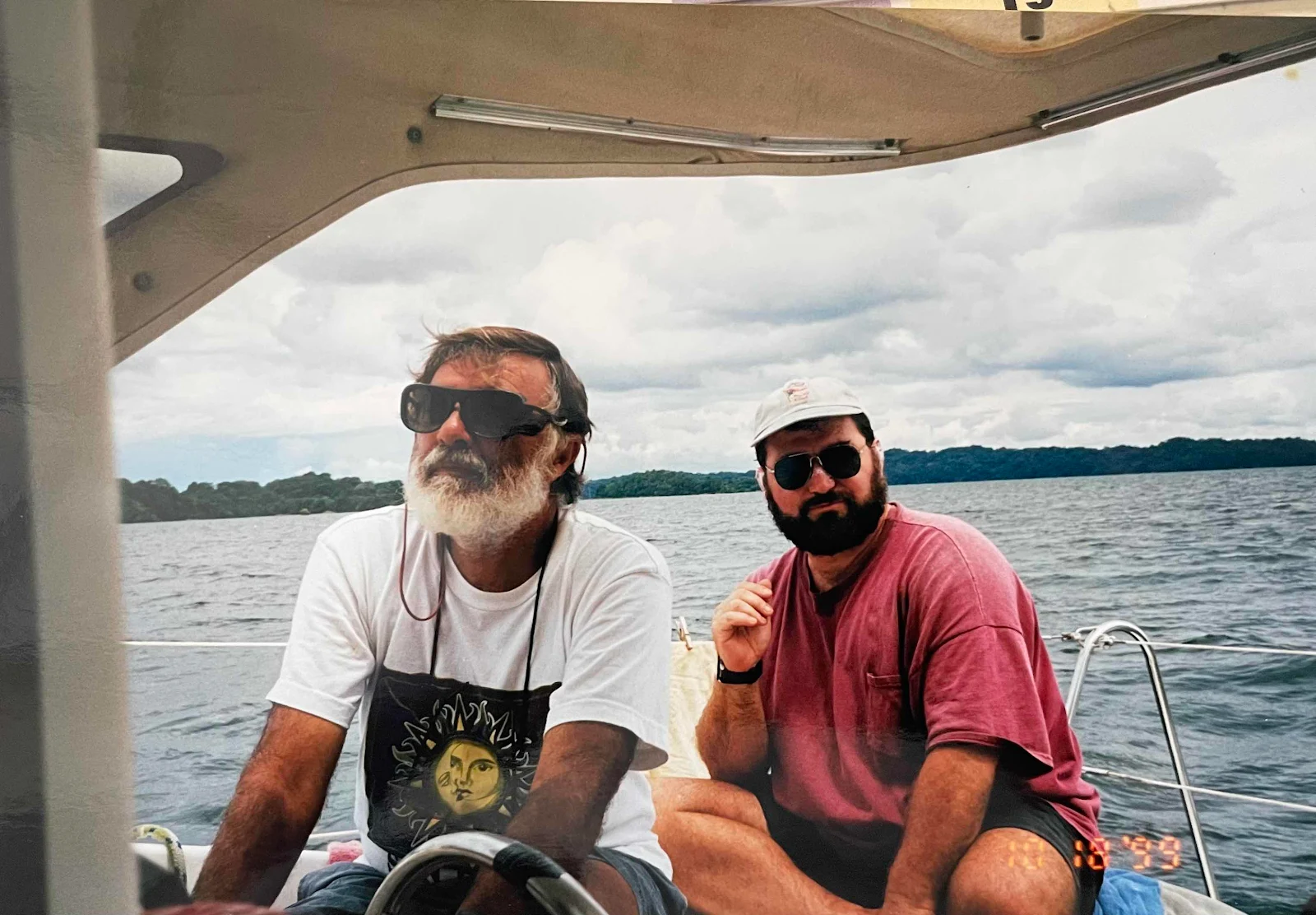
Finally we got the all clear and slipped past the moored freighter and parked in front of it in the chamber for the three giant steps down through the final Gatun Locks. After that we would anchor on the Flats next to the city of Cristobal (the former Canal Zone town next to the Republic of Panama city of Colon) and look out at the turquoise waters of the Caribbean.

That is quite enough words and pictures for the longest essay ever on this page and there will be more later after I sort out a few more pictures of the other end of the canal. The photoalbum has to be packed soon and we have to drive it to the storage locker in Miami...