
We were a long way south of San Cristobal before we saw a sign welcoming us to Zapatista Country. The Zapatistas seeking autonomy or independence for Chiapas named themselves after the Mexican revolutionary Emiliano Zapata and they spent the latter half of the 20th century making a nuisance of themselves annoying the authorities and frightening off tourists. They are still a political force in the state and they have left their mark by empowering unions and encouraging the voiceless to speak up and protest but they aren't what they were. Which is not to say Americans don't tremble at the thought of visiting this state.

Violence in Chiapas these days is more of the dollar crazed gang variety, drug dealers and so forth fighting over turf and targeted among people who don't like each other and rather less at people like us who have no dog in the cartel hunt. I am rather grateful at this moment for the notorious US policy of publicly refusing to pay ransoms and I don't think there is a GoFundMe large enough to buy back Layne, Rusty, and I should the need arise. We travel unscathed by the local dramas. Aside from the mild sloganeering in the middle of this stretch of highway the rest of our day-long drive was a delight of smooth roads twisting through pine valleys reminiscent to me of eastern Oregon, the high Sierra and desert-like forests of the inland areas of that great State.
 It was mostly two lane driving so we kept one slow wheel on the shoulder to allow passing in the "magic third lane" and occasionally we got stuck behind a very slow truck grinding up hills, on the order of ten miles per hour, no exaggeration, and so we in turn passed, but the driving was relaxed and full of scenic views and stops to buy roadside food and let Rusty catch a break. Chiapas was growing on me!
 It was Saturday, market day, so taxis and collectivos and pedestrians were everywhere along the road.


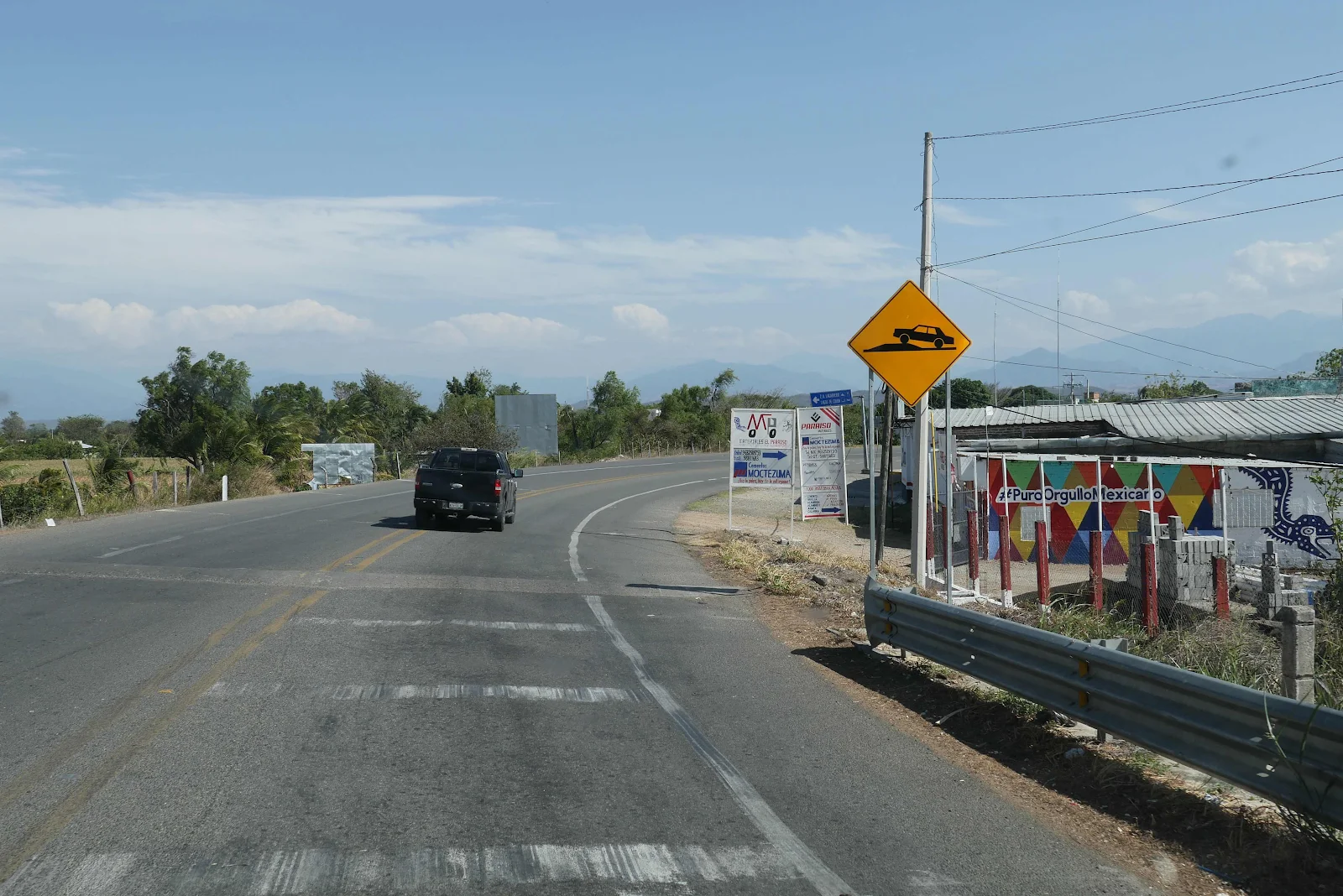
The drive was pothole free which rather surprised me though we found all manner of topes all over the place and I just can’t get used to random placement of speed bumps. When we come back next winter kissing goodbye to topes when we arrive in Central America will be my biggest reason to be glad to see the last of Mexico.
Rusty rides up with us either in front of Layne or between the two of us looking out of the side window. Driving is not his favorite part of the trip but we like to take frequent breaks to check out stuff of interest along the way. He instantly perks up when I shift to park and as soon as the engine is off he’s at the sliding side door ready to jump out. He doesn’t even mind if we walk nowhere. He just sits and watches the world after he’s checked for local dog ambushes and other perils in the immediate surroundings.

Layne is always looking for roast chicken by the side of the road which she thinks is the tastiest instant dinner we can buy. It’s usually sold as a package meal for around seven bucks, a whole bird with beans rice coleslaw and once we even got roast potatoes which was a surprise. We often use leftovers with green salads which we buy at Walmart or Costco. Other produce we buy at the side of the road, especially eggs which are generally unrefrigerated in Mexico and the small stores sell the best tasting we find. We stopped opposite three outlets with roast chickens so Layne asked the locals which was best.

“That one!” they said and indeed she gave us grilled tomatoes and coleslaw with her excellent free range ("campero") chicken.

The street was narrow so Rusty and I waited aboard until Layne had the chicken and fixings in a plastic bag and she invited the curious farmhands, our guides, to a house tour. Some middle class Mexicans are inclined to check us out with an eye to trying van life themselves but working class Mexicans are fascinated by a home in a vehicle no bigger than a collectivo bus. Much laughter as we show them the fridge and the microwave and the toilet and the bed, and of course Rusty’s bed. He tends to look down at the visitors from his perch with the air of a dog who is not fond of being put on display. We pay him back with roast chicken in his kibbles.

God bless the truck is a common theme.

Comitan is the biggest town between San Cristobal and Tapachula on the coast, not that I’d ever heard of it before planning the route. It turns out Saturday is a busy day.

This four lane went on for miles through town. I stuck to the left lane to avoid sudden stops by collectivos and cabs loading passengers.

Learning the market day ropes from Dad:

Civilization! It cracks me up how reassuring it is to see a Ram dealer.

The North American Free Trade Agreement has opened Mexico up to US corporations. I don’t know how it works for Mexicans but for us it means foods and auto parts and building supplies familiar to us are absolutely everywhere. It really is astonishing to see the penetration of Walmart Costco AutoZone Home Depot and fast food brands.

A collectivo driver in action. Ubiquitous cheap frequent mini buses on city and rural routes make the need for a car unnecessary for working Mexicans.

Need gas? We saw gasoline for sale by the jug all over Chiapas. Full service gas stations are frequent enough but these entrepreneurs serve local short haul three wheeled taxis and privately owned motorcycles in their neighborhoods. For me this kind of rural service is another reason to tour in a gasoline van. If I need it, it’s there. Diesel is reserved for gas stations. We do carry a specialized fuel filter in case we ever do need a roadside fill up.

Red light in Comitan. It’s not as crazy hectic as it looks! Trust me…to looks like all taxis and collectivos darting about but the road magically clears in the left lane when the light goes green!

I'm not sure where she gets these urges but Layne had developed a desire for mamey and she was ready to stop and buy the next one she saw. Mamey is a hard shelled tropical fruit and is expensive enough in the States Layne tells me, which is why we never used to eat it. It has the consistency and color of cooked sweet potato but its sweeter and Layne suggested it tastes rather like a fruit ice cream. We bought three, two ripe and one hard and we split them in halves for dessert after dinner. We scoop the fruit straight out of the half shell with a spoon. You will be astonished to learn mamey is good for the heart, circulation and I don't know what all else. It tastes good too so that's what matters.
 I enjoyed the drive very much. I used to look forward to my motorcycle commutes in the Keys until I wrecked of course! Now I look forward to driving new roads when we leave our overnight spots. The day is fresh and new and full of possibilities. I really like being a nomad, a concept that Mexicans find hard to swallow: "No children? No parents? No family? No house? No plans?" Here today and gone tomorrow.
 This map below was our goal for the afternoon, a campsite about seven miles off Highway 190, seventy miles before Tapachula the largest city on the coast right before the border crossing to Guatemala. As you can see by the blue dot we did arrive and we are parked about half a mile from Guatemala. Indeed my Verizon phone keeps offering me Claro telephone service from Guatemala instead of the usual Telcel service in Mexico. Most annoying, especially as we can't keep going south at this stage. Guatemala is in the plans for the Fall if we don't ship the van direct to South America from Florida after we visit friends in Key West this year.
 Gradually we dropped out of the mountains, through miles of uninhabited forests on a perfectly smooth two lane road with not too much traffic at all. We were listening to a book Layne had downloaded from her library app, a casual easy drive with no pot holes still and no topes for miles as there were no villages. It was lonely and thoroughly enjoyable.
 The warning signs, lines and edges of the road were well marked and there was no livestock or anything to impede our progress towards the border.
 "Autopista" means freeway but it's not really, its just a highway to the border but the sign made us feel like we were on the edge of new exploration. There were no police or military, no road blocks and only a couple of checkpoints outside the bigger towns and the police just waved us through. Of 32 checkpoints we've passed since we entered Mexico at Naco, Arizona, we have been stopped only once in Tabasco State where they asked us where we were going, a sixty second chat, Not one official has asked to look at our papers or permits for the vehicle or ourselves.


By now it was after three in the afternoon and we were on the agricultural plain that stretches to the Pacific Ocean. In the distance we could see the dark shapes of the mysterious mountains of Guatemala. Actually they aren't that mysterious, we drove them in 1999 in a rental car with two dogs when we took a break from sailing the Caribbean and I am simply ready to go back!


The road to the camping area was as empty of cars, tractors, people, animals or anything living as I've seen in Mexico. The large fields of corn were magnificent, the irrigation was everywhere and the mountains of Guatemala were ever present but we were totally alone rumbling down the road by ourselves at 30 miles per hour trying to take it all in. Google maps took us right there, through a small village at the end of the road, through. wood, across a couple of bridges, through a ford where the streams ran over the road, and so forth.
 The ford, and I am not used to driving through water so I figured I'd better start. It was no problem of course and just felt rather weird.
 The last bridge to Rancho Escondido (hidden ranch) was much narrower but as it was built of cement Layne was more worried than was I. She hadn't enjoyed some of the canyons we driven past coming down the mountains and she didn't like looking out over the water right below her, but we were fine.
 This whole area is devoted to water, waterfalls, ponds, swimming holes, barbecue pits, tables to rent, a total playground with several different areas. It cost a buck fifty each to enter the lakes and the lady at the gate wondered in Rancho Escondido wasn't actually closed. It is not, much to our relief.
 There was one Mexican family renting a cabin and I liked them immediately as their dog had become paralyzed a coupe of months ago and was now kitted out with a. harness and wheels and the little terrorist was running around chasing the campground dogs dragging its paralyzed hind legs and freaking young Rusty out who had never seen a dog in a wheelchair. The only way she could calm the dog down was to take it out of its harness and put it on her lap. My kind of dog people.
 The manager told us tourism is in trouble in Chiapas as rumors of violence and turf wars are keeping people away but she kept saying its quiet and peaceful here. I told her I'd seen nothing out of the ordinary and after three days here I can say it is one of the most peaceful spots we've seen. We have the place to ourselves an absolute Garden of Eden.


The grounds of the lakes area are vast and unoccupied. The village is a five minute walk away through the woods but not only is low season but fears of violence keep people away. The result is an incredible piece of good fortune for us who enjoy solitude and peace and quiet.

It was funny but Layne actually thanked me for getting us here. I knew I wanted to see this stretch of Chiapas and I wasn't going to et a road block stop me. And even though we found San Cristobal unlivable I knew there was more to this area than a tourist trap. Indeed Layne said she thought this might be the best stop of our trip. I'm not sure about that as there have been many extraordinary places but here we are, in a place where rumors abound and as usual are utterly unjustified.

Tuesday we plan to drive to the coast and visit our last anchorage in Mexico in 1999, a nostalgia spot I suppose. Then we will start the trek back north to Meet Layne's family in Zihuatanejo in the middle of the month. After that we will go even further north and take the ferry to Baja to get back on some isolated beaches. I wonder if they will be as pleasant as this?

Rusty could stay here forever. He has made peace with the two campground dogs, ankle biters of uncertain temperament, but he sleeps on his bed inside the open side door of the van able to come and go as he likes. The grass in the campground is thick and he enjoys moving around, under the van, in the shade, in the full sunlight and back again as the mood takes him. We take a walk morning and evening and he has no obligation to go anywhere or do anything. He eats like a horse and sleeps loudly enough to wake the dead, deep rumbling snores. I recall so much drama at the idea of taking my dog to Mexico in the van. As usual with predictions of drama and disaster its all bullshit. you can imagine what people said 40 years ago when I rode across Africa on a motorcycle. The din of fear has never ceased since.

The supply of water here seems endless, bubbling out of the ground and pouring down the slopes in small waterfalls to collect in the river. And only Layne and I are here to enjoy it. Rusty never has liked water.

I pick up fallen mangoes and eat them as we walk. It reminds me of my childhood in Italy, summer vacations at my mother's ancestral home, running in the fields picking grapes and coming home with no appetite at all. Boy, did my mother get mad at me and my unbalanced diet!

Rusty and I explored the woods filled with mango trees and trails past the ponds and streams. All by ourselves.

Our main swimming hole in front of the van, below. The waterfalls push the current and we swim upstream and float down, in refreshingly cool water. All day if we feel like it. Amazing.

If we didn't have obligations we'd be in Guatemala next week doing more of the same. Wait till you see pictures next year of Lake Atitlan, and Chichicastenango with its massive Mayan market, and the ruins of Antigua Guatemala. These places are fabulous and sitting there waiting to be seen. These places are real, and are waiting here to be discovered by people with cameras not guns. You'd be amazed.


