The shtick is that the place is isolated, as though the high cost is caused by the ground meat being trekked in by yaks, it isn’t as I saw the banal refrigerated truck idling as it unloaded. The view they say is superb and they aren’t wrong:

But $23 for this sandwich…(the fries are $8 extra and the soda $5.50):

I have no idea if it’s worth it but I’d return for another bite at Nepenthe in Big Sur. Our expensive lunch was throughly enjoyable. And by the way the most expensive burger I’ve heard of is a foie gras burger offered in a faddish Las Vegas eatery at $5000. Thats not for me.

Whatever you think of the place and the ideals of the founders, it is hugely successful at sucking tourists like us to lunch. As for the isolation it’s just an hour south of Monterey, on a winding coast road boasting lovely spectacular views.
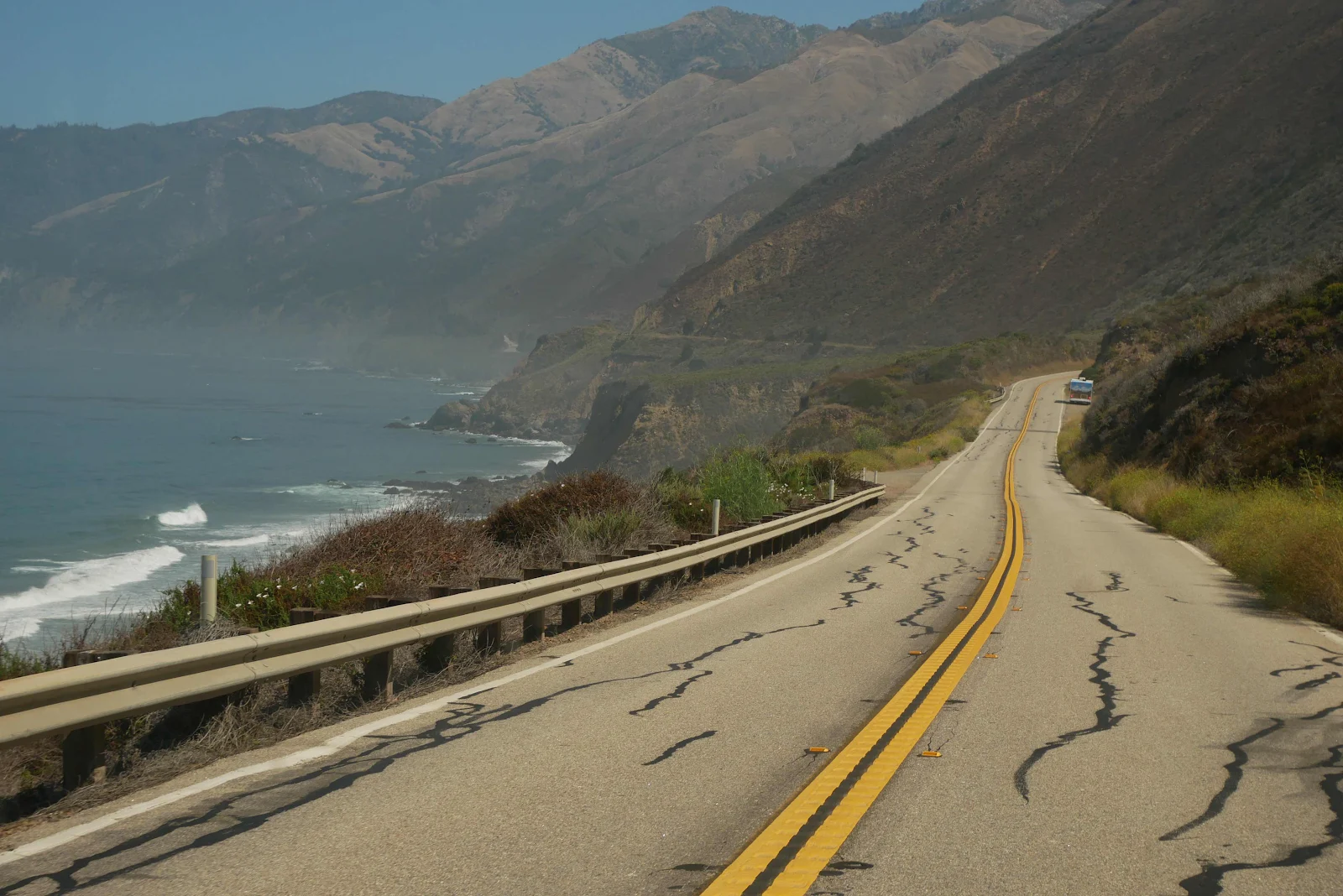
Nepenthe was the goal when we left San Simeon bound for Santa Cruz half a day north. Layne had it all worked out for us to arrive at opening time, 11:30am. Washburn Campground did the job we needed by giving us a place to sleep close to the start of the epic drive and by 7:30 Rusty was walked so we decided to go drink coffee at the water’s edge with a better view than this:

The first decent pull out we saw was just south of San Simeon and the entrance to Hearst Castle. Layne said we had to leave by 9:45 to make lunch before lines got too long at Nepenthe. We exercised, drank coffee and walked Rusty who has decided he likes California and it’s cool fresh air.

Then we drove up the coast to see how Big Sur has changed since last we were there. Not much it turned out.

If ever you decide to drive Big Sur you are looking at a mere 100 miles of California State Highway One and at no point are you going to be lost in a wilderness. There are villages, grocery stores and gas stations along the way. It’s not just the hamburgers that are overpriced so if you decide to buy gas on this coast you will deserve all the pain they mete out to you. Go prepared.

Go prepared to see gorgeous scenery in a place where government has prevented development and unspoiled mountains actually do plunge into the sea. There are some ranches and a few private homes in addition to campgrounds and hotels but most of the time the land appears undisturbed.

This is probably as good a place as any to drive a convertible. The Pacific Ocean brings ice cold water down from the Arctic and as the land heats up the cool ocean air is sucked up the hillsides so the moisture helps redwoods survive this arid location and gives humans a form of outdoor air conditioning. It looks like a hundred degrees but it was barely over 60 on this pleasant July Monday morning.

Choosing not to drive the weekend was a critical decision too, thus avoiding heavy traffic and massive crowds. As it was I pulled over every now and again for the inevitable faster vehicles but there are lots of turn outs and vista points to make that easy. Mostly we drove on our own. It was serene and pleasant.

Cyclists ride Big Sur but few trucks tear up the road surface so the highway is quite smooth for cars and a few motorcycles patient enough to follow slower vehicles.

It’s always a good idea to check for road closures as slides are commonplace. Winter storms dislodge the mountainsides and the highway can be closed for months at a time.

Currently one of the connecting roads to the interior, a lovely collection of curves and scenic views called Nacimento-Fergusson is closed for an indeterminate time. Summer fires burn plants that help hold the dirt in place then winter rains wash the whole mess downhill.

But through all this you get to drive and see some spectacular views. And yes gasoline is costly but the trick is to separate the return on investment from the cost. If you only know the cost of things but not their value you will deny yourself these and similar pleasures.


Of course there were already people in line when we arrived at Nepenthe but we waited only ten minutes for our outside seating.

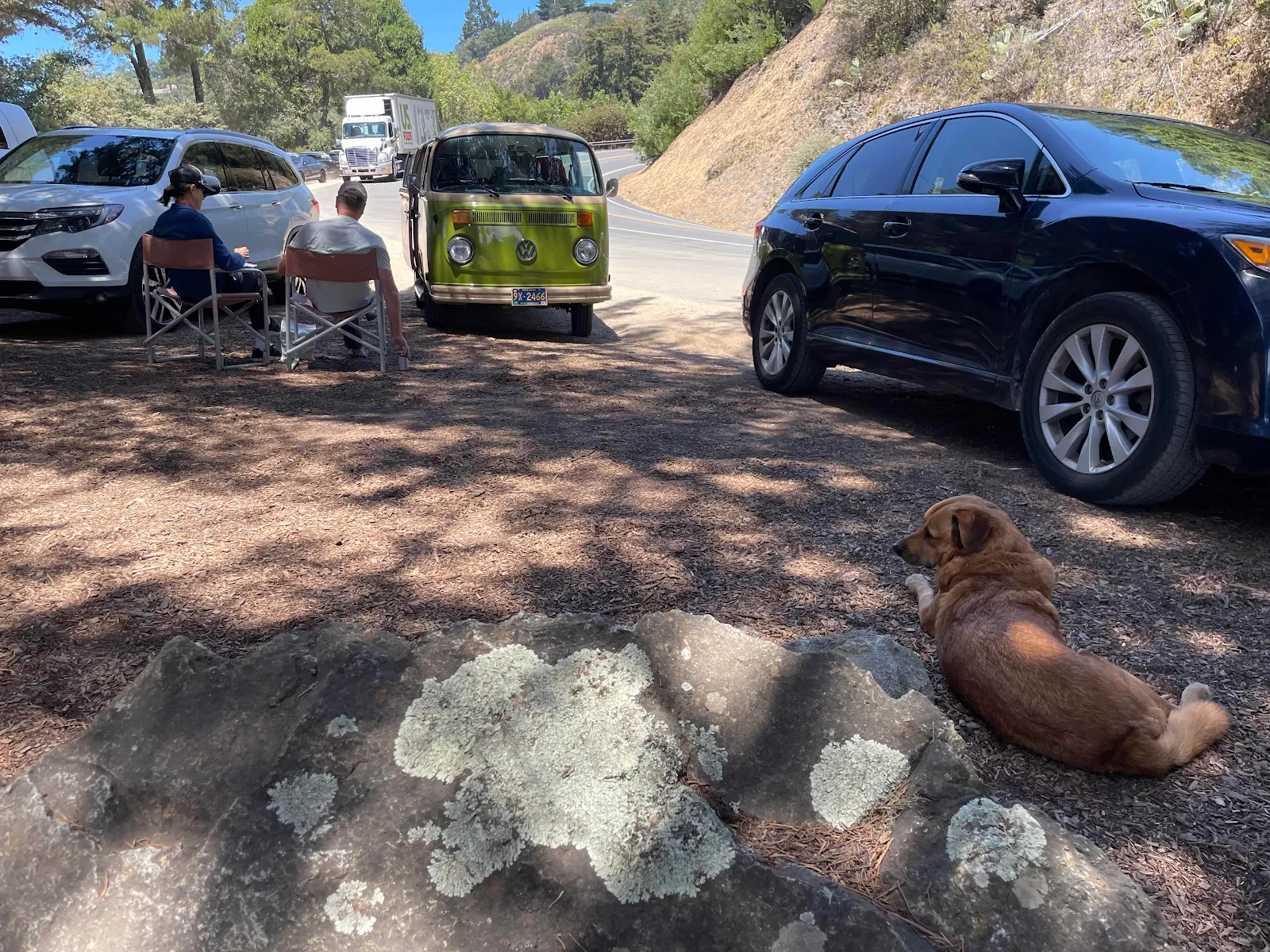
Restaurant time for us equaled van time for Rusty and he was glad to get out and sit for a while after we got back. There was a Volkswagen couple picnicking next to us which struck me as odd. There are much more scenic spots to enjoy than a restaurant parking lot. Good enough for Rusty…good enough for them.
The rest of the drive was more of the same, arguably more spectacular but it’s not an argument I’m willing to make. The whole drive is lovely, far more enjoyable than my photos can express. I’d like to spend a day by myself stopping anywhere I felt like with my camera to enjoy the views properly.

You could do the drive in three hours and settle down for lunch at Cannery Row in Monterey or you could take two days by stopping in the middle with a reservation prepared well in advance and stay at a romantic inn or an eye poppingly expensive private campground. You can put as much or as little as you want into experiencing Big Sur.

You can’t sleep overnight in the turn outs. They let you use them all day long but overnight is not on. Who checks and when I know not but the fine is said to be $250. We could have turned around in Carmel and driven back to Washburn Campground for a full day of driving followed by a night of cheap sleeping but we had a moochdock to get to in Santa Cruz.

The village of Big Sur itself is a little inland, a river with some campgrounds, both state and privately operated, and a few inns restaurants and stores including a gas station. But this point along the road is to me the least interesting: it looks just like any mountain village in inland California. The spectacular ocean is out of sight and mind hereabouts.

To me the restless ocean is the draw. We got there on a day with no wind and the mighty ocean was flat and smooth. The water heaved on the rocks and spewed white foam indiscriminately against the shore. It’s always glorious to watch from a comfortable distance!

I’ve sailed Big Sur a few times, sailing south pushed by the near constant northwest winds while motoring north hoping for flat days like this. It’s a long haul at walking pace and it takes all night to get past the empty forbidding coastline. The experience of boating here I think enhances the landlubberly experience of driving the coast road. I’m glad I’ve done it, and without adventures or mishaps. But it is cold and damp at night on the water in the sea fog all by yourself in the pitch black…better by van!

Big Sur - the big empty area of the south as it was known to residents of the Spanish capital of Monterey in the 17th century- lives by its reputation as a bohemian hideaway , a chic artistic locale full of history and art and historic artists who chose to live here. Nowadays of course it’s a chic destination for people with money and means. There are a few homes for sale but construction is practically outlawed. So naturally it’s not affordable for ordinary people.

However Big Sur was discovered in the early years of internal combustion and the isolation of the time made living here not only affordable but private. Writers and painters and photographers all played their part in making Big Sur famous. There’s still the Henry Miller Library open to the public. Ansel Adams and poet Robinson Jeffers lived in Carmel and Jack Kerouac visited friends in Big Sur and wrote of driving there in his book titled Big Sur. His drive was rather more hallucinatory than our staid journey as you might expect.

There are art galleries and artists in residence and all the paraphernalia of patronage but Big Sur is a tourist destination with the authorities estimating six million visitors a year with 1500 people living there year round. It’s great drive.

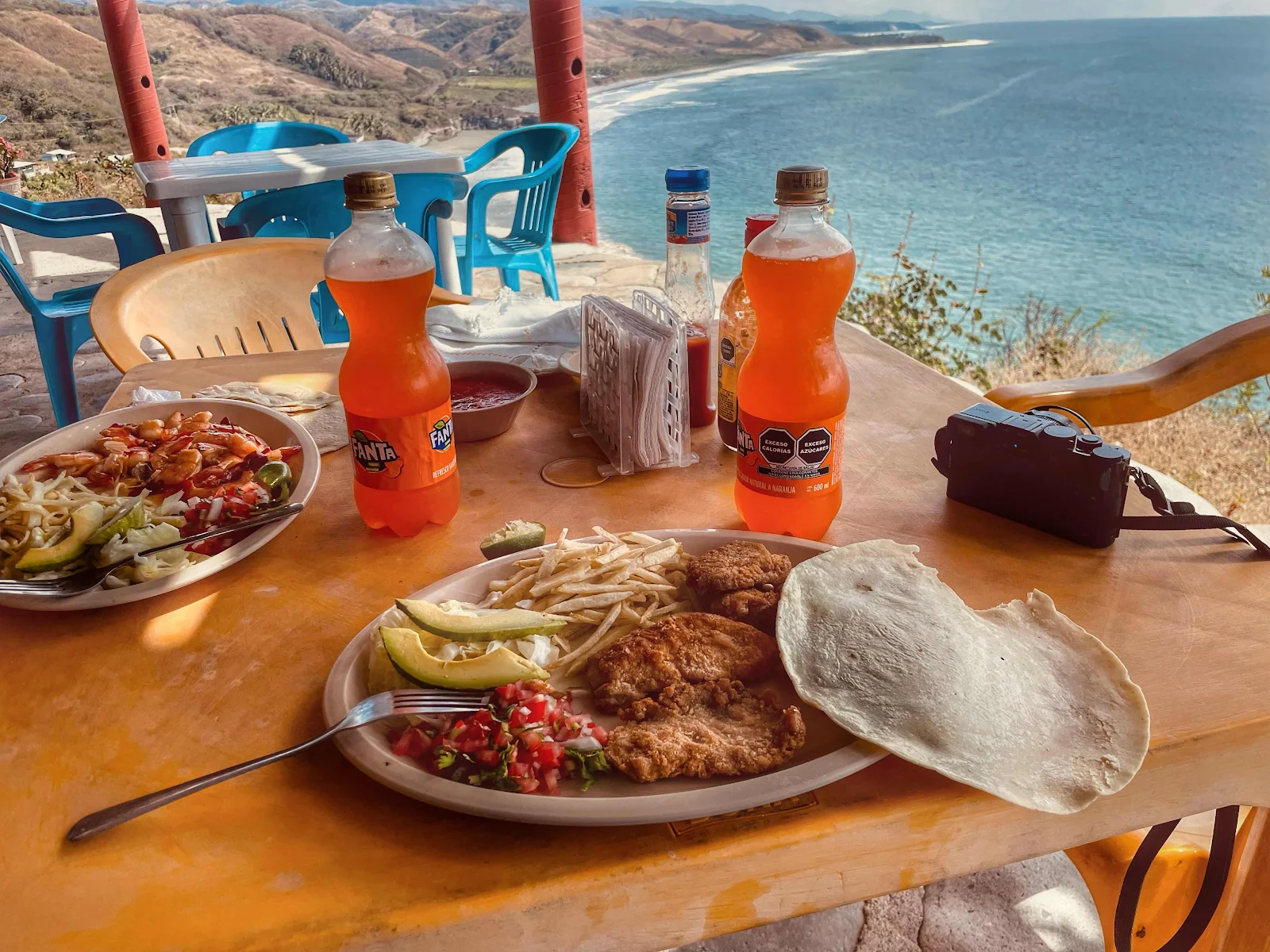
I’ve added a few pictures from our time last winter driving Highway 200 on the Michoacán coast. Just like Big Sur, we cried out nostalgically. Somewhat similar perhaps:

Funnily enough having driven the real thing I do see similarities but beyond that superficial physical similarity I see a connection to Big Sur’s past, in the sense that the Michoacán coast hasn’t yet been properly discovered. It’s much wilder and emptier.

It suffers from a terrible reputation for violence owing to past drug dealer turf wars. Nowadays the reputation remains but on the ground the country is at peace. We stopped for lunch here at a cost of maybe $14 for mediocre fish and glorious views. All to ourselves!
I am tempted to wonder which artists will set up shop here isolated and inward looking producing great art that will draw the faithful. It’s an interesting idea to me: perhaps I have visited the Big Sur of this new century!

Yeah. I know. We’d rather pay seventy bucks for familiar surroundings and I’d happily do that again. But I am sorry I missed out on the intriguing past of early exploration and settlement of this rugged and no longer isolated California coast.


 The thought of Deepwater Horizon and the Gulf of Mexico's gusher are never far from our minds. These rigs off Santa Barbara have been grandfathered in after a spill sent tar balls to the beach in 1969.
 When people ask us about the oil and Key West we just shrug and say we hope it never arrives, though it seems inevitable. I dread the day we have to even consider leaving to make a new life- uff, again-and i look at the cloudy July skies in my former home state and wonder if i could ever cope with this again. 65 degrees of a July afternoon?


 If one thinks of the canyons of condos that line the coasts of Florida and then one takes a peak along California Highway One the question has to come up: how come they preserved their coast like this?
 The answer is a little known legislative body called the California Coastal Commission, created by Democrats and hated by Republicans. All attempts to dismantle it have so far failed and the result is a coastline that the whole world wants to come and see. Houses are few and new construction cannot be permitted to be seen in any from from the highway. Permits are rare as California Condor eggs and the result is a socialist's dream: nature preserved.
 The road is an endless series of curves and turn outs that a few slow people were kind enough to use. My wife and I agreed (and I think Cheyenne would have too) that this was a once in a decade drive. Been there, done that- where's lunch?
 The home of the Ambrosia burger. Nepenthe in Greek means peace or oblivion and is often used as a synonym for the state of mind induced by grass. We were hungry at this point and sought easier gratification.
 I was hardly alone in my use of a camera, however we skipped the outdoor seating (62 degrees):
 The mushrooms are actually outdoor propane heaters, a common sight in California's hip coastal communities. People even keep them in their back yards to radiate heat down on out door parties. It is that cold after dark in July around here.
  The place was built around the middle of the last century as the back to the earth hippie movement took root and they proudly point out local logs were sacrificed for the building,which strikes a discordant note in our current obsession with preservation, but the result is excellent.

 It's the scenery that does it, and the view is excellent, though trying to capture it on a pocket camera seemed nuts to me.


 This is also where Cheyenne met the Pacific Ocean and encountered waves for the first time (on a leash per regulations).
 Imagine coming down here to learn to dive. I was a brave idiot. Little wonder I got the PADI certificate and quit. I am a warm water dude and this was as cold and clammy as it looks.
 The sand itself has a gritty quality, not like proper Florida talcum powder at all.
