Sunday, September 12, 2021

Art From The Past

From the archive I wanted to post  a few pictures from a  time when museums and art were available without thought or worrying about masks and all the rest. 2019 seems so recent. Interestingly enough the artists niece posted a comment saying she was unaware of the exhibit at the time so that was a nice plus!

Tuesday, September 10, 2019

Martha Watson Sauer

It was without doubt a splendid day Sunday in Key West, as warm as you like and humid but the skies were clear and all was well with the world. And downtown was filled with cruise ship visitors.
My wife noticed this extraordinary attraction as we walked past Clinton Square Market, a pretty decent place to shop for souvenirs and toys the last time I went in, a long time ago as I am not by nature a shopper. The point being you can ride an escalator in Old Town Key West. Fancy That!
And there was music of course to soothe the fevered brow and persuade shoppers to shop:
They got a bit of an audience and I was prompted to wonder if there was an equal or similar number of women inside spending the cruise ship dollars:
 We weren't the only ones enjoying downtown Key West though I didn't see them at the Tropic watching Tel Aviv On Fire. It was a busy Sunday as I am hinting here. Starting of course with an extended dog walk followed by a ghastly bicycle racing exercise class called Spinning which my wife signed me up for, without my consent. It was so hard I fell asleep in the movie and the only way to wipe out that shame is to take more classes and come to terms with Spinning. Which invovles pedalling like a maniac not standing around like these two:
The Custom House was designed by the Federal Government as  aborder post along the Canadian line where snow predominates for half the year. Down here the Federal building looks slightly absurd, ready to shrug off any possible snow that has never fallen in Key West. But the large wide porticos provide excellent spots to sit and watch the world go by. Or make a phone call I suppose.
The people ahead of us in line looked ready to mount a major expedition on the exhibits but I went in hoping things hadn't changed too much since my last visit as I was only carrying a  camera and had no other survival equipment along for the visit.
It turns out there were two splendid visiting exhibitions  and as I have far too many pictures, apologies, I'll showcase the other one this weekend in a separate entry on this page.
The watercolors on display were deft and bright from all over the place, Mexico, Martinique, Paris and even Key West. There was a potted biography on the wall for those reading this on a  large screen. The rest of us I found the signage on the Art and History Museum website and copied it below:
 With her sketchbook and paints invariably in hand, Martha Watson Sauer (1912-2006) created an incredible body of artwork while also serving as a teacher of watercolor painting and weaving in the Key West arts community.  A Key West resident for nearly 70 years Surroundings: Watercolors by Martha Watson Sauer pays tribute to more than half a century of Sauer’s work, which also include her personal effects and sketchbooks.  Her plein air watercolors spread beyond the island, they highlight architecture, landscape and people from her extensive travels around Mexico, the Caribbean, Europe and across the United States.
“My aim is to transmit to paper the delights of nature and the out-of-doors; the sun’s heat and the deep cool of shadow,” she explained prior to her death in 2005.  “My paintings are not puzzles.  I like what I see and try my best to present the scene so others may share in the enjoyment of it.”
Born and raised in Bucks County, Pennsylvania, Sauer came to Key West in 1936 during the Great Depression while the city was clawing its way out of its economic malaise by encouraging tourism with the help of the Federal Emergency Relief Administration (FERA), later called the Works Progress Administration (WPA).  Key West had not been her intended destination.  “My mother and I stopped by accident in a travel agency in Miami,” Sauer remembered.  “We saw these watercolors by [FERA artist] Avery Johnson with scenes of Key West.  It was such a dear little town.  So I said, ‘Let’s go to Key West,’ and we did.”
Arriving at a time when a number of the WPA artists remained active in Key West’s economic recovery efforts, Sauer’s innate watercolor technique was noticed by the professional artists.  She received early tutelage from members of the WPA, particularly F. Townsend Morgan.  Sauer was asked to create lino-block prints for tourist brochures promoting tourist destinations including the Key West Municipal Aquarium, the Hemingway House, West Martello and the Peggy Mills House.  
Sauer became one of the original members of the Key West Art Center that was known as the WPA’s Key West Community Art Center in the 1930s.  Her very first sale was a painting purchased by the eminent pragmatist philosopher John Dewey, once a Key West resident.  Today, her works hang in private collections in Switzerland, Japan, Great Britain, Canada and the United States, including the Key West Art Center located at 301 Front Street.
The Helmerich Trust paid for the exhibit which will be at the museum through November 10th. Well worth a  visit.

The artist's easel is preserved  and is part of the exhibit. It looks pretty much as you'd expect:
She was apparently a close of observer of the world around her.
The paintings are not usually labeled by location which is annoying, but people do that on Instagram forgetting to add time and date.

The artist and her spouse presumably around the time Key West was struggling to survive the Depression and was being described in all sorts of detail by various artists and writers of the period:

70 years in Key West is bound to give rise to a memory or two...
With journeys faithfully recorded in watercolor:

Apparently beyond the artistic exhibitions she also produced commercial work such was her versatility:
And the figure in the middle is herself, teaching:
Key West enjoyed her skill on the cover of the guidebook created to teach the visitors about the city they were being encouraged to visit. It seems extraordinary now but Key West was very nearly evacuated for lack of money in those desperate years when 80% of the population was on assistance from the government. 
And then Julius Stone dreamed up tourism and the city has never looked back. Rum smuggling didn't hurt either during prohibition. 
This one below looked like an Italian city to me but who knows...
And I am going to put this one squarely in Key West:

Saturday, September 11, 2021

Caribbean Panama 1999

Our journey through the Panama Canal was not a slam dunk as we crunched before we cleared the last lock. I lost control of Miki G our 34 foot light weight Gemini cruising catamaran and we spun round in the surge of a ship's wake and slammed our stern against a canal tug still tied to the seawall. It felt like death but after we regained control of the boat and our nerves there was just some nasty bending of the rail at the back of the boat (the quarter if you prefer). We met with an official investigator who established that the tug let go of us too soon but there was nothing to be done. We straightened the rail and got on with the trip. Just one more experience.

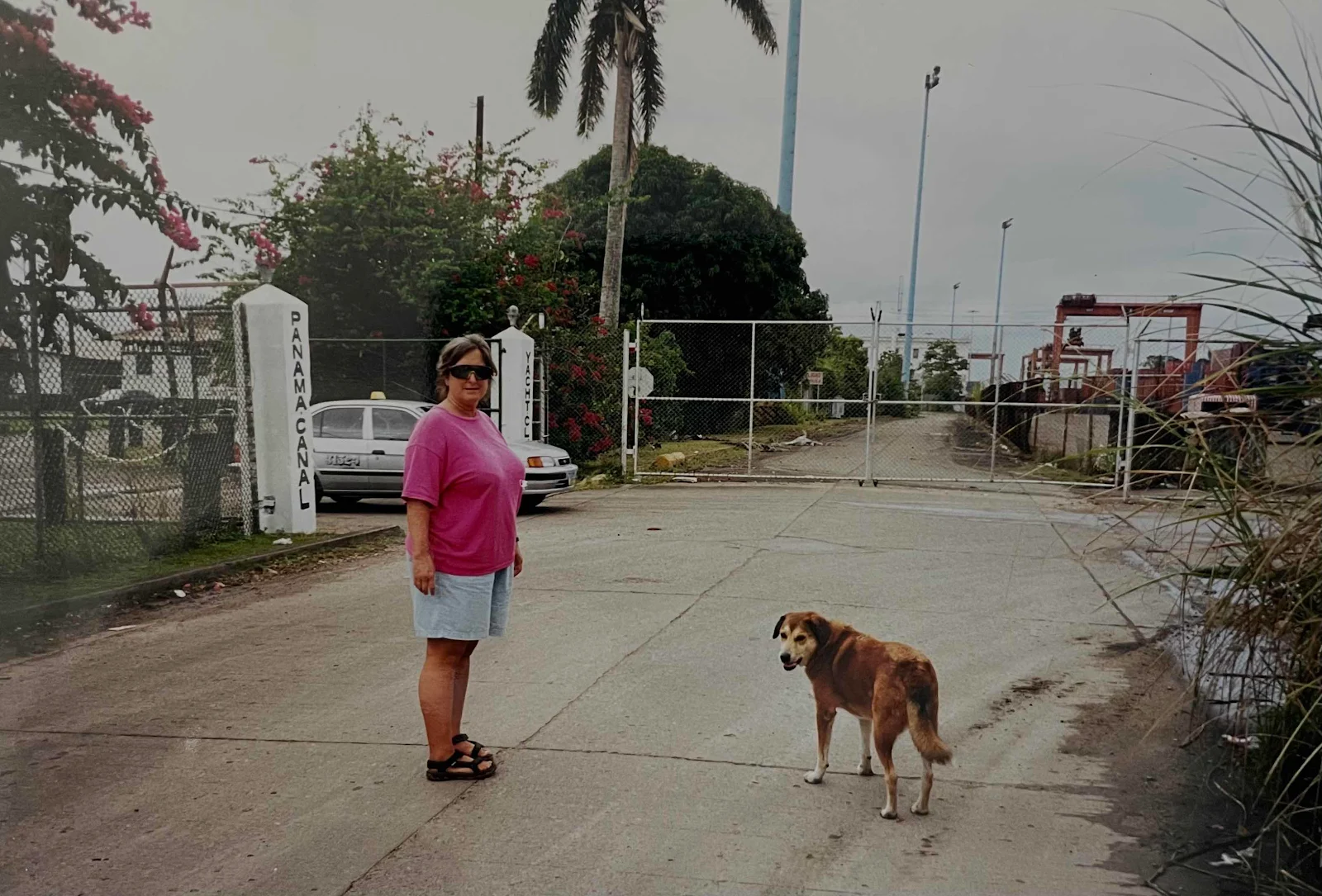
To deal with the rail and to get our exit paperwork from Panama we took a slip at the terminally decrepit Panama Canal Yacht Club in Colon. I don't think the city of Colon has improved much since those days but at the time the city was extremely dangerous. I don't like to exaggerate danger when I'm traveling but Colon was really dangerous. One cruiser at the club, not someone we had been introduced to, was shopping at a vegetable market outside the club and was stabbed to death in an encounter, a robbery perhaps? A moment of anger? Who knows. That incident sent a ripple through the cruising community. We stayed inside the club fences and kept the dogs close.

Luckily the grounds were relatively vast even if the club house itself was a damp moldy wreck. No one stayed there for fun but the trouble was Colon was the port through which we all had to pass. It was a pain in the ...colon. To go into the city to complete our paperwork or get cash from the bank we used cabs and the dogs stayed at the club. The cab drivers parked close by the entrance to the office were going to visit and an armed guard with a shot gun at the ready stood between us and the door. I couldn't make up my mind if we were royalty or prisoners in transit. It was awful and I like to think it was  a bad moment for the city and things have improved since then. We couldn't wait to get out.

In the days of the Canal Zone Colon was a city in the Republic of Panama surrounded by US territory. It has had a dismal reputation for the second part of the 20th century and over the last few years there has been a reported attempt to beautify what I remember as a crumbling wreck. The port city of Cristobal (Spanish for Christopher) was the Canal port for the US administration and the city of Aspinwall was renamed by Panama as Colon (Spanish for Columbus). Nowadays the port of Cristobal is a district of Colon and Christopher is reunited thus with Columbus.

In Central America traveling boats check into one country, then check out and check in to the next one. The idea is that you leave a country in good order and the zarpe (zar-pay - exit document) proves you didn't flee the last country leaving debts or unsolved crimes in your wake. From Colon we checked out and gave Porvenir as our next destination- which is an island in Panama. Weird. Actually it is the main administrative center of the Kuna Yala, an autonomous region along the Caribbean coast where the Kuna Indians live isolated pretty much from the rest of the country. It is a much prized destination among cruisers and we wanted to see for ourselves.

The Caribbean Coast of Central America was settled by the British who sort of spilled over in their Imperial way from their Islands across the Caribbean Sea. However the marshy insect riddled coast of the isthmus all the way to Mexico is pretty much economically useless so the British really had no reason to stay. They left behind a black African population of English speakers who ended up being attached to the Western (Pacific Coast) countries where they lived. Thus from the Canal to Belize (former British Honduras) the coastal populations of Central America are culturally ethnically and racially completely different from the Spanish speakers of the western and more prosperous parts of their countries.  If you look closely below in Colon you can see the church has an English language sign on it. This dichotomy was very striking in the second half of our cruise.

Meanwhile back in Panama we had a quick and unremarkable sail out of the canal area and into open water again. We were delighted to be away from that industrial nightmare. Necessary but what a pain! We stopped next in the bay at Portobello, a small coastal town founded as a port by the Spanish and now nicely forgotten and dilapidated. Portobello is noted for two things: it has the heaviest annual rainfall of any city anywhere in the Americas,  13 feet annually if I recall correctly with a rainy season lasting nine months! The other thing is that this scrubby little town was the shipping point for the precious metals mined in South America. The road to Portobello ("Beautiful Harbor" in Italian) is still visible as a rocky trail through the jungle. 

There is a fort overlooking the bay so we trudged up and had alook and it is a reminder of the breadth and power of the Spanish Empire as you can see these constructions everywhere, even in St Augustine and Puerto Rico and all around the world. The only other incident of moment in Portobello was our one and only dog fight of the two year trip. A scruffy mutt came out of a side street and attacked Debs. I had to get in and try to drag them apart which somehow I did and no one was the worse for the experience. That and the canal in the space of a few days! We needed a desert island in the famous Kuna Yala- the San Blas Islands of mythical story telling.

The harbor at Portobello is as perfect as you might expect to serve the silver and gold trade pouring out of the beautiful port into the coffers of the King of Spain. Its a broad fjord pointing northwest such that the prevailing coastal wind blowing from east doesn't get in among any anchored ships, but it does have one drawback. To get out and then turn right to run down the coast to the San Blas Islands there is a reef, unmarked, and a lot of wind at the mouth of the bay.  We motored out. with a reef in the mainsail as a precaution, but we could see the white caps at dusk and the seas looked enormous so caution was the order of the day. The fight t pull round the reef was annoying as we bounced around but a miracle occurred and the wind switched and blew out of Colon and started pushing our boat towards our destination.

I think it was among the most memorable sails I had in those two years. We had known a tropical depression near Trinidad was supposed to suck the winds out of our area and the fact that it came to pass exactly as we. hoped, added to my pleasure. Catamarans sail level in most seas especially downwind and Layne went below with Debs to make dinner while I sat in the cockpit with Emma, the Labrador impervious to rain or salt spray or motion, and watched the silver waves flash by. The moon was close to full and we. were sailing the Spanish Main, an area of myth and fable and for a romantic like me the history of the place just added to the delight of a really decent sail. I didn't have to touch a line or adjust the auto pilot and Miki G went downwind at eight or more knots while ate a quesadilla and beans and drank a cup of tea in the miracle of a level cockpit. The conditions went on all night and Layne enjoyed her watch later as much as I did mine. We arrived at Porvenir early but not too early and checked in to the San Blas islands for our cruising permit.

It would be wrong to describe the San Blas as deserted islands even though many of them look exactly as you would expect, a tuft of coconut palms on a circular path of sand surrounded by turquoise waters. The Kuna Yala as the province is called is an autonomous region of Panama and the Indians who live there use coconuts as a form of currency (in addition to dollars which Panama uses as currency) so touching a coconut is an absolute prohibition. On the other hand the Indians have their own courts and legal system based on there owns laws. One of our friends had some items stolen from his decks and Bill Gloege, being the bulldog he was took the suspect to court...and won! He told us all about the hearing and it was quite fascinating to hear how the local system of justice listened and pondered and acted. You can believe we never touched a coconut while we were there.

Another curiosity about the Kuna Yala is that the social system is based on a matriarchal line. Its a bit too complex for me to remember from a distance but even though men seem to be in charge of day to day operations when a couple gets married the groom goes to live in the bride's home and ancestry is measured through the women, not the men. As sailors we enjoyed the privilege of living among these people who lived a life that we in the First World often crave in our dreams. They were by no means backward or unintelligent or lacking in a broader understanding of the world outside, but like other groups you may be more familiar with they picked and chose which aspects they wanted in their world.

Rio Diablo was our supply point, a couple fo hours sail from our anchorage in the uninhabited East Hollandes Cays (pronounced "keys") and we bopped over once a week to make a satellite phone call or to buy food and drink and as you can see they had electricity by generator and shops and fishermen sailing pirogues with great skill. A Portion of the Kuna Yala includes a long strip of land on the mainland of Panama where the Indians keep fields and cultivate food but they prefer olive in the sandy, and cooled islands just offshore. This area is below the hurricane belt adding to the paradisiacal quality of life here.

Bob and Barb on Freya, a Tayana 42 first met the traveling saleswoman known as Liza another unusual feature of life on the hook among the San Blas islands. I photographed the sales event before she came over to our boat and showed samples of her stitching. Molas are the first thing anyone will mention if you say you are going to the San Blas (and they do have primitive hotels accessible by small plane if you don't have a boat). Liza was a master mola maker and we were her  customers. Having been forewarned we brought t-shirts for her to embroider and when our turn came we handed over a picture of Miki G and a few days later she came back with our shirts covered an an absolutely glorious design of our boat. Unfortunately we carefully packed them before I remember dot take a picture and they re secure deep in our Miami storage locker.

Liza isn't a woman. It is a tradition among the Kuna Yala for some of the young men who feel so inclined to live as women and she is one of them. It's not discussed obviously but the lore is passed among sailors. She seemed happy and she is certainly talented and in 1999 she had a great thing going. 

Living at anchor inside the reef we had the pleasure of watching the waves build outside and Kuna Yala fishing inside, in the flat calm waters. We went to the movies which was what we called snorkeling among the most colorful undisturbed reefs we have seen. If you have snorkeled the Florida Keys you have no idea what a rich colorful living reef looks like and we had the privilege for several weeks in Panama. I got pretty good at holding my breath and with one gulp I could go straight down twenty feet and slowly angle up looking into layer upon layer of coral built like a skyscraper above deep canyons and fissures in the rock. 

Giorgio and Pinella from Italy became our neighbors and we sailed with them on and off along this stretch of the coast. Later we met them in Maryland and slept onboard their boat on the dark muddy waters that looked nothing like this. Pinella died a couple of years ago and we ask ourselves how we never got to see them back in Cagliari. It was here that Layne started to learn to speak Italian listening to me chat with them. Pinella loved to cook and she taught Layne a bunch of Italian cooking tricks while Giorgio lectured me on unionism and capitalism in the United States, a country he viewed as rather lame and anti-worker. He got an entirely different view of the country after they bought a small RV and drove across the US and he saw up close life as it was lived and all the kindness and easy going world that was the United States before 9/11. He was man born to travel and learn new things through his open mind. Meanwhile I had to get lectured on the evils of unfettered capitalism and could he pass me another spoonful of his excellent Sardinian fish paste (bottarga). I sold out easily for good food!

Tomoe was made of steel and was the complete opposite of our lightweight open plan catamaran but we had lots of fun together swimming and talking and drinking and walking our dogs together.

Then cam Thanksgiving. Our little community of boats anchored in this lagoon surrounded by empty islands decided we were going to celebrate this most American of holidays with English, Australian, French and Italian sailors not to mention a couple of Canadian boats who already grasped the concept of course.  We made a plan and it went like this. A shortwave radio message was sent to a ships agent in Panama who bought $600 worth of foods and each boat put in its own order. We added M and M's, Layne's favorite candy as well as a plentiful supply fo fresh fruits and vegetables and all the stuff we couldn't get in Rio Diablo. The. four of us loaded with cash to pay the bills of the several boats took a dinghy ride to the airstrip to meet the four seater plane which unloaded a bunch of styrofoam containers filled with our supplies. We hurried back to the anchorage to get the food in the fridges and operation Thanksgiving was well underway. Thats how you do it without Internet.

It was a great day of course when a bunch of strangers came together to celebrate on an actual desert island. The dogs go theirs and they lived an unfettered life among people used to seeing them around. Emma was always checking out what the people were doing.

Debs the hunter  spent his days chasing lizards among the palms while Emma the lazy Labrador sat in the water up to her chest cooling off and waiting for him to reappear from time to time to fall in the water and cool off. The only fly in the ointment was we were running to of money and thus time and we had to plan our escape from the paradise islands and go north. What a drag.


Friday, September 10, 2021

Dark Walk

Even at five in the morning it's hot so my  pre-dawn trips already circumscribed by lots of overtime have fallen away slightly. But look at what I find when I'm out watching Rusty sniff a nearby shrub. 
The one above was a slightly bizarre take on a some air vents on a common-or-garden air vent on an electrical box and below I spotted some stripy shadows on a  line of jet skis.  I thought they looked  pretty good.
Greene Street a few seconds after a scooter passed me by and I stood there thinking how quiet and easy it is to get around Key West at this hour. It reminds me of lock down, and then I think of the hope the vaccine brought, dashed by the anti vaxxers and the inevitable appearance of the Delta variant, transmitted even by the vaccinated who can become carriers. 
How have we become so uneducated, so prey to snake oil salemen and public liars? A colleague of mine with barely a high school diploma to her name says she wants to understand the vaccine better before she takes it. I am on my way out so I keep my peace (and my mask on my face) but I want to ask her how long does she expect to take to get her PhD in virology to reassure herself of the vaccine's value?
My last official day is October 2nd and I am on leave now so all the issues of working twelve hours a day in a room with idiots is over. it's just that the business of packing and moving is actually quite dull and a walk with a  camera is still a welcome relief.
Kermit the Key Lime Pie artist.  I wonder how far across the world has Key Lime Pie gone? I shall have to investigate.
Shopping reflections at Yours and Mayan.
Were I a smoker I might do my reflections like this.
As it is I don't...