Sunday, December 19, 2021

Langtry

The only law west of the Pecos is a catchphrase ever since Judge Roy Bean labeled himself thus. Today's installment stops by his home, courthouse, billiard room and the place where he died.

US Highway 90 runs along the southern edge of Texas and after a few miles from the Seminole Canyon State Park it crosses the Pecos River, which itself cuts an impressive swath through the desert.

I read somewhere that some anonymous person has decreed that The West starts here. Fair enough then. There was little enough traffic on this major artery we managed to snag a decent picture from the bridge. 

Langtry is a ghost town and I doubt anyone would notice it were it not for the colorful life of Judge Roy Bean.

Roy Bean would be impeached in moments today but the place where he dispensed his form of justice was rather wild and wooly between say 1870 and 1910, broadly speaking, and he took full advantage.

In the photograph below we see the bespectacled image of the man who put Langtry on the map, a British immigrant by the name of W H Dodd, another of those incomers to this country who make nomads like me look bad. He became a pillar of the community wherein worked Judge Bean.

When I was in Langtry on my Vespa 200 in 1981 the story they told rather colorfully was that Judge Bean had a massive crush on a singer from the Channel Island of Jersey, essentially a British singer called Lillie Langtry, "The Jersey Rose." So they said he named the town for her, a tidbit I have remembered lo these 40 years.  He certainly did name his bar for her!

So much for that. The truth is the town was named for a surveyor called Langtry and the rest of the nonsense is all part of the allure of the infamous Justice of the Peace, a man who knew how to sell himself most outrageously and successfully. His bar/courthouse still stands, amazingly enough. Note the mention of the Jersey Lily (misspelled) on the front of the bar/courtroom.

Layne wanted to pose behind the bar but the state park rule forbad such licentiousness, so as you can see times have changed West of the Pecos.

As bare of furnishings as the place is you can still evoke the atmosphere of that time. When I am tempted to think the stories about Judge Bean are over the top I am forced to recollect Key West's own Tony Tarracino who lived outrageously and sold himself very successfully...So before you write off Judge Bean it's worth remembering some people are gifted at selling themselves.

Here we have the adjoining billiard room where Bean died in 1903.

The view from behind exposes the very tiny courthouse complex that housed the oversized character. It is now protected by a very. modern air conditioned museum in front and access to all of it is totally free. 

We took a walk through town after we inspected the grounds and paused in the shade of the museum building bathed in the glow of the free WiFi.  Verizon has overlooked coverage in this metropolis.

The Jersey Lily bar named no doubt in homage has closed and a hand painted sign directed us to its replacement a mile up the other entrance to town back on Highway 90.

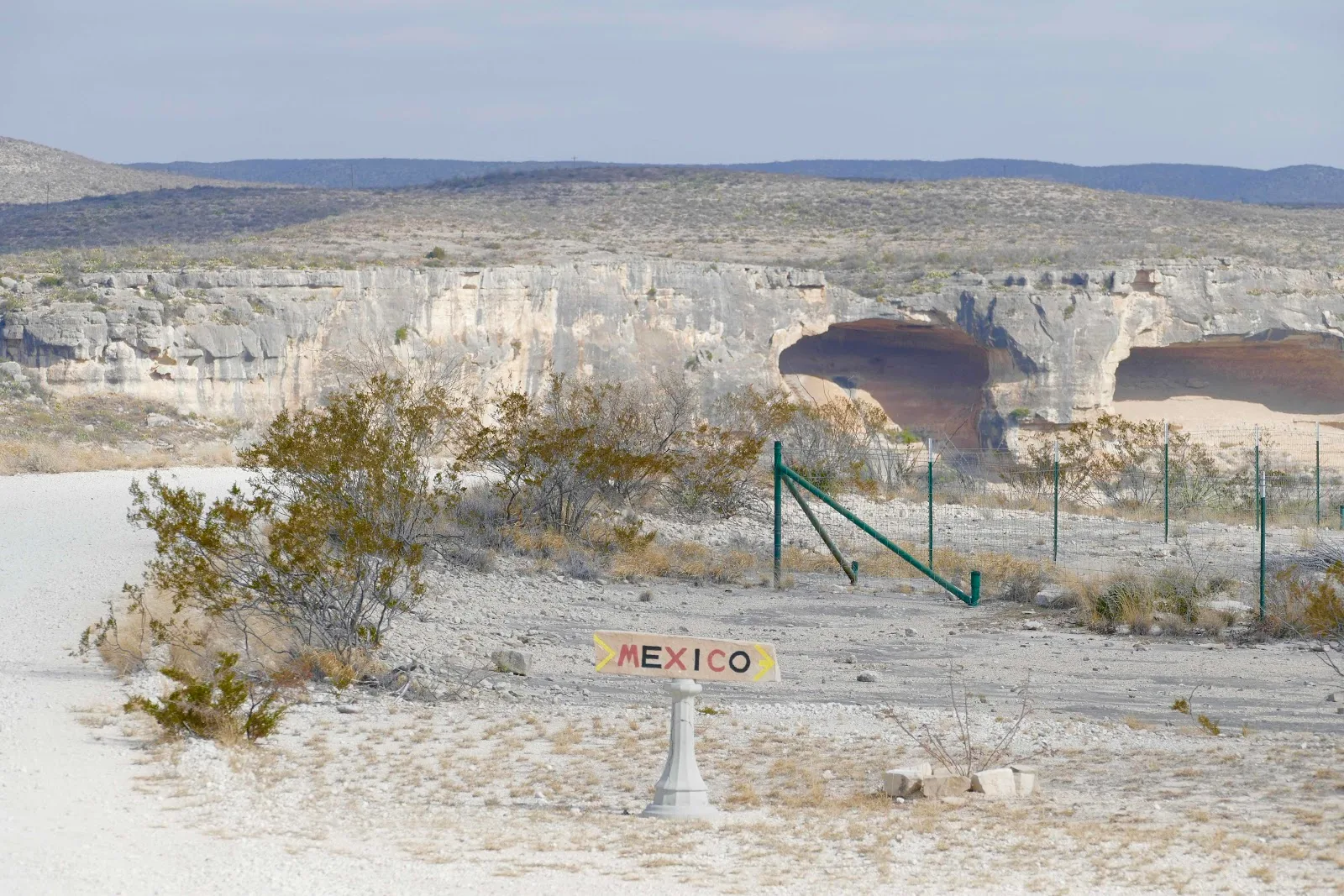
Langtry sits on a bluff overlooking the Rio Grande, the border river known to Mexicans as the Rio Bravo del Norte (the fierce river of the north). The Mexican side of this river is pretty empty all the way to Presidio, with a series of cliffs and canyons housing just two small villages. The American side isn't much more populated with a few small towns, the national and state parks and a road that parallels the river with, we found, hardly any traffic. Little wonder cell coverage is spotty.

That mark of civilization, the postal service is alive and well in Langtry.

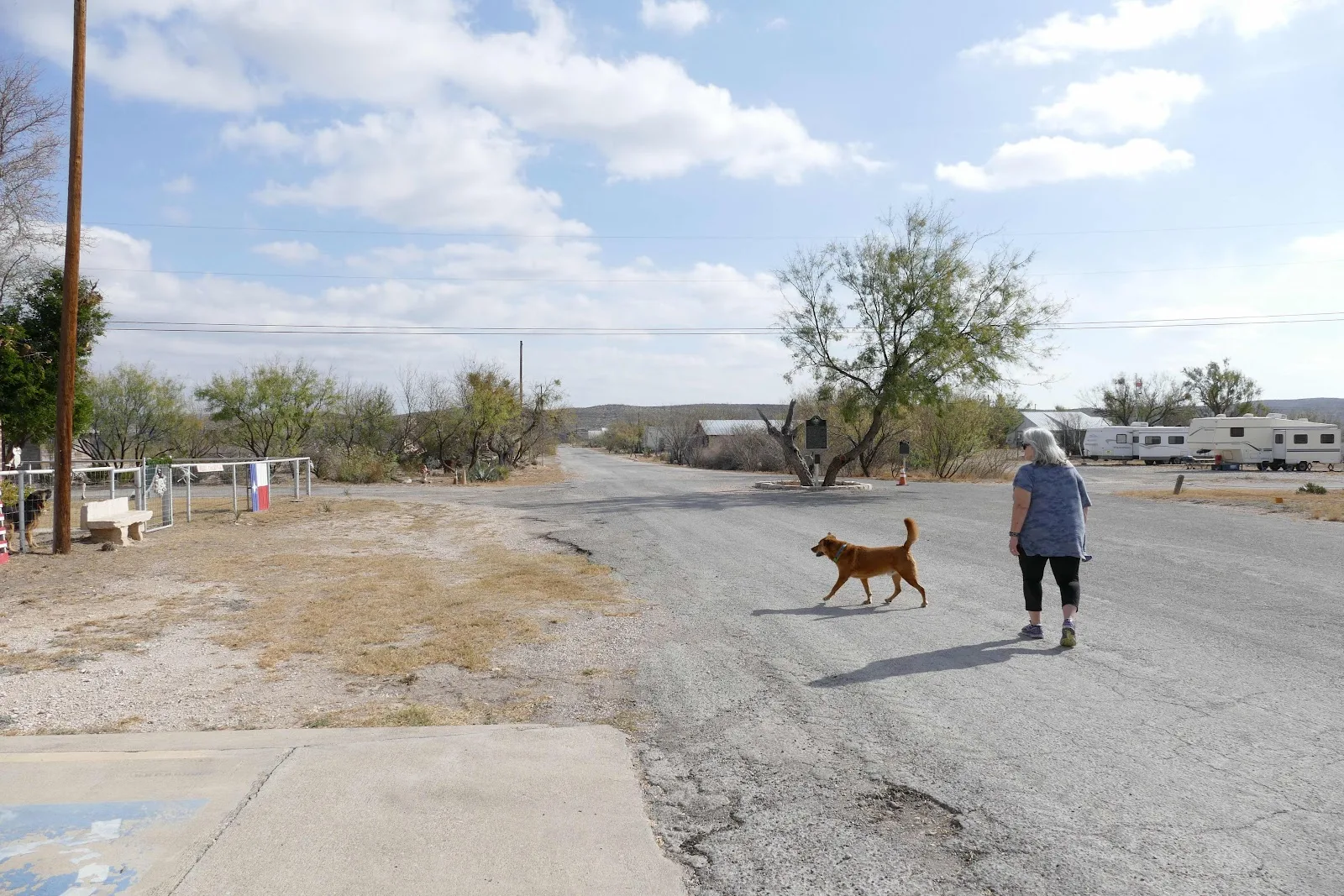
But as you can see they need a Fantasy Fest or similar to get people to show up around here. Rusty owned Main Street and he made the most of it as we walked its length.
Judge Bean applied his own logic to the law. Essentially the good Judge pocketed the fines he levied as his paycheck so if a case, or a defendant didn't look likely to yield a payout he was not terribly interested in dealing with the case. Hence his fame for rapid judgements.

I got the sense from a few historical notes that the Texas Rangers who were the police force in the area were less than enthusiastic about the judge's methods and his judicial reasoning. There is a documented story that a boxing match the Judge wanted to sponsor was not permitted by the rangers so the judge organized the fight anyway. For more color on the colorful judge check Wikipedia: LINK

The only thing was he set the bout up on a sand bar in the rover on the Mexican side of the line rendering the rangers powerless to stop it and not endearing himself to them at all. Especially as his notoriety skyrocketed after this act of judicial defiance.

Locally I saw signs of defiance among the rather raggedy homes and down at heel population. A flag with a picture of a 19th century cannon with the slogan "Come and Take It" rang a rather pathetic note. I don't see any of his fellow Texans lining up to take his guns or his rather fragile self respect..

This shabby little house is worried about the state of the nation, which is rather touching in an ironic sort of way considering whitewash and yard work are beyond his ken or his budget.

There lies Mexico, indifferent to the thoughts and feelings of forgotten Langtry.
Langtry was founded and named in honor of an eagle's nest in the Mexican cliffs of the river, as explained below:

Rusty awoke the interest of this prisoner serving life behind bars. A sweet old boy desperate to play with my superior dog who ignored him and trotted away. 

We said goodbye to Langtry the little town that time forgot but in proper style no one noticed or cared. We headed west toward Highway 90.

We had conceived a desire for ice cream on the warm windy very dry afternoon and we stopped by the shop, which also sells gas for the desperately unprepared. The ice cream was not delicious but the owner  who does not take credit cards did have a pack of Tamales for sale, a frozen pack of twelve for twelve dollars. Irresistible and they were actually very good. However we ended up giving some away to fellow travelers as our freezer is small the tamales were huge. Eccentric shopping seems to fit the style of West Texas.

Back on the road dipping and lifting in long straight lines to the horizon. Excellent driving.


Saturday, December 18, 2021

Seminole Canyon State Park

It so happens that about four thousand years ago on a rainy Sunday afternoon a cave dweller in West Texas was losing his mind with boredom and he picked up a piece of charcoal and started drawing yesterday's catch on the wall.  Pretty soon Prehistoric Michelangelo figured out he could get different colors and longer lasting pigments by mixing melted fat and crushed berries into what he called paint. Most remarkably these extraordinary works of art from a time unimaginable are still there and the state of Texas will let you get a work out to go and see them and learn a little about them.

If my description of the creation of the pictographs at Seminole Canyon sounds facile that is rather the point: no one knows who exactly made the paintings in the caves, no one knows exactly what they represent or what they mean. Essentially they know when they were made and what materials were used but everything else is up for grabs. 

Rusty wasn't allowed on the guided tour and for good reason as it is a bit of a hike and it is too fascinating to be distracted by a dog as lovely as he is. I walked him first and we left him in the van. Had it been summer he'd have had air conditioning but this time of year he was snug with the back sliding windows open. I liked the dog hypothermia warning. Pay attention:

I can't imagine this place in summer with no shade and no relief. Air conditioning on the roof of the van was prompted by our life in the Keys but out here it would be just as critical. Our battery bank is big enough to run it all night without plugging in. We tested it in the Everglades in August.

This is desolation of a different sort:

The sculpture overlooking the canyon is a 13 foot tall statue called the "Maker of Peace" by its creator the late  Bill Worrell commissioned by the State of Texas. 

I mentioned to Layne I had heard of Mormon Tea and she asked me about it and I had to admit I couldn't remember a thing...but luckily we have Google to help us out and I learn it is a natural astringent and the next time you get the clap it could be helpful. I'd go for penicillin myself but in the good old days they had to use was they had.

I counted eighteen people in our party including an incredibly tough well behaved little girl who walked in and out with the adults.  She has definitely inherited pioneer genes because the tour, rated as moderately strenuous started with a downhill walk on a neatly made cement path followed by 225 vertical steps and the tour returned the way it came.

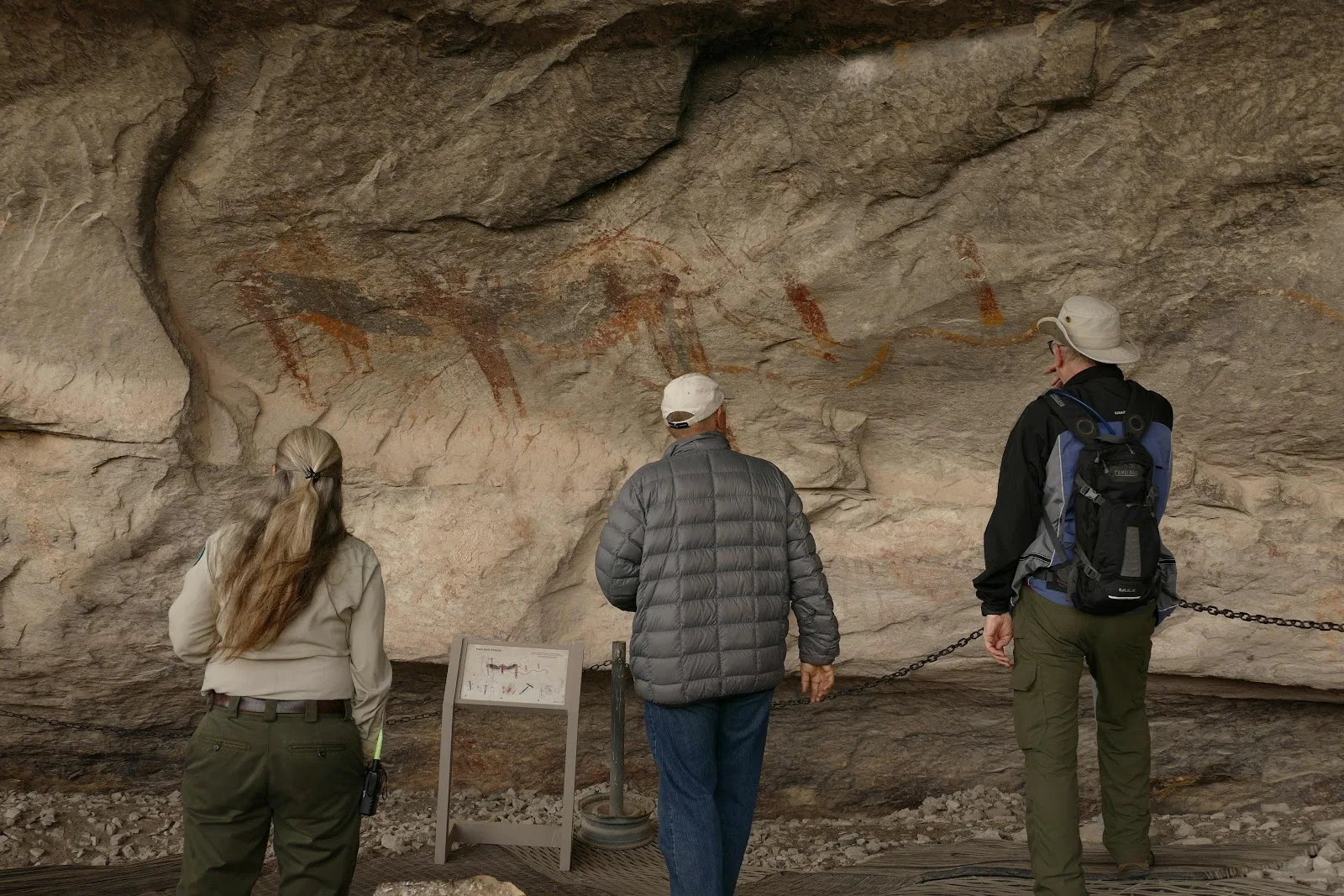
These amazing works of art were the point. 

In the one below I could see a wiggly frame, a line of paint around the figure in the middle. 

The caves are named for the rancher who donated the land, via his widow I believe, and his was the rather odd name of Fate Bell. 

Our guide, one of those incredibly well informed treasures of state park systems everywhere explained that under Texas law land cannot be expropriated unless there are taxes owing to the state (not Federal) government. This means Texas depends on the kindness of its residents to donate worthy lands for preservation. She did allow that ranchers in the area who own  land with pictographs are careful to preserve them but these have been in the state's care since 1977 and opened in 1980. 

The history of this area is actually quite bizarre. Scientists say people arrived fully 12,000 years ago but left no artwork. They say the land was more moist with trees and grasses that supported large mammals like bison and mammoths. Slowly the desert took over and only 4,000 years ago did the people still living here start painting. No one knows why.

This is the stuff you read as you carefully tread the mats to avoid mucking up the paints with dust. But to be there and see these paintings three feet away is quite awe inspiring.

These are decidedly desolate lands but the ranger told us she has seen the canyon in full flood from some distant rainstorms and she says waters can reach a death of fully 14 feet. Mind boggling on a dry day like the one we saw.

I was walking next to a couple who look after similar pictographs in northern Nevada and they were quite fascinated by what they saw. I couldn't translate what they were saying as the language of scientists is dense, but they showed me a phone app that has been developed to highlight such faded artwork. The study of this stuff is one huge sub culture I had of course never heard of.

There they were:


This one below os the most famous of the Fate Bell pictographs, a shamanic figure with antlers on the head and arms supporting wings spread wide. We had a lively discussion about the figure.

The ranger told us Hopi Indians had been brought to the site and they say it has absolutely nothing to do with their people but they pointed out one thing of interest. The Hopi noticed the ceremonial robes were straight at the bottom. In their culture she said such robes are worn by women. Men wear robes that come to a point at the lower hem. 

I thought the shaman might be a man owing to what appeared to be antlers from a buck on the figure's head. This was a five minute discussion among members of the public staring at these paintings. I can only imagine how scientists talk about them after a life time of study. There is so much that is unknown that the detective work to unravel any clue is endless. 

If you want to see them you'd better get a move on. Their life span is running out, mainly because wind, water, dust and sunshine are wearing them down and in twenty years they may be gone altogether.

Apparently scientists have tried to figure a way to preserve them and no one has come up with any ideas that might not end up ruining them prematurely. So they sit, mostly in the shade, but some also exposed to early morning sun, fading slowly away, unexplained and unknowable.

Back up the 225 steps..! Well worth the effort.

We let the party go on ahead and sat for a while staring at the countryside imagining what it must have been like to come across the canyons in the desert, finding shelter where none was apparent thousands of years ago. 

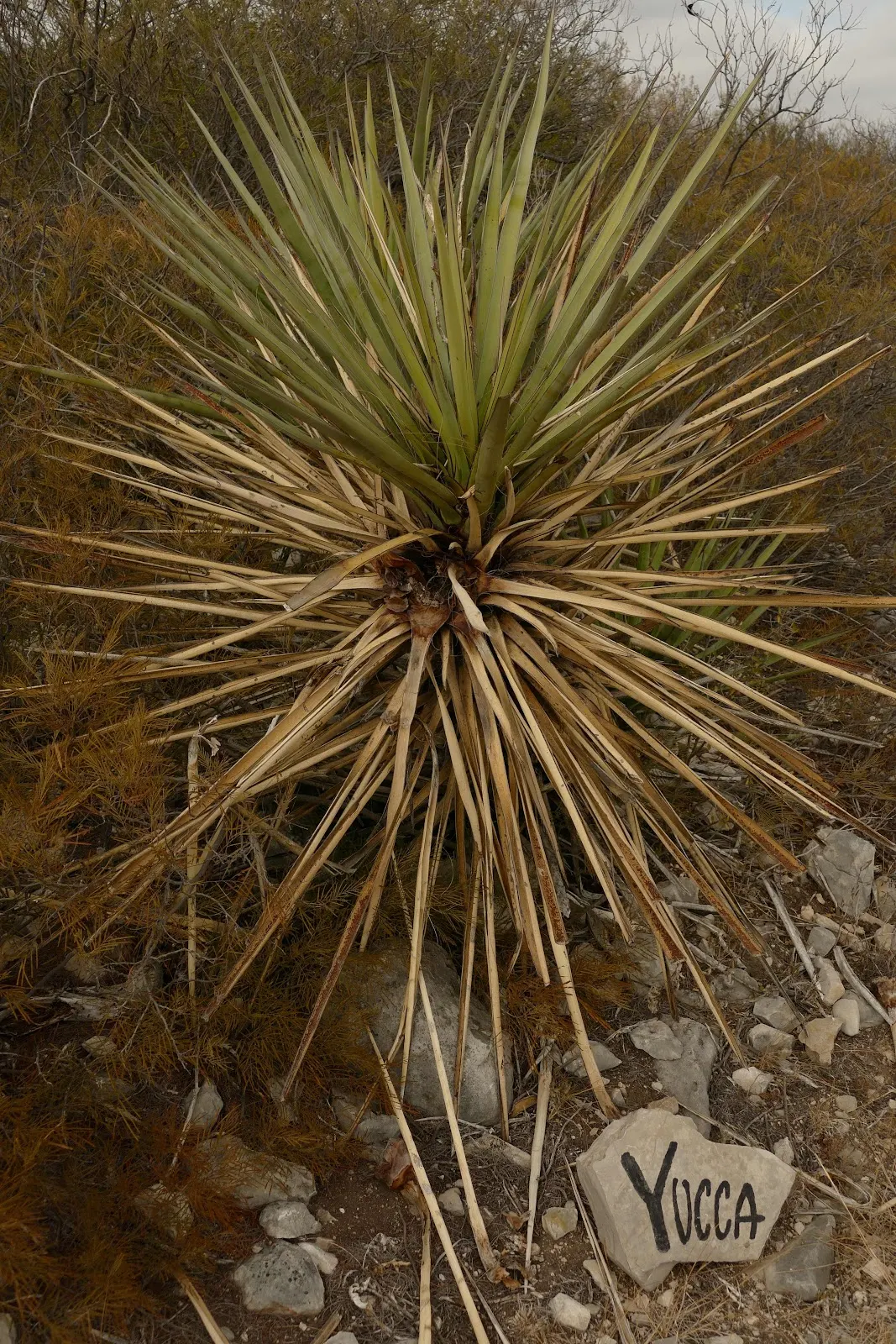
If like me you enjoy eating yucca now you know where it comes from. It doesn't look appetizing to me.

The black and white pictures put me in mind of the late 19th and early 20th century explorers of the western lands who brought  home pictures of what they had seen to the politicians and the people in the civilized eastern states.

The park headquarters has a short film of the various pictograph sites as well as boards explaining the natural and human made fathers of the area.

A word about the name of the park. Apparently the government hired Seminoles from Florida in the 1870s to come to Texas to assist in Indian suppression and protection of the settlers and the border. They were stationed at what is called Fort Clark and gave their Florida name to the canyon lands. I mention this assuming you know the story of the Florida Seminoles who were taken from their homes in the plains and relocated to the marshlands of South Florida, watery land that white settlers at first didn't want to know.
Of course the Seminoles were later found to be in the way of development and several Indian wars followed, based from Fort Myers. At the same time runaway slaves had been fleeing south and joining the Seminoles where they could live free in the Everglades. So when the Army formed the Seminole Scouts African Americans were among their ranks. 
And they have given their name to the Pecos River style of Pictograph painting found close by the enormous body of water flowing through here.
We had lunch in the parking lot, a tuna fish wrap and a cup of tea, hot for me cold for Layne with chicken strips for Rusty and off we went toward the Pecos River and a date with justice as dispensed West of the Pecos. Thus far West Texas has been anything but boring as the landscape is so often stereotyped.