Tuesday, December 7, 2021

Gibsland Louisiana

At 9:15 on the morning of May 23rd 1934 a Ford V-8 came rolling down the Louisiana Highway 154 from Gibsland, where the occupants, two outlaws, had bought a BLT and a fried baloney sandwich for breakfast. The car was coming at speed until they saw a familiar pulp-wood truck parked on the side of the road, so they slowed to speak to the owner Ivy Methvin, the father of their accomplice Henry. The details get mixed up here but it seems that Ivy himself was not present in the most reliable accounts and the truck was parked simply as a decoy. It worked. Prentiss Oakley, Deputy Sheriff of Bienville Parish stepped out of the ambush and opened fire first. He hit the driver, Clyde Barrow, and before the other five officers could open fire in turn they heard a loud scream from the passenger, Bonnie Parker before she too was shot. They loosed off around 120 rounds and the two outlaws reportedly were hit fifty times each. It all happened here;

When I was sitting at my desk on long night shifts waiting for the 911 phone to ring I used to wander the Internet all over the place. Sometimes I would read a headline and chase down the details looking at Street views on Google or checking the history of an incident or place that caught my eye. I have trudged all over the most remote settlement in the world, Pitcairn Island on Google Street View. I have studied the last climb of Mallory and Irvine on Mount Everest in 1924. I got caught up in the life and death of Bonnie and Clyde and found myself surprised by the complexity of an apparently simple piece of banditry. I always wanted to include this post on our drive across country. We drove the back roads of Louisiana to get here and I am grateful to Layne for her indulgence.

Gibsland is the Parish seat of Bienville Parish, a town of of about a thousand people and though it claims to be the daffodil capital of Louisiana I don't think they would get too many visitors were it not for the garishly named "Ambush Museum."

The gift shop is the location of the coffee shop where the bandits stopped to buy sandwiches for their final drive, and they say Bonnie Parker had hers in her hand when she died. This whole Bonnie and Clyde thing is garish and weird and detailed and profoundly odd to me. Despite the many years I worked for the police in Key West I am not an aficionado of true crime stories nor am I much inclined to describe robbers and killers as "Robin Hoods" so for me crime is something I'd rather not deal with in any capacity in retirement. Yet, here I was and not by accident.

If this story doesn't interest you, - and why should it? - feel free to look away. If you want to know more and disagree with the conclusions I have reached feel free and there is lots online on these two characters and the men who took their lives for you to peruse. Below you see the car that was used in the movie with Faye Dunaway and Warren Beatty to depict the life and death of the gang. In my opinion they got the sense of the crime spree but the details were woefully inadequate. 
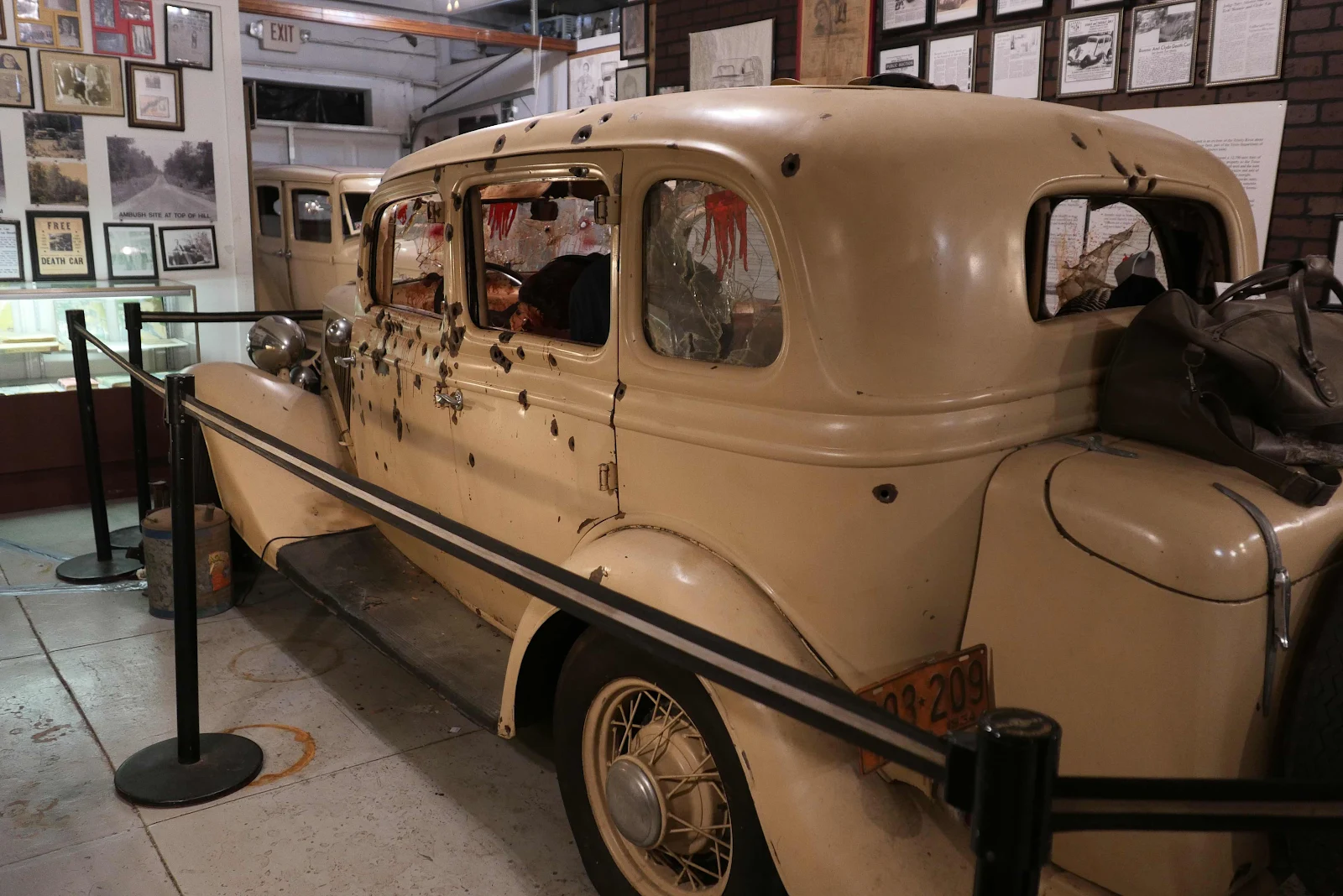
If you want to see more artifacts, the actual car and Barrow's blood stained clothes (!) they are in a casino in Nevada, the kind of institution that can pay the absurd prices asked for these macabre relics. They have some in the small town museum but most of this place is dedicated to photographs, articles and re-creations. And they are dog friendly though Rusty was terrified of the cat that actually owns the place.

Like I said the cat is in charge and keeps a close eye on the mannequins and displays:

Bonnie and Clyde were on the run for four years and by the time they were caught and killed they had dispatched fully nine law enforcement officers and four other people. She was 23 and he was 25.

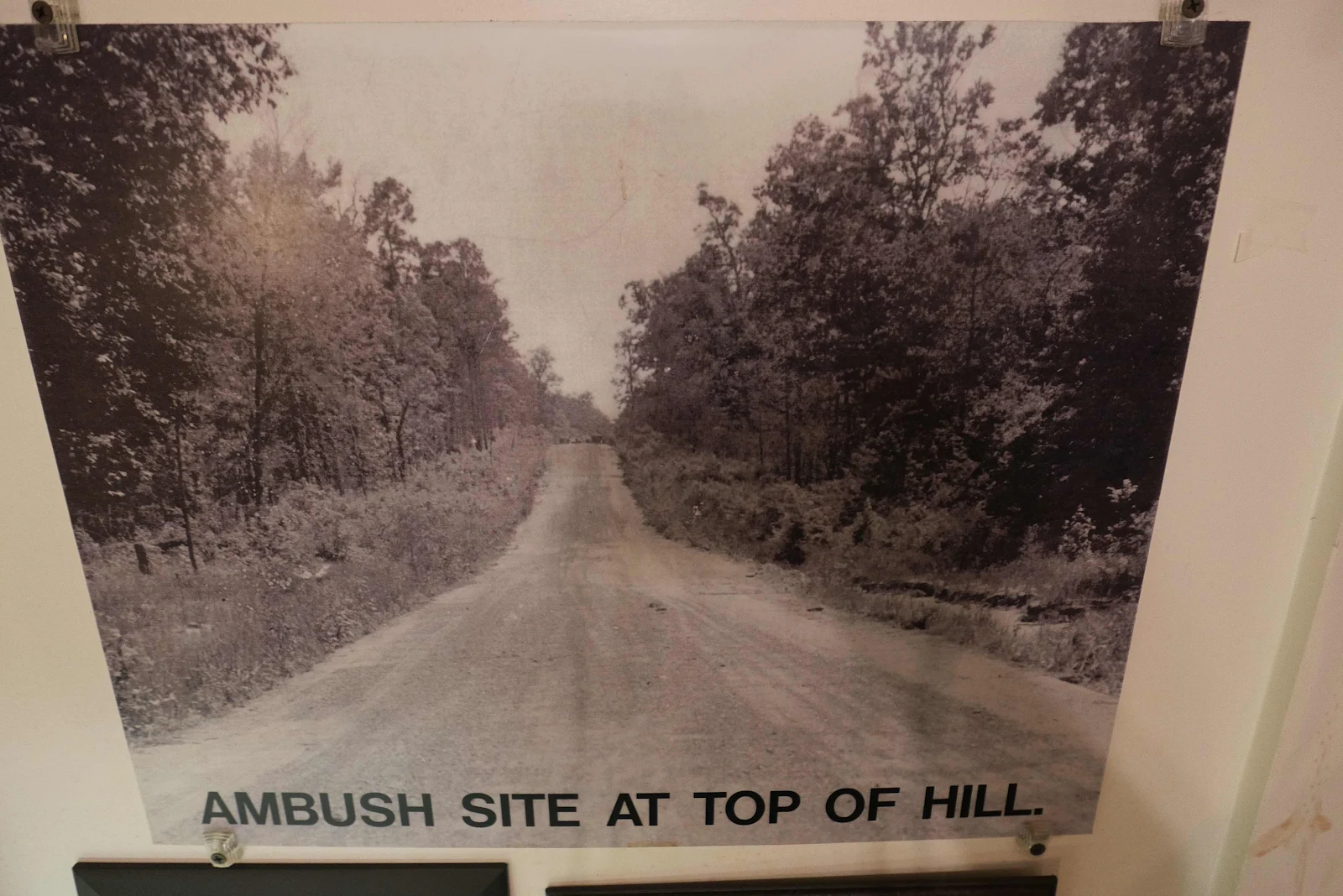
1934 was a time when photography was in full swing and there is a ton of pictures online surrounding the last day of Parker and Barrow but I was surprised by the number of pictures in the museum that I had not seen online. We were going down the road to the spot itself which was of much greater interest to me and I noticed how the road looked back then.Gibsland was seven miles behind the photographer and the hill on the horizon is where the markers are now. 
Three law enforcement agencies were involved, two former Texas Rangers, two Louisiana state police and two locals. They were armed to the teeth and set up their ambush with some care. The details once again are disputed as to how the ambush actually went down but the preparations aren't in dispute. They were led by ex Ranger Frank Hamer who was determined to catch them. He followed their trail, learned their methods and came to the conclusion that he could get ahead of the repetitive pattern their journeys took them on. 

They made a deal with Ivy Methvin to go easy on his son Henry and were ready when Clyde Barrow was supposed to be visiting the the Methvin home in Sailes Louisiana. We drove through Sailes south of the ambush site and it's a crossroads and two mobile homes along the highway. This is a remote area.

Some accounts say the ambushers waiting two days, others say they arrived the night before and waited. It is also said they were ready to give up when at last they heard the car coming down the road. There isn't much traffic today on the road and I wonder if there were much back then. In any event the ambush worked out. You have to think the lawmen were scared rigid of the two killers who had evaded the law for years and been utterly ruthless is pursuit of their freedom. I think that explains the 120 or more rounds fired into the car at close to point blank range.

We parked around the corner form the Ambush Museum and I spent some time on a rather cool afternoon checking the tire pressure on the van as we had had the tires rotated after we had our flat repaired in Ruston. The tire guy had rotated the tires but did not reset the pressure so I got busy and made sure the pressures were accurate front and back. It happened we were parked next to the town hall and police station which were both, oddly enough, closed for the day. I have no idea how a town sustains itself with just a thousand residents.

We left town to drive to the spot I really wanted to see, two small monuments on Louisiana Highway 154, I have no idea why, but I hoped that standing there I might get some idea why Bonnie and crude are such myth makers in American history. 

As we drove the seven miles down the road we were both silent. Later Layne said she felt a creepy vibe, melancholic even as we approached the spot. The road is surprisingly scenic, dipping and curving, breaking out on a hill top just past the "Historic Marker One Mile" sign giving views across the rolling tree covered hills. We came around the corner at the top of the next hill and in the distance I could see the markers next to the telephone poles.
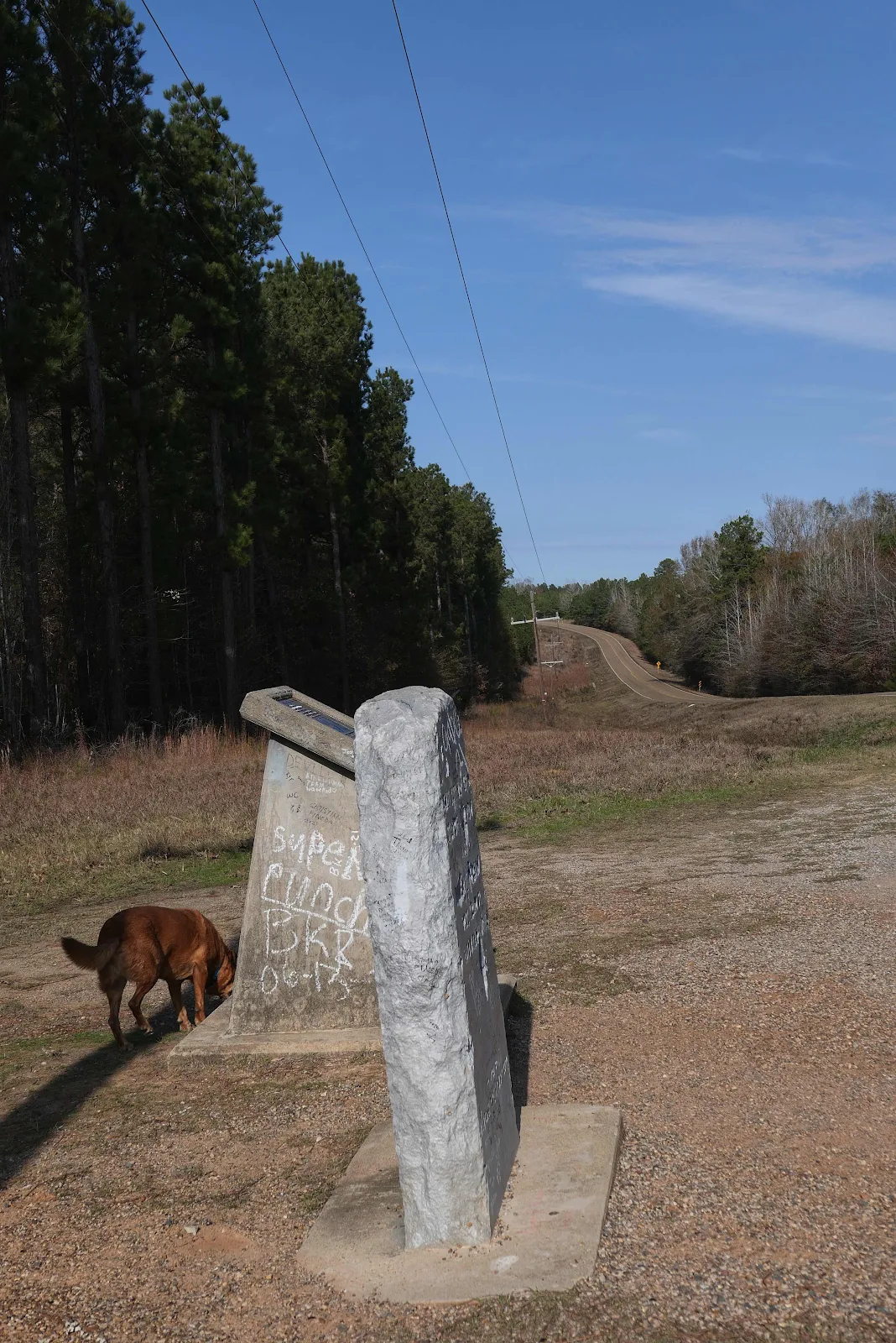
The road as seen in the original photo was not nearly as clear of brush on the sides as it is now to accommodate the telephone poles. There were bushy ferns growing to give cover to the lawmen  who hid in the ditch for a very long time. They were determined not to fail. Lest we forget...they were the good guys in this story.

I wonder if in another life and with other opportunities and certainly a better sense of the morality of life Clyde Barrow might not have made a great salesman. He knew how to feed his outlaw life to the press for maximum positive publicity. He even wrote a letter to Henry Ford a month before he died in praise  of his best getaway car. The Ford Museum has it on display!

Handwritten on paper: Tulsa, Okla 10th April Mr Henry Ford Detroit, Mich. Dear Sir: - While I still have got breath in my lungs I will tell you what a dandy car you make. I have drove Fords exclusively when I could get away with one. For sustained speed and freedom from trouble the Ford has got ever other car skinned and even if my business hasen't been strickly legal it don't hurt enything to tell you what a fine car you got in the V8 - Yours truly Clyde Champion Barrow
Below I have added photographs taken by the pair and found abandoned by law enforcement as the chase closed in on them. I have read speculation that the torrid love affair between them inspired public interest and admiration. Perhaps their occasional acts of mercy, letting hostages go, made them folk heroes. But still they gunned down nine lawmen, people with families and who were as much merely state employees earning a wage, as the hard core G men of the "Bureau of Investigation" in Washington. Interstate crime laws were toughened up after the Bonnie and Clyde affair came to a conclusion, making the job of the G men that much easier to pursue criminals across state lines.

I enjoy being on the road and not being wanted and not having to camp out because I am so notorious restaurants will call the police rather than serve me. Faced with a life of drudgery they made the choice to become notorious, to play to the crowd, in the only way they knew. And they did it appallingly well. Even now these monuments to crime and law enforcement cannot be left well enough alone. The signatures and scribbles and crap attached to the criminals makes me wonder. Do you get glamor from associating yourself with the Bonnie and Clyde Death Spot, as Google maps labels it?

The life they avoided is still on display along the roads in the back country. I can't help but think a life of misery in poverty riddled, Depression era America could have been handled better than a murder spree. I suppose by the time the glamor wore off and the reality of their crimes penetrated the public, who turned their back on them, for them it was too late and they were trapped in the life. It's easy for us to put the glamor back into their myth as we are so far away from the reality of their awfulness. The desire for fame overrides all else in some people and they don't care who they drag down with them. After I saw the spot I celebrated the lawmen who did their duty and apparently suffered their own trauma after the experience, and I still wonder how we can celebrate fame unglued from morality. It still happens today all the time. We humans are weird.


Monday, December 6, 2021

Dog Mining In Louisiana

We crossed the Mississippi River yesterday and I was gad to leave the state of the same name. Roadside litter, inevitable in any state did not seem to be a concern to lawmakers charged with clean up and trash has piled up along the roads in an unsightly manner. I was surprised it annoyed me so much but I was vastly relieved to take a lunch break across the river in Vidalia, Louisiana, whose cleanliness and order were a balm to my middle class soul.

Vidalia is named not for the sweet onion or some other thing but in memory of the city's founder a Spanish official by the name of Don José de Vidal who created the city in 1792. It was a cheeky move as it pushed Spain's possessions across the river into French territory. In 1803 Vidalia got sold, along with the French colonies as part of the Louisiana purchase. In all these communities through which we pass I can only sympathize with the confusion of the residents who were constantly changing language, nationality, currency and allegiance whether they cared or not or had even been told or not.
Layne heated soup and made a salad while I walked Rusty along the waterfront deeded to the city by Vidal and preserved as a pleasant open space with an amphitheater and not one sign of trash, though we took advantage of the dozens of trash cans. I also took advantage of the public toilet, a prison-like affair consisting of a stall with a low wall and no door (!) to discreetly empty our own toilet. We had driven in past some people preparing floats for the inevitable holiday parade and on the way out they were gone.
Indeed they were gone and we found them up the street creating a giant traffic jam on the highway toward Monroe Louisiana...We are not in the Keys anymore I said  to Layne and there must be an alternative route. We turned back toward the river and took a side road out into the fields and farms settled behind the river levee. We drove in a wide arc under gray skies with no traffic and I saw a dog chained to a tree in a yard, and yes we aren't in the keys anymore as such barbarity is outlawed there. It was as pleasant as the washboard road surface would allow. As we bounced along Layne said: "How long is the gravel road to the Arctic Ocean, again?" Oh about five hundred miles I said through rattling teeth, "Not that far, really." Dawson City to Toktoyaktuk. That promises to be fun on the Inuvik Highway.
Meanwhile we had troubles of our own. Gas looked cheap in Jonesville at $3.16 ($3.15.9 but I always round up as I'm not fooled by advertising! Ha!) and I pulled forward to walk Rusty a moment. He likes to get out of the van at every stop and have a sniff and I try to indulge him when I can. Walking back I saw the white spot on the tire and hoped as one always hopes that it was a pebble lodged in the tread but it wasn't. The tire did not seem to be losing air but it was getting dark and our planned stop at an I-20 rest stop was two hours away. What to do? I could pull the screw and stick in an emergency plug from my wilderness kit. We could ignore it and run the risk of a flat front tire on a road with no shoulders in the bayou somewhere. Or I could change it here on the cement pad in relative comfort.
When Key West PD advertised for a Quartermaster a few years ago one requirement was knowing how to change a tire. Apparently it is a lost art among the younger generation. I want say here and now I never call Triple A for tire assistance unless it's a last resort. I had practiced lowering the tire under the van at home, I bought a padded mat to lie on in comfort no matter the surface, I have and use a compressor and I even had a car sized plug repair kit similar to those I have used successfully on my motorcycles. I even bought an additional lug nut wrench for what I presumed would be tougher wheel nuts to remove. I was ready for this. Layne retired to the bed to catch up with her friends on the phone and I got happily to work.
I actually bent the tool slightly as I tried every way I could to loosen three of the five nuts. An older black dude had driven by and offered help but I was so confident I'd said I was fine, thanks. Over confident me. We called Triple A as we had forgotten to activate our Good Sam Membership (!) and help was on the way in 90 minutes. Then Bugger came back. You not okay! he laughed. I explained my predicament. I'll be back he said. I canceled the tow truck.
You can see my salvation in the picture above between Bugger and his happily intoxicated side kick, the long silver fence post. I'm buying one in Shreveport after we fix the tire. Then I will be ready for any flats that come my way! I asked his name and he said: "I'm called Bugger, and people think that's my nickname but its my real name." I was slightly taken aback as I say "Bugger!" when I'm confounded and I don't want Americans to know what the word really means. "That must have been tough at school," I stuttered. "Oh," he said shrugging, "I only got to third grade." He refused our offer of money but his wino buddy, sweet as Walter Brennan in To Have And Have Not ("Did you know you can be stung by a dead bee?") eyed the $25 like all he could see was jars of Night Train stretching out before him. Give it to him Bugger laughed and "Eddie" took the money gratefully.
It was a lovely encounter brought on by my own shortcoming. I was annoyed for a while I had failed to properly prepare and I nearly missed a turn or two in the darkness as I pondered my failure. In the end though it was good that it happened the way it did in the right place at the right time and I know where I will stash that tube we need!
We drove through the dark, arrived at the rest area and ate the barbecued chicken Layne bought at the gas station and it was delicious. And then we passed out. I awoke around seven to the sound of scrabbling under the bed as though the largest rat in the world was sharing our 70 square foot living space. A peal of enormous thunder rolled over us and rain hit the roof of Gannet 2 like hail. I must have been awakened by the thunder I thought to myself. Then I heard the scratching again from under the bed. Layne went to look for Rusty and there isn't much to look at in our living space. Sure enough our traumatized dog, shot at and abandoned in the Everglades with angry farmers for neighbors had crawled up under the bed.
Leave him there Layne said if he feels comfortable. I thought that sounded a bit off but it's true: Rusty knows what he wants and right now he wanted a dark tight space to evade his nemesis. I lay there for a while as Layne tried to get a tire company in Shreveport to answer their phones. Then I got up because I couldn't leave the poor runt squashed up under the bed like a Russian miner under a roof fall. I got up, got dressed, fumbled for the umbrella and put on my head lamp. "Are you going dog mining?" Layne asked. I never thought this would be one the tasks of van life but here I was ready to go out the back in the downpour and pull my dog to "safety.".
I was reluctant to get out as it was pouring with rain and as I dithered the scrabbling and scratching started again and sure enough a small brown face reappeared under the bed. We waited together for the rain to ease and we ended up going for a splash filled walk.
I felt better once he felt better, but I think the storm was fierce enough to make telephone communications awkward. We couldn't get through to Shreveport so we will stop after our planned and long delayed stop on the way, and the we get to the city we will see what's what this afternoon. It's at times like these that not being on a deadline is really rather lovely.

From the 1944 movie Walter Brennan with Lauren Bacall:

  • Eddie Was you ever bit by a dead bee?

    Slim Were you?

    Eddie You know, you got to be careful of dead bees if you're goin' around barefooted, 'cause if you step on them they can sting you just as bad as if they was alive, especially if they was kind of mad when they got killed. I bet I been bit a hundred times that way.

    Slim You have? Why don't you bite them back?

    Eddie That's what Harry always says. But I ain't got no stinger.

Sunday, December 5, 2021

Morning Cuppa Tea

Hands up anyone in the class who knew tea is grown, commercially and successfully in the Untied States? Anyone? So let me just say I did my best to follow along as we got our tour at the Great Mississippi Tea Company but the details in the two hour talk got a bit fuzzy. I love tea but apparently I know very little of how it's made. I know more now and I shall pass ones many details as accurately as I can, but bear with me.

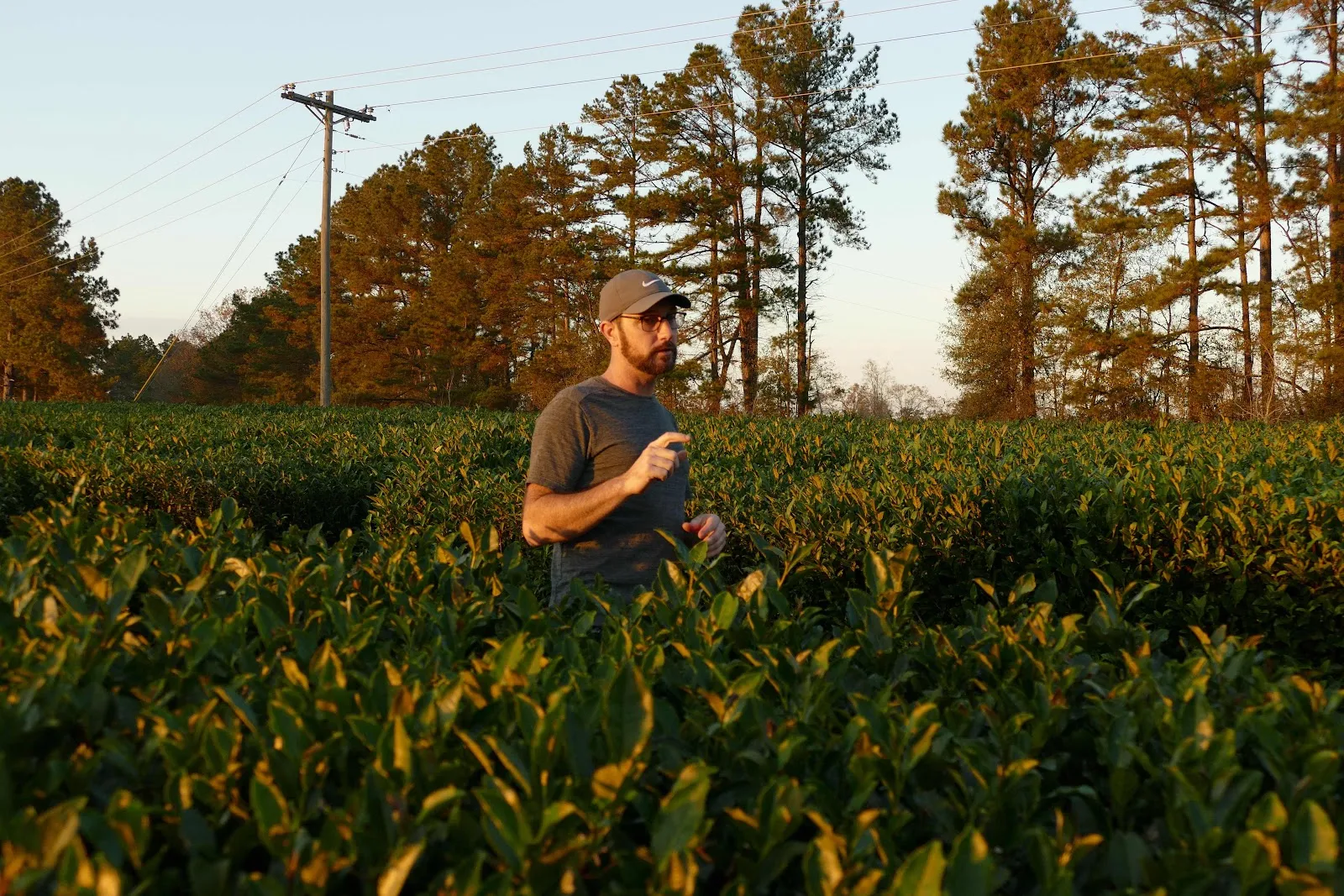
Layne found the Harvest Host stop in the middle of nowhere Tennessee, more precisely Brookhaven somewhere northwest of Hattiesburg. She was dead keen to spend the night there. and I was ready to indulge her whim. I thought it was a retail and blending store and wasn't I surprised when we rolled up on a tea plantation of seven acres of bushes, actual tea plants.  

The host, Timmy, was very casual about Rusty who I discovered absolutely loves exploring rows and rows of tea bushes. He was happy as a clam. We were the second RV over fighting and a tour was about to start with the first couple which we enthusiastically joined. Off we went...

Apparently Thomas Lipton, the Englishman famous for tea sales in the US did actually grow tea in several southern states and the problem wasn't the growing. It turned out the tea couldn't be harvested and processed at competitive rates, and you'll soon understand why. Tea is grown where it's grown because it is -in short- cheap to do so. Fact number one I learned!

Timmy loves his job and he explains it very well. Fact #2: tea is the most complex plant in the world and once you get the seedling of cutting into its third year it is pretty much unstoppable and will grow no matter what. They do have drip irrigation on their seven acres but tea plants are strong.

Timmy and his partner Jason inherited 300 acres of land from their grandparents who raised dairy cattle here. They didn't want to raise cattle so they wondered what they might grow, and for some reason they settled on tea which takes years to mature and produce and no one else around grows the stuff. Timmy did say, Fact #3 there is commercial tea grower of some size in every state in the union. Their operation is the second largest in the country and I can't remember who is bigger. No familiar name at any rate.

They sold the cows and all but 36 acres and settled down to grow tea. Their planting and seed growing operation is what you see above, and it ain't much. But what you need to keep in mind is they are expanding, hiring (if they can find anyone who wants to learn tea production) and are even exporting. Before Covid they tell me Fortnum's and Mason's in London sold their tea. That is a well known shop so these guys aren't messing around. Fact #4 : Mississippi tea in a high end London emporium. Their first year they produced ten pounds of tea several years after they started planting cuttings in 2012. The planned production rate is a ton of tea per acre and they have seven acres growing into maturity now.

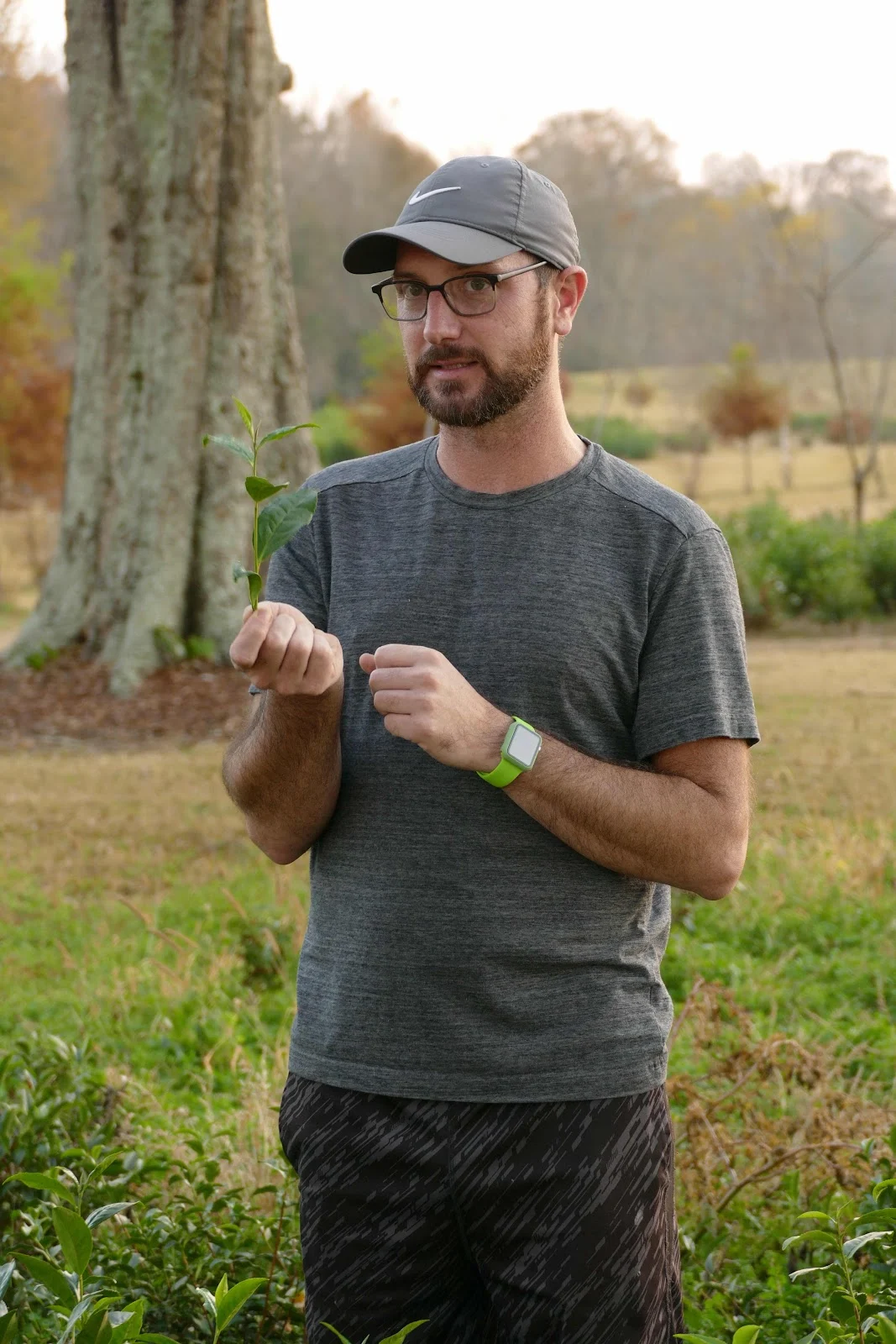
They sell black, green and yellow tea, which last no one has ever heard of as only in China (and now Mississippi) is yellow tea produced and sold. Fact # 5 all teas come from the same leaves, as the flavor and style is in the processing. Timmy stripped a tea plant showing which leaves are used for which color tea. Only Oolong uses the whole stem. He described it as their most floral tasting tea. By now I was gasping for a cup, like a chocolate addict in a chocolate factory.

Incidentally the weather was perfect yesterday, sunny and 75 degrees, shirt sleeves even after dark and no sweating. Eventually a ground fog came up after dinner and Rusty came into the van and went to sleep as we closed the door on the night sounds and stayed quite comfortable with no heating or cooling required.

Rusty was free to roam and in the morning I got up late - hey! I'm retired! - and wandered around with my camera and occasional views of my dog's tail chasing back and forth between the rows of tea plants.

A neighbor deploys bees to take advantage of late blooming tea plants:

But back to the tour. After we studied plants, growing methods and leaf types Timmy walked us across the road, where locals don't slow for pansy tea tourists ambling along the shoulder... and we entered the world of Chinese tea making. Not that our guide has ever been to the Far East to see where tea has always been grown. They use an agent to ship their piles of equipment.

I can't detail the process as it would take ages, I didn't take notes and I was overwhelmed by the steps but everything is precise,timed to the second and processes are repeated until the desired degree of drying and rolling and  even bruising is achieved. Chinese drying racks for black and green teas which get different lengths of time to lose their moisture:

The roller which came with no manual, no YouTube instruction video or even any warning signs in English. Any paperwork the tea makers needed translating they emailed to a Professor of Chinese Studies at the university for her attention.  

There is a line of machines to dry and roll and curl and sort the different teas desired and all from the same bushes outside. I had absolutely no idea tea making was so complicated. It has so many steps, so often repeated it makes wine making look simple.

You dry leaves repeatedly, curl them so they don't flatten out and even bruise the edges so they release their flavors properly. You pick leaves one day a week and instantly start on this multi step job that takes hours of precision work. From here on I promise to drink my tea, whatever brand it may be, with due reverence and respect.

The Chinese don't build this stuff for export, and the measurements are all metric, even though Timmy thinks of Celsius in degrees Fahrenheit which I think is weird. He says his employee doesn't even are about the numbers. She just knows Green tea gets say 2 unites and twenty seconds at 90 (Celsius) and black gets four minutes fifteen seconds at 60. Where American electric motors can't be used the Chinese send adapters, hoping you can read Mandarin.

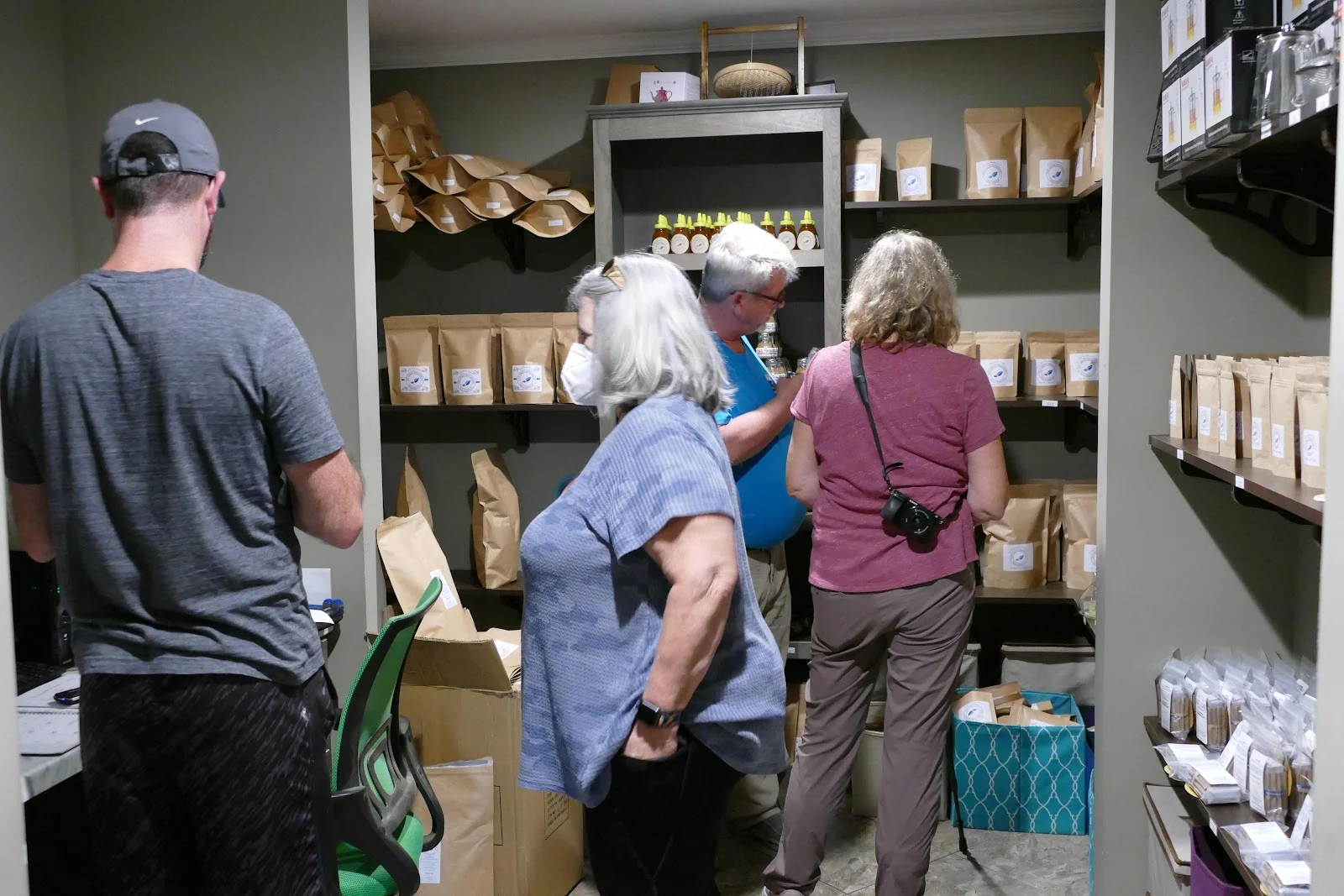
The tearoom, the holy grail of the trip. Harvest Hosts welcome RVs, offer no facilities for the vehicle so we dry camp for free and the idea is the hosts are rewarded by selling a little of what they produce. We obliged as you might imagine. 

We got Chai for Layne and some green and yellow tea for me. Yellow tea incidentally is fermented by the Chinese, a process Timmy adapted by putting leaves in a vacuum bag and submerging them overnight in a sous vide water cooker overnight. If you are tempted they do ship, obviously.

The other couple from Illinois in a more conventional forty foot home with all accessories said they were interested in the farming but all they drink is iced tea - barbarians! There were teas for them too of course. 

In the morning Timmy rolled by with our tea orders, Chai for Layne and the mysterious yellow tea for me. I found it quite interesting lightly sweetened. It tastes like strong tannic green tea. Fact #6: Incidentally Timmy says the white tea that has become popular only uses the very tip of the plant and requires one hundred thousand leaves to make a pound of tea. Too fiddly even for his immense patience. I can't even taste white tea so I am not a fan.
Bees humming, birds chirping and yellow tea to hand. Rusty was off minding his tea bushes nose down and tail up. 

Eventually he too slowed down and settled to watch the world, his favorite activity.

Ed the coffee drinker came by and we exchanged thoughts about tea and travel and the hope that the virus will fade away. he has moved full time into his rig and he says they like to wander around looking at small farms and local producers all over the country as his wife grew up in a farming family. The pleasure of retirement on the road is where you find it.

Everything climbs to the apex is how I would translate the poster, I hope accurately. Slightly obscure but the French often are. 

I'm actually quite glad the boys didn't stick to conventional farming making milk or butter or something banal. Tea in Mississippi? Why not.