Showing posts with label Webb Chiles. Show all posts

Monday, October 12, 2026

Webb Chiles 6

Webb Chiles is publishing another book. It’s available to order now on Kindle but it’s available to read November 14th.


There won’t be a paper edition in a world where publishing photos costs money and we are, most of us all electronic, but that suits me the nomad with hundreds of books stored on my Kindle reader. I’m looking forward to GANNET 6 not least because Webb knows how to write about travel. In a world filled with illiterate influencers I am eager to grasp good travel writing where I can. 
If you don’t know who Webb Chiles is there is a biography attached to the book: 

One of the world’s most experienced sailors, Webb Chiles, set out on his sixth circumnavigation at age seventy-two.  No other American has ever circumnavigated six times in his own boats.  He was seventy-seven when he completed the voyage.

On his first circumnavigation, completed fifty years earlier, he became the first American to sail alone around Cape Horn and set what was then a world record for the fastest circumnavigation in a monohull, breaking Sir Francis Chichester’s record by more than three weeks.

Two years later, seeking an even greater challenge,  he set off to circumnavigate in an 18’ open boat, an undecked Drascombe yawl, in which he crossed both the Pacific and Indian Oceans, before after 20,000 miles being arrested and held as a spy in Saudi Arabia.

Webb Chiles has written that the defining responsibility of the artist is to go beyond the limits of human experience and send back reports.  That is what he has done for fifty years.

For his sixth circumnavigation he chose an unusual boat, an ultralight Moore 24, known to sail exceptionally well and intended to be raced around buoys in harbors.  Some had been raced to Hawaii, but no one had ever sailed a Moore 24 farther.  Even at seventy-two, Webb Chiles wanted to push limits.

He named his boat GANNET, after birds he admired when in New Zealand.  He made her totally self-contained.  Once he owned her she was never connected to shore power.  She ran from sun, wind, and his aged muscles.

The voyage was one man sailing alone, without sponsorship or shore team.   And it was sailed.   In 30,000 miles GANNET was under (electric) power for less than 15 miles.

It is an inspirational true tale for readers intrigued by what can be done in old age, at any age, if you have the will and the gifts and don’t let others define you.

GANNET 6 is more than just a sailing story.  Webb Chiles has been called the most talented living writer in the sailing world.    It has often been said that he takes the reader with him into his boats, causes them to feel the experience of fifty-knot gales, masthead in the water knockdowns, as well as the beauty and serenity of what he calls the monastery of the sea.  

But he writes about more.  About the places he visits,  often visited before.  The kindness of strangers.  The books he is reading.  The changes in the world he has seen.

Readers attracted to what they think of as an adventure should know that Chiles, who is an original, has written:  “Amateurs  seek adventure; professionals  seek to avoid them”;  but still in GANNET 6 there are storms, knockdowns, freak waves, and soul eroding calms.

GANNET 6 will take you where you have never been, and may make you seek to do more than you thought you could.  If so,  Webb Chiles will be pleased.

Gannet:
The great cabin:


Read this excerpt then decide for yourself if you would go sailing or drive a delivery van in comfort: 

As soon as I opened the companionway I knew we had too much sail up. The wind was much stronger than I had realized down below: gale-force. GANNET was being overwhelmed.

I hesitated only a moment before deciding to let the main halyard go and continue under furled jib alone. The windward running backstay was already in place as had become standard practice when I expected the wind to be on the same side of the boat for an extended period. The fully battened main slid down the Tides Marine track. I grabbed a line from a cockpit sheet bag, crawled the few feet to the mast, and, hanging on with one hand as twelve to fifteen foot waves crashed over us, crudely lashed the sail to the boom. Back in the cockpit I felt that even the remaining scrap of jib was too much and furled it down to T-shirt size.

The fourth and last tiller pilot had died the night before so GANNET was sailing on a close reach with the tiller tied down, but the tiller pilot had lasted long enough to make it possible that we would reach Opua on this day after a three act passage from Neiafu.

The first act was fine sailing with GANNET covering almost half the 1200 miles in four days with days runs of 131, 144, 145, 145.

Act two was nearly incredible as we sailed through a high-pressure system. For three days GANNET made only sixty to seventy miles a day, but she did so with no apparent wind. The days were sunny, the ocean flat. We might have been in a perfect anchorage, except the water was miles deep. The little sloop kept moving when almost no other sailboat would have. She was perfectly level, and the tiller pilot almost silent. Our course was straight. There wasn’t a ripple to cause the slightest deviation. I stood in the companionway and tried to find the wind.

I turned my head from side to side to feel it against my skin. Nothing. I held up my hand. Nothing. Yarn tied to the shrouds hung limp. GANNET sailed on wind imperceptible. And those improbable two hundred miles had brought us within forty miles of Opua and Act 3: a chance to get in before the northwest gale backed southwest and headed us, effectively shutting the door and keeping us at sea for several more days.

I have always sailed without outside assistance. No sponsors. No shore team. No PR agent. No weather routers. But I do not consider it inconsistent to listen to AM radio as I near land, and so I had heard the forecast on Radio New Zealand National, though I know how wind circulates around lows in both hemispheres and would have expected the wind to back given the falling barometer.

For that matter the radio forecast was partially wrong, predicting the west wind would veer northwest the day before. I very much wished it had. Twenty-five knots on the beam would have made the ride easier and faster and we would have already been in. But the wind remained west until well after dark, and GANNET labored south at around 210º True.

After more than 6,000 miles in four months, the little sloop was unraveling. Tiller pilots were dead. The port pipe berth was unusable after the tube had jumped from its socket when GANNET became airborne off a wave and crashed into a trough. One of the two floorboards was split along its full length. Insufficient solar charging was caused by two of the six panels not functioning. GANNET’s interior had never been wetter, messier or more chaotic.

There was not a dry surface anywhere. I had slept the night before—when I slept at all—in full foul weather gear, including sea boots, with a sleeping bag as a blanket over me. We needed to reach port before the cascade of failures become a torrent.

During the night the barometer dropped sharply, and the wind began to veer perhaps being bent by the land. Now, finally, it was on the beam which was good and bad. GANNET was thrashing into the waves, but she was heeled 30º to 40º, and when waves broke they rolled her dangerously.

Taking a flotation cushion to sit on I made my way aft to the tiller, untied it, and turned GANNET a bit farther off the wind, bracing myself with my left sea boot on the far side of the cockpit and my right on the post through which the backstay control ran up to the main sheet traveler bridge.

The overcast sky was dark, solid and low. It seemed to press down on us. I could feel its weight. Rain was falling, colder than the water from the ocean. Although it was 0900 the light was that of pre-dawn. And when darker lines of cloud came toward us, which I quickly learned meant a five to ten knot increase in wind and torrential rain, the sky was night, but the surface of the ocean frothed ghostly white.

GANNET was not hard to steer. But the waves were coming from starboard, slamming unexpectedly into and over us, literally blindsiding me. They were hard blows, as though we were being punched by a ranked heavyweight. Several knocked me from my seat, lifting my body so that I started to fall forward and down into the sea. I couldn’t possibly leave the helm long enough to go below to get my safety harness, so steering with one knee, I looped a sail tie through the slotted toe rail and tied a bowline as a strap for my right wrist. Now so long as my arm remained attached to my body, I would remain attached to GANNET.

When the heaviest rain hissed down, I couldn’t see the mast-mounted Velocitek and steered by feel, turning GANNET and surfing down waves. She ran beautifully true with no tendency to round up, her bow wave rising above the deck. When visibility returned, I often saw speeds of eleven or twelve knots on the Velocitek, but by then GANNET had slowed, so I don’t know how fast she had gone. Whatever the number it is the fastest I had ever sailed.

I couldn’t see my watch, but after what surely had been an hour, I started looking for land. Cape Wiwiki should be off the starboard bow. Cape Brett off to the south. The nine mile wide mouth of the Bay of Islands in between. But I found only cloud.

I had to twist my neck a long way to see the oncoming waves. Surfing down some, I turned up into others—a split-second decision, often based on how much crest was toppling, sometimes based on instinct. Still a few caught us and rolled GANNET almost to 90º, until feet braced, tiller in left hand, sail-tie strap around right wrist, I was standing parallel to the surface of the ocean and looking down into it. As the waves passed, gravity brought GANNET back onto her keel and sat me down.

Beneath my heavy set of foul-weather gear, I was wearing a Polartec fleece and Columbia Omni-heat pants over my usual shirt and Levis. Despite rain and waves, they were staying dry and only my exposed hands were cold. My left knee began to feel the constant strain. I tried to ease it and take more weight on my right foot.

The last position I had seen on the iPad Mini chartplotting app before coming on deck put us twenty-four miles north of the waypoint at the entrance to the Bay of Islands. Surely we had covered seven or eight miles since then. But still no land.

Another estimated hour passed. We shouldn’t be more than ten miles out—perhaps less. Land should be visible. And then, off to the south, clouds thinned and Cape Brett materialized, followed by the ridge leading west from it. Pleasure flooded over me, as well as a wave, both at seeing the familiar landmark and because it was the first solid indication that we were likely to make it in before the wind backed.

A little later Cape Wiwiki appeared much closer. I began to steer more toward it, wanting to stay to windward as much as possible. I knew that even this close we could still be in trouble if the wind suddenly headed us and we were forced east of Cape Brett.

The low, dark clouds continued to lift, and patches of blue sky appeared ahead. I expected the wind and seas to diminish as we closed the distance to land, but they remained strong until Cape Wiwiki was abeam.

As we entered the partial shelter of the mouth of the bay, I was able to tie down the tiller long enough to duck below to grab a protein bar.

GANNET’s bilge has a narrow sump. Usually in rough weather a couple of inches of water collects there and I pump it out with a hand pump that has a hose long enough to go out the companionway and reach overboard. With us now heeled 10º to 15º the bilge was overflowing. I got the pump and emptied it. But when I went down an hour later it was full again, and I began to wonder if the hull was cracked.

I took the protein bar back on deck just in time to see two of GANNET’s handsome namesake birds glide across our bow.

GANNET meet gannets.

We still had fourteen miles to reach the quarantine dock at Opua.

While the water was smoother, squalls that buried the lee rail continued to hit as we sailed deeper into the bay. I furled and unfurled the jib, and alternately hand-steered, tied the tiller down, hand-steered.

Familiar islands drew closer, a cloud of birds on Bird Rock, white with guano; vivid green hills; exposed brown cliffs falling into the sea; tiny foot-long penguins bobbing on wavelets. I smiled when I saw Paradise Cove on Urupukapuka Island where I have often anchored, and the lookout platform high on Roberton Island to which I’ve often climbed.

Not until we made the final dogleg turn beyond the rocky ledge off Tapeka Point, just north of Russell, did the wind moderate. I brought GANNET about and hove to so I could fit the outboard bracket, Torqeedo, fenders, dock lines, and Q flag. Then I turned us and continued south under sail. I knew the way.

Just north of the car ferry crossing, within sight of the quarantine dock, the wind died. I furled the jib, turned on the Torqeedo, and lowered the main. Misty rain began to fall as we powered the last two hundred yards at dusk.

Opua’s quarantine dock is the easiest to approach of any I know in the world. I had GANNET prepared to tie up port or starboard. With no wind the current was decisive. It was running out, so I continued forward to tie to port.

GANNET and I were weeks ahead of the herd. The long marina breakwater, of which the northern two hundred feet are the quarantine dock, was empty. I turned the Torqeedo tiller arm to neutral, glided the last few feet, stepped off, and tied dock lines.

I went back on board and into the Great Cabin for the bottle of Laphroaig in which I had saved an inch for that moment. Crystal glasses broken, I poured my favorite liquid into a plastic tumbler, straightened up, and, still wearing foul weather gear, stood in the companionway indifferent to the light rain, which was nothing compared to the total immersions of the morning. The little sloop’s deck came to just above my waist. I looked around at familiar hills and took a sip. Then I took another.

The date was September 20, 2014. We had sailed from San Diego on May 20. 6,408 miles by day’s runs in four months—or, actually because of crossing the International Date Line, a day less than four months. And from Neiafu we had again come remarkably close to sailing the rhumb line with day’s runs totally 1208 miles for a minimum possible distance of at least 1190.

Passage over.

Ocean crossed.

And though an American and not a New Zealander, I was home. In coming days I was honored to receive emails from several New Zealanders welcoming me back to my second home.

The New Zealand Met Office reported that the wind gusted fifty-five knots that day with 4.5 meter/15’ waves.

That night the wind backed to the southwest, closing the door on a 31’ cutter that left Neiafu the day after GANNET. She reached Opua a week and a day later. In harbor, water continued to trickle into the bilge from odd corners of GANNET’s interior for several days, and then stopped. – Webb Chiles


Tuesday, November 2, 2021

Driving Webb Chiles

There was a joke making the rounds in the Brezhnev era in the Soviet Union that came to mind Monday morning as I went out with author and circumnavigator Webb Chiles. The connection to a common-or-garden daysail may seem tenuous at best but it was a feeling I had all morning as I went on a modest boat ride with a man revered by sailors the world over for his fearlessness and ability to manage peril on the ocean. 

It seems President Leonid Brezhnev had a penchant for Western cars and he apparently imported many to his dacha (vacation home) outside Moscow where he would test them out. On this particular day he decided he wanted to take the wheel and he told his chauffeur to sink into the luxurious seat in the darkness of the rear of the limousine he had chosen to drive.  The gate guard saluted as rigidly as ever as the supreme leader of the Soviet Union rolled by.

"I just saluted the man who really rules the country" the guard told his colleague in high excitement. "Who is he, then?" his colleague asked. "I have no idea," the first guard replied. "But Brezhnev is his chauffeur."  

Somewhat to my surprise Webb agreed to go for a daysail with me, which is odd as a casual sail for Webb might involve a couple of weeks and a thousand miles, which seemed unlikely for us as we only had a morning at our disposal. What a morning it was! Sunny and warm with a light breeze and glittering waters outside the marina on Skull Creek. "I'll be the passenger," I told Webb because even though I enjoy sailing to undertake a task sitting next to a sailing legend might, I figured, break my last nerve. 

My friend Wayne sent me a message after seeing a photo of me out sailing: Judging by your man-out-of-captivity facial expression on Webb’s boat I’d guess maybe it was among your best birthdays?  
"Take the helm" Webb said in a tone that brooked no discussion.  I plunked my tightly sphincter bottom down where his rear had sat for thousands of miles between here and here by way of Darwin, Australia, and tried to concentrate on sailing. To make matters worse the creek is narrow and winding and the wind was at just the right angle to require the ultralight Moore 24 to tack and tack again. Sailors call it short  tacking as you buzz madly from one side of the channel to the other, trying to make each tack count while not running into shallow water and mud at the end of each leg.

"Watch the depth sounder and if it goes under twenty feet call out," was the first instruction. I felt a light trembling through the tiller as I sat next to my very agile 79 year old line handler and kept glancing at the depth sounder and trying to keep the sails full and drawing. "Point higher," he said and obediently I drove the boat closer the wind, closer at an impossible angle and of course the racer turned long distance  thoroughbred of a boat responded just fine. One had to assume Webb knows what he's talking about when he gives direction (!) and the ride became a wonderful series of swoops, occasionally heeled hard and sometimes riding flat and fast. It was tremendous fun.

As the depth sounder hit 19.9 we'd get ready to turn and I'd push the tiller away and lumber after it in the unfamiliar space. Webb leaped from side to side like a teenager hauling in the jib sheet and watching the situation develop as we sailed back and forth up the creek toward the sound. I have no photos of this section of the sail as it was a bit busy for poor old me, the least legendary helmsman in the history of Moore 24s, a boat which was built in Santa Cruz where I lived as a new immigrant. Also the town where I once delivered a pizza to George Olson, known as the "father" of ultra light sailboat design. I was young and paid for my VW van by working for  Pizza My Heart doing deliveries to the great and good around town which included famous names and hungry bored whores. That was a job with a few stories I should get around to one day. Anyway the former pizza delivery youth was now helming the world renowned sailor up the creek...and feeling nervous.

Lots of boats passed us, all under power many creaming bow waves and leaving largish wakes behind them. I kept my eye on little strings of wool attached to the foresail such that we were in the groove when the string flowed back horizontally showing clean passage of air over the sailcloth. That and watching the depth sounder kept me busy enough not to keep harking on who it was who was sitting next to me. A friend, yes, but in his element, and what an element it is. I was not wanting to let him down.

As the other boats passed us, sailboats using engines not sails, I had to wonder who among them was wondering who that famous sailor must be? They couldn't quite place him but he must at the peak of his sailing powers obviously, because no lesser a figure than Webb Chiles was his obedient crew!

On the way back from the sound Webb relieved me at the helm and replaced me with an electronic device that steers without human intervention, following the trend of grocery stores given to automating checkout cashiers thus eliminating the human touch. In this case he gave the human touch a chance to sit back and enjoy the surroundings which was considerate. He also deployed the electric motor that powered him in and out of harbors around the world. This is the newer Torqeedo, made in Germany, that replaced the original model he started with half way round. Nevertheless I looked at the modest little motor and figured it had been further on the water than I had and it still pushed us at walking speed. Webb sails, he doesn't motor boat.

Three hours after we started we were back and I allowed my crew to do the dreary work of disassembly and tidying up for me. Especially as he has done it a few thousand times and I had no clue where or how things went. The orange ring floating around the post is an innovation from New Zealand that allows you to tie the boat off  to a point that rises and drops with the tide. A very clever thought.

Many years ago I lived on a tubby little 20 foot sailboat  that I could stand up in and offered a surprising degree of comfort and sailing ability. I bought the Flicka for ease of sailing, as I wanted a boat easier to handle in Santa Cruz than the 30 foot Catalina I started out with. I showed the boat to my new wife in Ft Myers whence I had sailed and she took one look and said: cute but no. We lived on a spacious 34 foot catamaran with all amenities as a result. Webb's boat is so spartan inside I would balk at living aboard but he loves the life and the intimacy with the environment and the speed and ease with which the Moore 24 sails. I got a small taste of that and was astonished by her ability to point and to move at the merest suggestion of wind. It was a great sail and a superb birthday present. That and the autographed book which will be very helpful when things go wrong. Whatever van problems present themselves they will be as nothing compared to some of the issues he has dealt with and written about.

Webb lives in sight of the marina and he was quick to point out the short black mast as belonging to Gannet, the original after which we named our van Gannet 2. Webb was very complimentary about my sailing which was a bit of a surprise as I hadn't done any in years and I did get a bit of a twinge of nostalgia as we tacked up the channel in flat water and crisp sunshine. You may actually be a sailor he said, giving me a steely look. In my head I agreed I might be underneath the veneer of a van lifer!

Ah well, it will take a while for the warm glow to fade but we had traveling to do and Webb had people to meet. You don't circumnavigate six times and write a fair few books -LINK -without having to do interviews. One reviewer said if you aren't too fond of the sea read Webb Chiles and he will change your mind. He does have a rather seductive way of describing life at sea but I am van committed as I have a wife and dog to live with and no desire to start again.

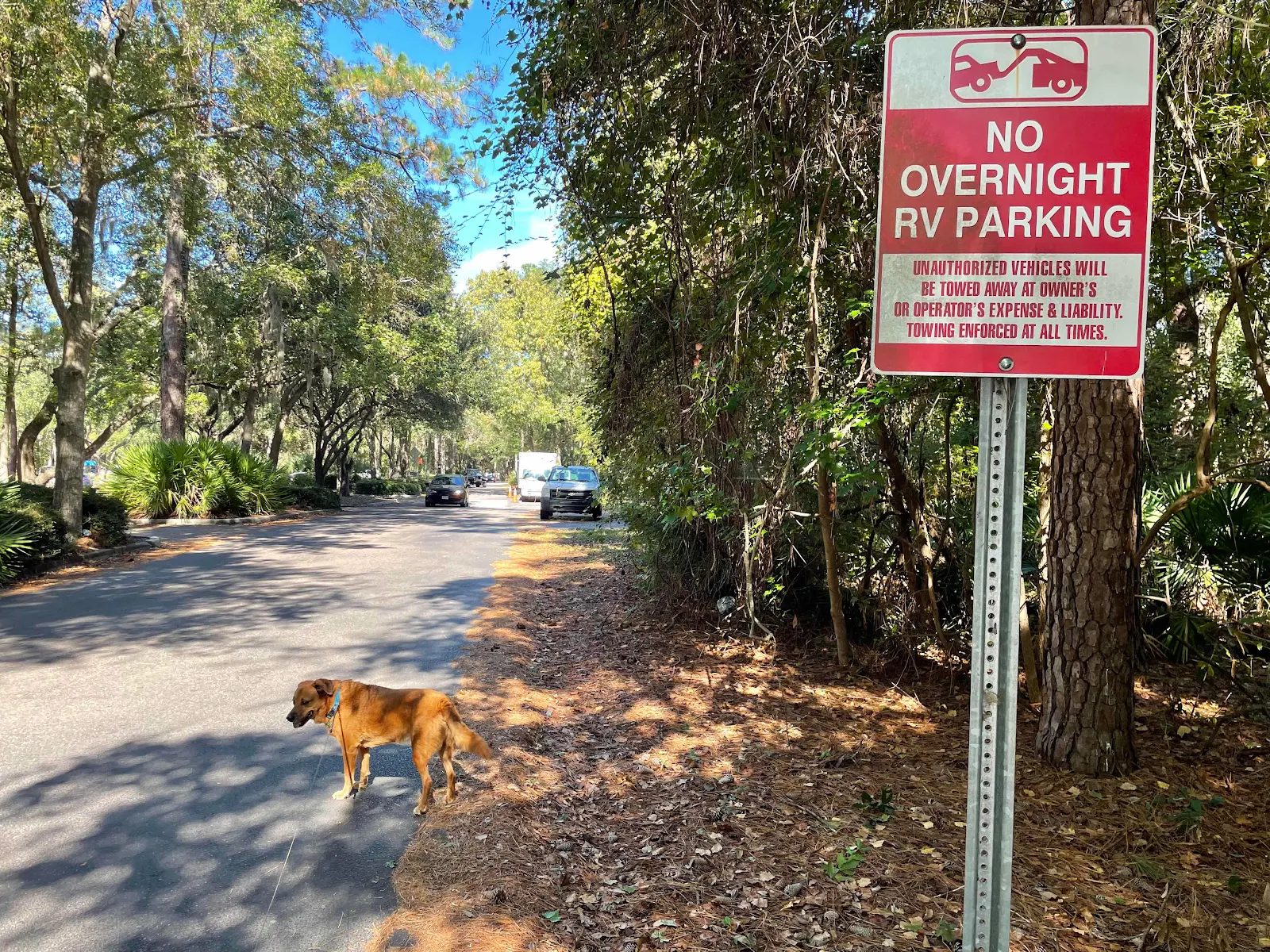
What these two pictures show is Gannet 2 ( the 21 foot Promaster, not the 24 foot Moore- now you know) parked at a Walmart for the first time. The store on Hilton Head is surrounded by a pine forest and we found it to be the perfect place for tuna fish sandwiches and a full strength energy drink for the drive ahead. We had no intention of sleeping there which was lucky, because it was clearly sign posted: 

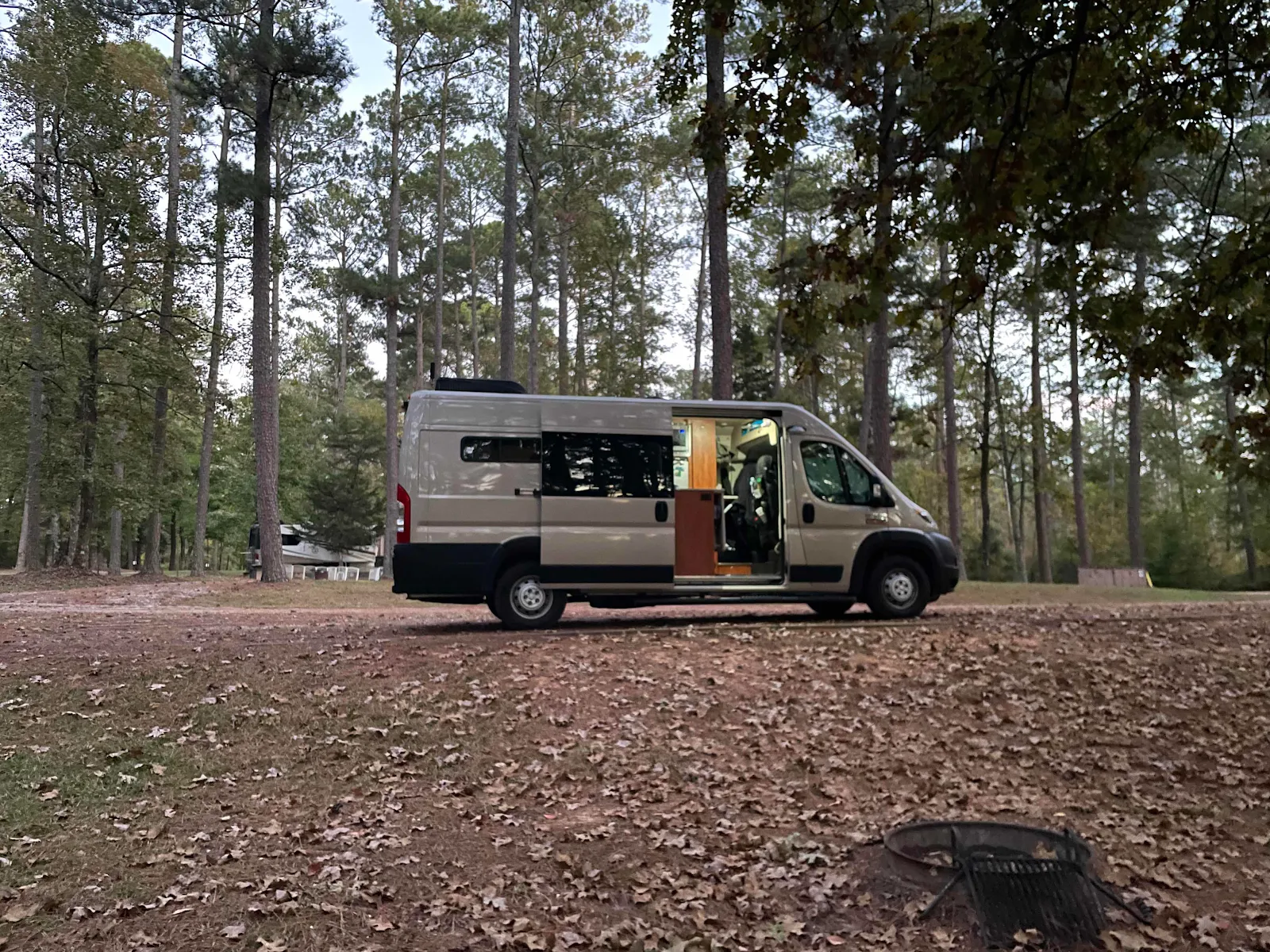
And the next picture doesn't look much different except it's three hours away, not counting freeway accidents which had us diverted all over the countryside for some more pleasant driving, in a national forest near Greenville, South Carolina. Fully pre-paid and reserved for us.

I found the place on the iOverlander app and followed up by getting the recreation.gov app (I am very Modern) and reserving a spot for a couple of nights. I wanted to expand our experience and learn by doing, how to handle all this up to date way of stopping and camping and it worked quite easily. Next time I will know we have the National Parks pass which entitled us to half price fees, from $5 a night to $2:50...and next time I won't cock up my times so we will only pay the $8 administrative fee once and not twice...Even at $26 for two nights it's not bad, even though it should have cost us half that! Layne was very forgiving. I promised, after the flogging stopped, I'd do better next time.

It is an organized campground but there are no hookups, just a few spaces occupied by empty trailers and tents, slightly weird and possibly reserved by hunters as this is the season, and a couple of pit toilets, the cleanest I've ever seen, and some trash cans. There is some traffic noise in the distance but if you saw me sitting here at the picnic table typing in the gentle autumn sun you wouldn't think this road trip to anywhere was a bad idea. Last night it went down to 45 degrees but our well insulated van was quite comfortable even when Rusty abandoned us and went to his own bed on the floor. By day it's 60 degrees and with no wind its warm enough for shirts only. I can do this non tropical stuff.

Rusty will need more time to adapt to a new world. He got nervous on the trails I tried to walk and pulled me back to the security of the van. We have a thirty foot tether for use in campgrounds and after a leashed walking circuit to inspect our immediate surroundings he sits in the sun on his tether  watching everything and not seeming to mind being tied up at all. It's as though being on a leash or tether gives him the secure feeling he needs. I expect by the time we get to Alaska he'll have morphed into a Jack London character and run like Buck.

Two nights here, a week with my sister-in-law in the North Carolina mountains and then we drive north for Illinois. Then back south, then at last we go west and take the Promaster where our camper van has never been before. I wonder if we'll sit in the desert and reminisce fondly about the forests of the southeast back when Rusty was a nervous van lifer?

Monday, November 1, 2021

57 Degrees Of Bliss


It might be reasonable enough to suppose that a life spent sailing and writing, and living by writing, is a life that merits no reward, the life itself being the payback for stepping outside the norm. You could also argue that Webb Chiles is a lucky man, and leave it at that. In driving to Hilton Head I was reminded of a quotation from the lips of Joseph Campbell, a philosopher Layne and I quoted endlessly to each other when we started out making ridiculous journeys together.

I am not given to religiosity or spirituality and I say that at the outset to dispel any quirky ideas about me in a world much too much given to  seeking cause and effect where there is none, and imposing comforting dogma in the face of uncomfortable empiricism. If you do travel a bit you won't find yourself saying everything happens for a reason in the face of worldwide misery and poverty and abject starvation. Human greed and fear are the reason for most of what happens in the world and the rest is happenstance, I believe. Thank heavens indeed for small pockets of kindness and generosity and thoughtfulness. Here is the story of one such, wisdom offered to to one much less wise.

In the face of all that, Joseph Campbell got on television in an era before reality TV was commonplace and he told PBS viewers to "follow your bliss." A dangerous admonition indeed, in a world devoted to the idea of freedom constrained by the demands of conformity. Campbell said it out loud, adding that if you follow your bliss doors will open where there were no doors before. Layne and I repeated that mantra to each other with increasing nervousness as we periodically threw off the shackles of conformity and prepared to do some other stupid thing.

Had we not sailed to Key West giving up a highly satisfactory life in California we'd never have found all the doors opening to us in our new lives. But open they did, and our life afloat had equipped us to take  advantage of the opportunities we preferred. And had the life in Key West not worked out I'd like to think we would have been flexible enough to find some other bliss to follow, some other path to pursue.

This piece of learned wisdom came back as a powerful reminder as we drove away from St Petersburg where Dale offered us a place to return to when we are done. If we want it a life awaits back in Florida tailored to us. Layne was enthused, not by the desire too settle down before we'd started, but by the proof that doors do open. It was a strange and surreal moment, the lessons learned in the past had reappeared and thus affirmed the correctness of our course. That Dale is an excellent companion and entertaining eccentric and a wildly successful businessman is all the more intriguing.

Do not be fooled into thinking that any of us were ready to settle down, and I'm not sure even Rusty would have voted to stop the journey, but the idea that the connection is forged was actually very much affirming our intentions to move. I should note that I discussed with Dale the possibility that in the event Layne and I die on the road he would fly wherever and rescue Rusty and deliver him back to Florida for a secure retirement with friends we trust to look after him. I know a lot of people would be happy to look after him but only Dale would enjoy a sudden flight to some improbable place to find a dog, pay a reward and get the mutt home. I drive much more relaxed knowing Rusty's future is sure.

It would not be an exaggeration to say that because of Webb I and therefore Layne (and Rusty) are here. From being in a state so broken I couldn't sit up, to being able to walk and keep up with the Junior Furry Explorer, I was acutely aware that life was now a second chance  for me and I had to do something with it. The thing I am best at is wandering which is no great skill in a world dominated by people being busy doing and building and shifting tons of money all over the place. It was Webb who suggested an alternative path.

Go to the edge of human experience he said and send back reports. Nowadays he likes to say beyond the edge, but the edge seems enough to start with. He has done this all his life, and he did it the old fashioned way, thinking and plotting first, then preparing then carrying out the plan and then sitting down and publishing the book that would pay for the next one. As plans go there was no retirement because as he himself puts it he felt it unlikely he might grow that old. And how do you retire from being yourself?

And yet through all the disasters and struggles he came through to a quiet anchorage properly married with a real address and nearby a dock with his boat and a climate suitable and an ocean nearby. Not bad for a man who followed a very personal bliss and set up no retirement plan of any kind. 

Sitting in the van with my fingers falling off from the cold, my nose frost bitten in a way I cannot remember from my life before Key West, I wonder wherein lies the bliss. My sisters sent me birthday wishes, a reminder we are all of us a year older and they are as settled as they have been all their lives, entirely content on their farms in their villages grumbling about their governments and their taxes and the weather and all the rest of it. Me? I'm sitting in a tin box voluntarily freezing to harden myself up pondering the fortunes of life 3,000 miles away. This is my retirement plan! 

We went out to dinner Saturday night to eat an Italian meal on a patio outdoors, properly dressed for the cold and under a heater. Webb entertained us with sailing stories which makes it sound as frivolous as a gameshow but the stories were real and recorded in books, and each of them steps along the way to a peaceful settled old age. 

He told of his time in a Saudi Arabian jail accused to plotting a terrorist landing by the simple act of mistakenly sailing onto a beach. He spoke of spending time with other prisoners and of time alone of interrogations and and uncertainty and despair. And out of it grows the certainty in my mind of the correctness of flowing your bliss.  

My wife and I hate the cold so he told of sailing round Cape Horn bailing his leaking boat, unable to plot his position owing to cloud cover and while wet and struggling he was living through a summer sail at temperatures hovering around freezing. He completed the journey and became the first American to sail alone around Cape Horn. Was it worth it? It was to him.

Imagine capsizing your boat in the South Pacific and being forced to drift downwind in your dinghy tied off to your half drowned mother ship. Had he missed the next island he would have had to drift 1400 miles to Australia taking six sips of water a day and hoping for the best. Does that sound blissful? I'm not cut of that cloth and as I sit in the van at my desk and look around at a comfortable bed with a dog sleeping stretched out on it, a fully equipped kitchen, my own fridge and all the accessories of a suburban home I know I'm not in the same league. But bliss is where you seek it. Webb sought his from a young age with a verve not many of us possess and yet he landed on his feet with time and a place to sit and think and share his world with a woman he loves. Pretty damn amazing frankly.

One can never tell what the result of choices will be, obviously, but the idea of feeling stuck has never appealed to me so even before I heard Campbell's quotation I followed my instincts in the face of much criticism and went where I was minded to... So far so good, but if Webb's example is  a template then I would dare to suggest that thinking too far into the future may not be my best bet. I'm guessing our bliss will get us where we need to go and I trust I shall be thanking the man who set me on this course as much then as I am now.

Link to Webb's site.

(using my picture I'm pleased to say, taken in Marathon).

Friday, October 29, 2021

St Petersburg Nights

I woke up unexpectedly at 2:30 this morning and lay silently in bed hoping to fall back asleep. By 3:00 am Rusty had figured out I was awake and he started yawning loudly, his way of demanding attention. My fate was sealed.

As I fumbled in the dark for my socks and sneakers (my Crocs were locked in the van outside) my wife woke unto a ghastly charley horse in her leg, so I was absolved of any blame for waking her. Eat more bananas I said as I slipped out into the night. Trader Joe's sold us some nananas that appear to be going from green to dead with no intermediate edible stage so -joy - more shopping may be on the schedule. Retirement is one tough option after another busy day.

There wasn't a soul about on foot (I think), and only one car sped down the 22nd avenue corridor to some improbable destination. Rusty walked ahead as though he owned the neighborhood, which he did for a half hour.

I was busy putting this well lit, Halloween-free, home into black surroundings until I noticed, below my viewfinder, my dog in the all too familiar posture. Dale had a large beef bone the night before for dinner on some semblance of the Atkins diet and I feared all Rusty's gnawing on the ample leftovers might produce a rather more wet egg than I like to pick up. I swept through and removed all trace of something quite easy to pick up. There is no chance this neighborhood is going to get up in arms about rowdy van dwellers ruining the local charm. Such are the worries of a well bred nomad.

Later in the morning you will see enthusiastic drivers of expensive cars rushing off to pay their bills after jogging and dog walking and cycling to get fit for a day of savage officery. I can hardly believe my luck that I've put it all behind me.


Lost glasses anyone?

Dale bought his escape pod after we oversold the joy our box on wheels brought us. He had Custom Coach build him a 19 footer and he's driven it to New England and back to see his son in college, and his son drove it back which was an act of faith only a father would have. Dale sees his van as a hurricane evacuation tool as well a vacation device and now my wife has been through it, it is ready to go. Not as soon as ours.

Had the powerful cold front from Up North not swept across us last night I might have been tempted to go for a dip. However it was cool enough and quite windy enough for me not to have oozed one drop of sweat since the winds came upon us, so clearly the fresh water pool at 3:30am was out of the question. 

Rusty curled up next to me and watched while I did the crossword and read about an Italian monk who noted down the presence of Markland in some notes he wrote. As it was in the 14th century 150 years before Columbus sailed the ocean blue, and because his notes were only just discovered, the academic world is in ferment, as it should be. The next thing we'll discover is Columbus knew perfectly well how to find degrees of longitude at sea. Probably not.

The mind tends to wander a bit at that hour. I was getting sleepy but being unwilling to disturb my dog I sat on waiting for some signs of life from the curled up dog.  

Eventually he sat up and I went back to bed. 

He will be glad to know there's not much driving today, two hours to dinner with a friend in Ocala then we have our eyes on a rest area just inside Georgia two hours beyond dinner. Tomorrow Hilton Head is the goal and like the three Kings we will bear a gift, a bottle of liquid gold, for  Hilton Head is home, oddly enough, to Ulysses' younger brother home from the seas and the key to the kingdom is called Laphroaig.